

 Search
Review of Posthuman Pathways
 Goto [ Index ] |
I belong to an organization called the Indie Game Developer Network, as does Jason Pitre, creator of Posthuman Pathways. I'm going to be doing a review of one of the members' games monthly. Anyway, the last one I did was Wizards of the Three Moons. In some cases this may mean I get a comp copy; in this case I didn't (I bought it at GenCon a few years back).
Posthuman Pathways
Posthuman Pathways is a story game about, as the cover says, transhumanism, sacrifice, and transformation. It takes three (exactly three) players on a journey through the changes that the world experiences when life-altering technology appears, and asks players to consider how their characters in particular and culture and society in general shift in response to that technology.
The Look
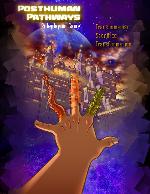
Posthuman Pathways a set of five pamphlets and a cover card. The cover card boasts the title of the game and an illustration of a hand with the fingers changing (one into a tentacle, one digitized, one into a robot) and futuristic city in the background. The forearm also sports the credits to the game, and graphics in the corner tell us that the game has no prep required, lasts 3-4 hours, and requires three players. It's a very busy cover, but I'm glad it makes those requirements and facts clear up front. I'm not sure if the cover would move me to pick it up in a store or not. The format is strange, and the art doesn't feel inviting to me. The pamphlets fold out to four columns of text; the game doesn't have interior art. The text in the pamphlets is simple black on white, and is clear and easy to read and follow. The pamphlets are numbered; the first one is the Introduction, which explains what the game is and how it works. The second is Setup, which tells the reader how to get the game going and how it progresses. The other three are pamphlets for the three roles (Guide, Trailblazer, and Voyager), which each of the players undertake in turn (meaning that the pass these pamphlets around as the game progresses). Posthuman Pathways also requires a few index cards (we often joke at my table that you can tell a storygame because it uses them).Game Play
Posthuman Pathways is GMless and mostly systemless (that is, there's an order of operations but not a randomizer). The game starts off by choosing starting roles; by default, the person most familiar with the game starts off as the Trailblazer. Game play progresses through three Eras (Human, Transhuman, and Posthuman), and in the Human Era, the group determines what country, city, and specific locations the game takes place in.The players also set up index cards labeled with the Era ("Human," to start out) and "Pressures." The Pressures are the conflicts and challenges that force the characters into tough places, and as the game progresses, new ones get added. "Time" is always listed as a pressure, though. On the Era card, the Trailblazer writes a question (for the first scene, it's always "What augmentation question changed everything?").
Character Creation
The players also make their own characters, but they only play those characters when they have the role of the Voyager. Creation characters consists of coming up with four drives: Status, Identity, Vision, and Ritual. As the world progressively gets stranger and further away from "human," those drives fall away, until you're left with one that's managed to survive the shift from Human to Posthuman. Characters don't have stats or numbered traits, and they don't necessarily ever have to meet each other. Really, Posthuman Pathways is telling the story of how society changes through the eyes of three different people, so it's most interesting to have the characters come from disparate backgrounds and statuses.Scenes
Posthuman Pathways proceeds in scenes, three in each Era. During the first scene, the Trailblazer answers the question on the Era card (which, remember, establishes what the technology is that changes everything). The Guide then sets up the scene, placing the Voyager's character in one of the chosen locations for the game. The Guide also establishes the Pressure, what the driving force of conflict is going to be during the scene. The Voyager roleplays based on the Guide's exposition, and the Trailblazer can, during the scene, ask either of them questions to clarify details or flesh out the world. At some point during the scene, the Guide presents the Voyager with a choice between one of their drives, and the Voyager has to decide which one to keep. The player crosses out one of the drives, the Trailblazer writes a new question on the Era card (not about that character, but about how the world at large is changing) and everyone passes their pamphlets to the left. Then the new Trailblazer answers the previous Trailblazer's question, and the whole thing starts over.Once an Era is over, the players are meant to take a few minutes to talk over how their characters change. As much time can elapse between Eras as the players want (depending on the tech in question, it could be quite a lot!).
At the end of the Posthuman Era, each of the players gets to narrate an epilogue for their character, based on their journey and what drive they have remaining.
Actual Play
I played a game of Posthuman Pathways with two of my friends, both of whom were very interested in transhumanism in general. Both had also played storygames like Fiasco and were comfortable with improvisational roleplaying, so they fell into Posthuman Pathways pretty easily. We wound up having the technology being a kind of real-time internet interface, which then progressed into overall mental enhancement and finally being able to remotely control robots (makes a "remote office" a very literal thing!). My character started off as a more blue-collar sort of fellow who wasn't a fan of the tech, but wound up embracing it wholeheartedly and kind of succumbing to the weird ennui brought on by being able to, say, jump into a body that could then jump off a sub-orbital platform for the hell of it. The other players' characters were a bit more reserved; one of them wound up in a tiny village on the Hebrides (we started in Edinburgh) where the tech hadn't taken hold, unwilling to give up community and human contact.The game was really interesting, and game play seemed pretty intuitive. The Trailblazer asking questions of the Guide and Voyager didn't always feel smooth, but it might just be that the world was getting built smoothly and collaboratively enough that there wasn't much to ask.

