

 Search
Review of Cryptomancer
 Goto [ Index ] |
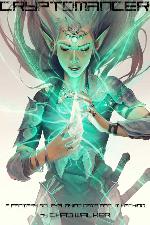
Produced in a very solid 430 pages B5 hardback, Cryptomancer is physically a very attractive book. The cover art by Philipp Kruse of an ethereal elfin figure manipulating a crystal shard is beautiful in its simplicity and evocative in its content. The internal artwork, also by Kruse, is greyscale sketches which whilst fairly attractive are lacking detail, although they are contextually appropriate. The use of marginalia artwork to differentiate chapters is creative, but flawed; chapter titles would have been a lot more useful, and would have required less space. The game comes with a one page index, presented an is POSIX-style directory listing, and a very helpful five page index. The writing style is often informal and verbose, and sometimes the opposite, making it a challenging read at times. Entertaining and contextual short-stories are interspersed throughout. The text uses a sans-serif font for headings and a serif, single-column justified, font for text body making it fairly clear. The organisation is heavy on the chapters and sub-chapters; there are 23 chapters altogether. Page numbers artistically presented but not always a hundred percent clear. Note that the following review is not entirely in order of the chapters.
The initial feature of Cryptomancer is the broad setting focus. As the "backcover blurb" explains, this is a fantasy hacker game, designed by hackers, informed by information security, mass surveillance, and political analysis. The introduction continues this theme: "Cryptomancer is a tabletop role-playing game about hacking in a Tolkienesque high-fantasy setting", and has the motto "Kill all the orcs, hack all the things". Following an introductory "Obligatory RPG 101 Section", it describes how the game satisfies both the "dungeon-crawling romp" but also the "tradecraft, intrigue, espionage, and information security" type of game. Despite being Tolkienesque and even having a player-GM agreement on lethality "When it comes to the player characters' efforts against this existential threat, Cryptomancer takes more cues from H.P. Lovecraft and George Orwell than it does J.R.R. Tolkien." The game is also aware of the nature of "evil" in roleplaying games, along with "relations between humans, elves, and dwarves that purposely allude to real life conversations and tensions associated with race... The intent here was to be introspective about the fantasy genre's weird relationship with race and racism and The Other..". But what of the orcs?
Setting and Cryptomancer
The setting provided in Cryptomancer differentiates between a Mythic Age, where Elves, Dwarves, and Humans satisfied the standard fantasy tropes, and the Modern Age. In the Modern Age, "[t]he dwarves have become Medici-like merchants, the elves have become expansionist industrialists, and the humans struggle to maintain decaying feudal and caste systems in an era of information and social networks". The change is primarily due to two events. The first is the development of the Shardscape, "the magical equivalent of the real world's Internet", which "has been absolutely disruptive to society". Shards are polyhedral crystals from the mines of Subterra, which can be cut into smaller equally sized-shards which can be used to instantly transmit thoughts to the other shards in the set, a shardnet. The second the discovery of soma manufacture among the Elves, , the honeydew secreted by giant insects called gigaphids. Soma is a much sought-after commodity which in its pure form is an extraordinary pleasure-giving hallucinogen and in its distilled form an effective healing drug.
The world consists of three realms, Subterra, Sylvetica, and Sphere. Subterra is the realm of the Dwarves and other underground races; Sylvetica, is the realm of elves, an enormous "oppressively vibrant" forest; and Sphere is a network of city-states that is the main domain of the populous humans, and acts as a gateway between Subterra and Sylvetica. Added to this is the Shardscape which connects all realms, and where messages are encrypted with keyphrases by "Cryptomancers". The human world in particular is one that is dynamic, extreme, and prone to danger. This is kept in check by an oppressive cabal of mages known as the Risk Eaters that maintain an army of spies and engage in global risk analysis through Dwarven decision machines, carrying out political intrigue and assassination to ensure stability and balance on their own terms. They are, quite deliberately, set up to be the organisation which the PCs begin the campaign to have a thoroughly antagonistic relationship with. This is reinforced by a metagame currency known as "risk"; then a PC accumulates enough risk they have attracted the attention of the Risk Eaters who will unleash their forces upon them.
An illustrative and basic chapter is provided on cryptography, starting with the simple symmetric key method where an unencrypted message is encrypted with a cipher, before moving on asymmetric key methods where a public-private key pair ensures that messages can be sent encrypted in a public key that can only be decrypted with a private key. In Cryptomancer encryption keyphrases are spoken, and decryption phrases are thought and permanently remembered. An artificial mechanic ensures that encryption is only one level deep. For asymmetric keyphrases a message encrypted with a "true name" can only be decrypted by the soul key associated with that true name. A true name given to all sentient beings at birth by their parents, is a "private key". Children are typically not told their true name until they reach an age of maturity - pity the orphan!
A chapter is dedicated to each of the protagonist races. The mythic Dwarves were great intellects, warriors, and epic tales; the discovery of shards has converted their cultures into one of high art, opulence, espionage, and intrigue. In contrast the elves were a relatively primitive, if cold and calculating, race who have been transformed by the aforementioned discovery of soma. The main problem is the production of soma involved the destruction of huge sections of forest, leading to a tension between the primitive conservative elves and those who wish to engage in modern production and commerce. Humans, although old, do not feature in the Mythic Age - their time is the Modern Age. They are notably for their diversity and their massive levels of urbanisation. The Risk Eaters too receive their own chapter, although this is deliberately written as vignettes to give a sense of their mystique; short expressions of their various operatives within human, dwarves, and elven society.
Character Generation
Character generation in Cryptomancer consists of the player determining the character's common name, true name, race, sex, age, and optionally appearance and personality qualities. From there it is assigning core ranks, assigning ranks calculating the derived characteristics hit points and magic points, spending 10 Talent Points among talents and spells, defining a trademark weapon and outfit, and selecting a "reasonable" amount of equipment. It is essentially a point-buy and player select method with some notable aspects. Firstly, character race has no influence on characteristics, and the appearance and personality traits have no influence on play.
The core characteristics for a character are Wits, Resolve, Speed, and Power. These are described as ranked as trivial, challenging, or tough, where are enumerated as 4, 6, or 8. All values start at 6 (challenging), and upgrades to tough (8) are matched with a downgrade to trivial (4). Each core rank, used as a resistance characteristic, is matched by two attributes used for influence. Strength and Endurance are derived from Power, Agility and Dexterity are derived from Speed, Presence and Willpower and derived from Resolve, and Knowledge and Cunning are derived from Wits). The value of Core is divided among the attributes according to the player's choice, with a value of 1 to 5 in each (e.g., a Wits of 4 could be split to have Knowledge 1 and Cunning 3).
Attribute ranks regulate a variety of skills. The ranks determine what dice a used for a skill check, whilst the difficulty determines the outcome. Every time a skill check is made, 5 dice are rolled; a number d10s are rolled to attribute rank (attribute dice), and the remainder as d6s (fate dice). Thus a character with a Cunning of 3 will roll 3d10+2d6 for skill checks. For attribute dice a success is based on a target number; so a trivial cunning test at 4 with the prior example successes on the 3d10 roll are any which result in 4 or more. An individual die result of 1 is a botch, removing any successes. The total number of successes and failures determines the degree of success with critical values from -2 to +3. For fate dice, a success occurs on a roll of 6 (counting as the equivalent of 8+ on attribute dice) with botches on a 1 or 2 (counting as 1 on attribute dice).
In total there are twenty four skills described usually in several sentences each with an example skill check, although it must be noted that this is far from a detailed range of suggested modifiers. There is an emphasis on skill scope and as a result the descriptions can be fairly broad, such as "Brute Melee" to cover a wide range of weapon skills, or "Craft", which is for any range of objects and materials. Oddly there are however some very specific skills (e.g., "Lock Picking"), although this is an exception rather than the rule. For certain situations the attributes Endurance and Willpower can also be used as skills.
Talents and Magic
Characters also receive 10 points of "Talents", natural gifts, techniques, and expertise, which are typically rated from 1 to 3. These are the equivalent of D&D-style Feats, or GURPS/Champions advantages and disadvantages. Some appear initially counter-intuitive but nevertheless are still applied as a Talent. For example, a character with the Cowardly talent will gain 1 success to avoid confrontation in the future every time they fail a Willpower check due to fear. Over sixty Talents are described.
Learning spells is achieved through self-study through book-learning or tutelage, both of which are conducted in downtime, and require an expenditure of Talent points . Spells are powered by mana, costing from 1 (cantrips) to 5 (miracles), and are cast as an action. Mana is equal to a character's Willpower+5 and is regenerated during downtime. Spells are described in a paragraph or more each, with issues such as range incorporated in the description where relevant. A dozen cantrips (1 MP, 1 Talent) are so described, seventeen basic spells (3 MP, 2 Talents), and seven major spells (5 MP, 3 Talents). Despite the modest quantity the spells themselves cover a fair scope and often come with some interesting special effects. Ritual magic also exists in the setting, but no rules are provided. Several sample magical items and relics are described, albeit without much in terms of the creation of such things.
Combat
For the ambiguously-timed turn-based combat system initiative is based on first declaration. Each turn, a character has one move and one action, the latter defined as anything that requires a skill check, plus other more complex time-consuming actions (quaffing a potion, reloading a crossbow). Move actions are changes to range increments (close, short, medium, long, and extreme). Attacks are opposed skill checks one of a target's core ranks. The type of attack (melee, missile, or magical) will suggest a type of attribute-derived defense (parry, dodge, take cover, or resist). For example a missile attack can be parried (with a shield) or the target can move out of the way (take cover) but they cannot be parried.
Attacks inflict HP loss equal to the number of successes rolled in the opposed skill check, plus or minus a value depending on the weapon used (i.e., damage is all or nothing). Hit points measure a character's health, starting at Endurance+5. At zero or less the character is unconscious and will lose -1 HP per turn, and at -10 they're dead. Single wounds that cause more than 3HP damage will also generate additional wounds when aggravated, and at 4HP they will also bleed at an addition -1HP turn. Add to this a handful of spot rules for healing (harder to do you on yourself), grappling, sneak attacks, use of the shardnet in combat, and a couple of environmental hazards.
Cryptosystems and Other Security
A cryptosystem is defined as any system that employs cryptomancy. There are a variety of implementations elaborated, encrypted messages and town bulletin boards, cryptosignatures for legal documents, Shardnets and the Shardscape for the equivalent of a public internet, golems (robots with shards), and cryptogears (shards with gears). Unsurprisingly there is also denial of service attacks, and code-breaking engines which basically engage in brute-force attacks - but are also a source of meditation among Dwarves and the Code Clerics.
Mundane security is also described with the medieval castle correctly described as an implementation of defense-in-depth, and elaborated to include the same principle to the dungeon. On other levels social engineering is, of course, an issue of mundane security, as is lockpicking, the use of stealth, aliases, political fronts, and up to and including violent forced entry. It is mainly descriptive text, but all very handy for generating a feeling for a game that is heavily focussed on the security angle.
Equipment, Downtime, and Campaign Mechanics
Personalised equipment is encourages in Cryptomancer. An abbreviated system of weapon descriptions and qualities provides a great deal of information about the weapon and integrates well with the game system. A version of the same is provided for outfits, which of course is applied to armour (there is both damage reduction and deflection, for example). There are 16 sample weapons and 12 outfits. Without such descriptives is a selection of sample "equipment" and "consumables", which include specific items (e.g., buckler, kite shield, round shield) and generic products (e.g., climbing gear, medicine bag etc). Some 14 sample items of equipment and 21 consumables are provided.
An interesting generic rule for the game is "downtime", an eight-hour game-time period where the PCs are considered safe from immediate danger. This is a period which allows for natural healing or surgery, which can be used for restoring magic points, learning a spell, brewing consumables, crafting items with an estimated project time based on the size of the item and its complexity, setting traps, social networking, and following leads. It's an excellent collection for a block of activities, and the craft and project table should also be adapted for research projects as well.
The most serious campaign mechanic is Risk; it's a bit of a bomb. A new campaign starts at 1% Risk, which reflects the likelihood the Risk Eaters "will ambush the party with their most lethal agents at the party's most inconvenient time". Poor security operations (e.g., conducting a security operation with many witnesses) increases Risk. Players can also "Defy Fate" by buying their was out of dramatically unfortunate die rolls, but this also adds to Risk. Certain situations (e.g., downtime outside a secure location) can result in a Risk trigger, where the Risk value is checked. The number and power of the agents that the Risk Eaters send depends on the party Threat Level, which increases with each triggering. The ability of the party to grow and prosper is handled by the Strategic Asset campaign mechanic, earned from the successful completion of missions, and are manifested as safe-house improvements, loyal allies, and mounts, each of which have individual components (e.g., "Alchemy Lab", "Golem", "Smuggler Cell", "Molephant"). In addition there is also character improvement, reflected by Talent Points. This are achieved by surviving a session, hacking things, and by narrative gaps.
Adventures
Four 'campaign' chapters bring the book to a close; 'Adventuring in Crytomancer', 'Threats', 'Running Cryptomancer', and 'Silent War for Thronehouse'. The first is a brief description of the major locations in the default campaign world, with each major locations (Sylvetica, Subterra, and Sphere) provided with several short adventure hooks, along with various aspects of economics and social groups.
The 'Threats' chapter is pretty much the Cryptomancer equivalent of a monster manual. Threat ratings are defined and statistics are provided. Descriptive text provides various implementations of the threat ratings; Orcs are a thoroughly dehumanised species whose sole purpose in life is violent hedonism. Giant vermin, zombies, mercenaries, gnolls (bipedal giant lions), and dragons are described as well. To emphasise again, there is not statistical values given to the various creatures, rather they are provided behavioural and exception criteria. The dragon, for example, is simply described as "Tough", and the statistical values ought to be introduced by the GM.
The chapter on 'Running Cryptomancer' engages in a usual and necessary description of what constitutes a campaign and scenarios, with a default assumption that the PCs are 'on the lam'. Various implementations of plot elements (opening scene, environment creation, challenges, NPCs, and an overly descriptive and superficial "social network analysis". Something that is surprisingly absent is 'actual play' issues on a metagame level.
The book concludes with a scenario, 'Silent War for Thronehouse', designed to draw out the game system mechanics, which is always a good idea for an introductory adventure. It involves a meeting in a city-state to elect a leader, which involves multiple factions and competing interests. It involves various chase-scenes, investigations, and bit of violence, treachery, research, dungeoneering discoveries, rescue missions, etc and all the usual features that are part of a Cryptomancer game. Apart from the thematic elements it also has a sense of narrative evolution.
Overall
Stylistically, the best aspects of Cryptomancer is the creative thematic consideration and the physical product itself. This alone makes the product worthwhile. The general layout and organisation of the text, the artwork, and readability is less inspiring, but certainly of passing and average quality. In terms of substance, it is overall a very solid and consistent piece of work, with particular strengths in the detail provided for the main theme. Where there are apparently surprising omissions or arbitrariness they are made up with extra detail or flexibility in other areas. Certainly would could hack the rules and setting to, for example, give kin-based modifications to attributes without engaging in undue violence to the game system.
Overall, the game implements a setting and a consistent rules system that examines a particular thematic variant of encryption and communication by an author who certainly knows what they're taking about in this subject. One aspect which wasn't explored and perhaps should have been, was with this wide-range of communication the speed of technological (or magical) development that would follow. With no effective communications barrier and high levels of security, how long could existing power structures survive? That at least should bring some comfort to PCs on the run from the Risk Eaters.
Style: 1 + .5 (layout) + .4 (art) + .8 (coolness) + .5 (readability) + .8 (product) = 3.9
Substance: 1 + .7 (content) + .6 (text) + .7 (fun) + .5 (workmanship) + .5 (system) = 4.0

