

 Search
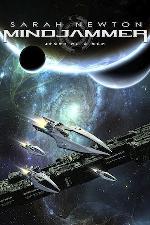
Review of Mindjammer
 Goto [ Index ] |
Blurb from the publisher: 'It is the second age of space...
In the seventeenth millennium, the New Commonality of Humankind is expanding, using newly-discovered faster-than-light travel to rediscover lost worlds colonised in the distant past. It's a time of turmoil, of clashing cultures, as civilisations shudder and collapse before the might of a benevolent empire ten millennia old.
In the Solenine Cluster, things are going from bad to worse, as hyper-advanced technologies destabilise a world in chaos. Thaddeus Clay and his SCI Force special ops team are on the trail of the Transmigration Heresy. What they find is something beyond even their imagining - something which could tear the whole Commonality apart...'
What you get: Your EUR 11,65 or USD 13,95 or GBP 9,99 buy you the 446-page Mindjammer - The Novel, the first novel to be published for the Mindjammer Roleplaying Game line, in both hardcover and pdf format. Those preferring the pdf version only can obtain it for EUR 3,48 or USD 3,67 or GBP 2,99.
Spoiler warning: As much as I am not going to describe, let alone detail what is going on, part of the plot might be revealed while discussing the novel's strong and less strong points.
The strong points: There is probably no better product to start exploring the transhumanist, space-operatic setting of Mindjammer. Everything that the setting stands for is included in the homonymous novel, and by that, I really mean everything. The novel tries to progress the plot as much as reveal the universe in a sort of asynchronous way. The good news is that the plot is not something random, but a subject that could, under certain qualifiers, preoccupy the inhabitants of the universe 15.000 years from now.
There's the age of rediscovery, the different civilizations, the culture shock, the elites and the disenfranchised. There's political intrigue, the objective professionals that do their work, believing or almost believing in their cause. There's the hominids, the synthetics, the ship AIs and other AIs that might or might not be helpful. There are scenes that are taken straight out of role-playing sessions: infiltration objectives, military objectives, exploration, outrun the enemy, and many more. There is tons of action both in real life as well as inside the mindscape, ubiquitous technobabble, and all the wrappings that keep sci-fi fresh and interesting.
Sarah Newton, the writing force behind everything that relates to Mindjammer, opted for the immediate immersion approach: from the very first page things are explained by the terminology that the characters of the novel (and the residents of the 17th millennium) understand. This is nothing but technobabble to me and you, which gets slowly explained as the novel progresses. I enjoyed the approach; it kept me on my feet and contributed to the adrenaline rush of wanting to know more, decipher the plot and unveil the nuanced layers of the Mindjammer universe.
Setting aside the ever-present action scenes, the transhumanist concept of the setting touches on the idea of what it means to be human. The novel's plot is effectively a take on exactly this question: the Commonality is stretching already the definition of humanity (hence the world 'commonality'); is there something that it cannot accept as fitting that definition? The question is valid when seen through this lens, even though it slowly deteriorates later on; keep on reading. It is refreshing to see the characters 15.000 years from now behaving slightly differently than we do. The morals are clearly not the same.
RPG fans will rejoice about how much the whole novel is set like a campaign for a group of heroes that has all the tell-tale signs of a party: the brains, the bruiser, the caster and the rogue. The characters live to tell the tale, yet they hardly escape a battle unscathed. In fact they take quite a beating pretty much on every encounter. Sometimes they win, sometimes they loose, they are definitely likeable however.
The writing is of a good quality overall, with some unpolished gems here and there. One of my favourites (and I am slightly paraphrasing here) was 'death silent, glory unseen', referring to how battles between starships actually run. If it were up to me, this would be the title of a new novel on the Mindjammer universe.
The price is unbeatable. The money to buy the pdf twice aren't enough to buy you a coffee. If you don't buy this, it's clearly not because of the price.
The weak points: The technobabble keeps the reader on his toes, if this is however the first Mindjammer product your peruse, it gets to be too much at times. You will not be left wondering in the end; everything is explained one way or another. It is just that this knowledge does not happen immediately, and you might have tons of questions which are only answered in a slow trickle. Prepare for many unknown words, not because you are not scholarly enough, but because these words literally do not exist outside of the Mindjammer universe. At times I felt that this approach was rather heavy-handed, blatantly advertising not what the universe is about, but what a trained insider in this universe can actually do with his chips and skills. Thus, at many points it felt as if the novel addresses itself mostly to the potential RPG player and not the sci-fi enthusiast who wishes to enjoy the novel bereft of any role playing aspirations.
This is particularly prominent in the action scenes. Many of them are frankly redundant, or pointless in their detail and process (not however the result). Even though I did not do so, at many points I felt like skipping pages in order to follow the overarching plot instead of the tedious fighting. That's one of the worst things that can happen in a movie, book or series; sacrifice the pacing to showcase some cool effects. I would have been substantially happier if, after a couple of prominent examples, the action was paced like in the last part of the book, which is only 85 pages long. There, the battles that decide the fate of the universe, be them space battles, old-style boarding and punching till your last blood drop or spectacular Mindscape fights, don't drag whatsoever. Hell, they are almost Tolkienesque in their efficiency, going from attack to end-result in just a few lines. Often, less is more. In the case of this book, it could have easily been some 100 pages shorter, if not more, without losing anything.
Figuring out a writer's favourite expressions is as cute as it is distracting. Quirky phrases like 'arms akimbo', 'to scythe', 'the place he just liberated' and many more are used more than once each in the novel. It is as if homonyms or other descriptive ways to convey the same meaning ceased to exist. A good editor should have caught this, frankly.
There are many holes in the plot itself, as well as the full immersion that has been opted for. Easy example for the latter: for a universe where religion is outright banned for hundreds if not thousands of years, the protagonists, hardened Commonality operatives all of them, use the 'god' expletive extremely often. It killed my suspension of disbelief every single time. This, however, is just fluff; I can as easily imagine them saying 'grud!' straight from Judge Dredd.
There are numerous other issues that relate not to presentation, but are a core concept of what is actually going on. Mindjammer is unfortunately yet another novel where ground level operatives get to make overarching policy decisions for an unfathomably vast organisation. The reader is very likely to realise half way through the book what the novel's antagonist is trying to achieve; the heroes only do so practically at the end of the book. Disappointing. The conceptual battle that pitched the two sides against each other slowly decays into being utterly irrelevant. Why is it anywhere near a problem for the Commonality if eidola can be manufactured to believe they are a continuation of their previous self, if they remain fully stable and functional and do not disrupt the commonality concept? What is the actual difference between mindscape and comsentience when in both a singular entity can enter and exit the melting pot, as Vanner does? How unified is the comsentience when its avatars behave individualistically, like flamboyant James Bond antagonists, exhibiting the most trite verbosity one can humanely expect? And, more importantly, why hasn't the comsentience won this already? The gates allegedly relay information as well as matter. Why does the Deep Black need to actually pass the gate for it to dominate the core world's mindscape and doesn't do it from a distance?
The end is unsatisfying, with a predictable and annoying deus ex machina that had been readily foreshadowed by a couple of other author's fiats, and which gives the finishing blow to the conceptual battle; namely, the good guys also do what they don't want the bad guys to do, but in a limited way and with nobody knowing. Oh, please. In the era of the mindscape, and while ushering in an era of transmigration, the bad guys actually opt to inhabit a single super high tech space ship, which, should it be destroyed, conveniently takes them out for good (or not). How can they be so utterly stupid? The concept of the cloud doesn't make it to the 17th millennium or what?
There are some other considerations like side-brushing what in real-life would be considered a warcrime leading to life incarceration (very poorly hidden under the 'different morals' concept of the 17th millennium), some underdeveloped noise about two of the protagonists having an affair at some point (one of which checks out to be a - ok, I won't say that), the leading figure of Thadeus Clay gradually exiting the frame the more the book progresses and so on and so forth. Annoying as these might be, in reality they are not more annoying than The Matrix (the movie) failing its basic scientific test: humans consume more energy than they create, thus they can't be used as batteries. Yes, it's wrong, but it shouldn't really stop you from enjoying the rest of the plot.
I never understood novels that refer to chapters only by number and not by name. What does chapter 23 mean, when progress is as linear? And why is there no table of contents of either parts or chapters? Even more so, why aren't the parts and chapters pre-bookmarked on the pdf? This is extremely surprising, taking Modiphius' former flawless record into account, where pdfs actively facilitated one's searches.
Conclusion: Mindjammer - The Novel is contemporary science fiction that touches a lot of bases, with all its pluses and minuses. It has a steep learning curve for those not into Mindjammer - The Roleplaying Game, yet it is undeniably captivating, especially if one has a hard-on for sci-fi battles. Those who approach it as part of their full Mindjammer RPG experience will find nothing less than a treasure chest, leaving no questions unanswered about what a character can do in the world. For those caring for the plot as much as they do for the world, it might be a hit and it might be a miss. At half the price of a coffee however, it deserves a try.
For more info on Mindjammer - The Novel, visit the Mindjammer Press and the Modiphius Entertainment websites at https://mindjammerpress.com and http://www.modiphius.com respectively.
Shameless plug: for more gaming news and content (including, for example, pictures of Mindjammer - The Novel that I am unfortunately not able to upload on RPG.net for the time being) and to better keep track of my reviews, subscribe to my Antonios S facebook and twitter page.

