

 Search
Review of Godsend Agenda
 Goto [ Index ] |
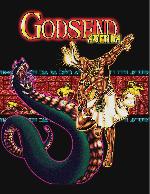
This review is going a little out on a limb; instead of reviewing the most well-known iteration of this game, the second edition which utilised the D6 system, it is taking a look at the raw but worthy first edition. The well-glued 224 page softback with a simple but effective golden scarab as the cover motif. The greyscale and line-drawings for internal art are usually of a fair to good standard. Of particular note is the massive comic which introduces the game, taking up some 40 pages, with others scattered throughout the text; notably the author seems fond of the naked female form. After that one can finally glance at the table of contents, which is a very annoying place to put it. Furthermore there is no index. Combined finding things in actual play can sometimes be a little challenging.
This said, page numbers are clearly marked and the two-column serif font is easy to read. The greyscale text for highlighting incidentals is also clear. The language is quite informal, but fairly clear, although sometimes key examples of play are incorporated in comic-book style pages which are not exactly the easiest to find. The organisation of the text could do with a little bit of work. There is metaplot and setting information scattered at the start of the book and at the end, and mixed with the introduction which provides the basic mechanics. The chapters as titled are, after a hefty introduction, 'Character Creation', 'Powers', 'Combat and Recovery', 'Gamemaster', 'The World of Godsend Agenda'. There is also some appendicies which includes sample characters, animals and NPCs, charts, a timeline, and some plot hooks.
Character Generation and Core Mechanic
Character generation is point-based system which allows variation according to the GM's setting. It begins with a concept and archetype, the latter providing a personality template and a bonus for certain actions the lead to the recovery of Ka, a metagame currency to modify die rolls. It's a fairly limited set but workable, and the Ka rewards in actual play don't seem as important as the natural recovery rate. In addition it's a attribute and skill system. Average human attributes range is between 1-5, and the superheroes of Godsend Agenda typically push that upper limit and might have a couple of extraordinary values. The attributes are Strength, Dexterity, Intelligence, Spirit, and Influence.
There is also important figured values from this include Base Damage (half Strength), Mind and Body Points, representing mental and physical stamina, respectively. If either of these are reduced to zero the character is unconscious, and if they are reduced to a negative value, the character is dead. It should be evident from this that PCs are not typically too much powerful in terms of the ability to take damage than normal characters. Base Initiative in tactical time is also a figured characteristic; player characters receive 3 Action Points per round whereas NPCs receive 2. Finally, maximum Ka is also a figured value. Notably characters may also combine and form a Ka Pool (instant joke there).
There are roughly thirty base skills are rated in ranks with an associated attribute. The broader skills include the various ranged weapons (seriously, one per coarse type should be enough) and various knowledge skills. The list is a quite biased towards contemporary settings, which is not what all the scenarios provide. Each skill receives a paragraph or two in description. Task resolution is based on skill plus attribute plus 2d6 versus a target number – the average being 13, and recommended variations, without many examples it should be noted, from -4 (9) to +30 (43). Double one's represents a critical failure, and double-sixes are open-ended without limit.
In addition to attributes and attribute-linked skills, characters also have advantages and flaws, the latter providing additional character points. All this may begin to sound familiar with several other RPGs. These are what would expect from other games and our typically purchased on a per-level basis. The game does include some inventive names for common examples worthy of note; this includes Dervish Defense (bonus dodges), Ball and Chain (effectively DNPC).
Powers are likewise purchased on a per level basis and are based on concrete rather than abstract descriptions, and also have an associated attribute. There is close to one hundred powers all up, giving quite a good range of potential implementations. Powers have “add ons” which refer to special modifications from the base description, both positive and negative, which varies the point cost. Given the typically fairly gritty level of PCs in terms of their usual attributes, the powers is where the superheroes have the opportunity to show their outstanding characteristics. There is all sorts of weightings involved in range, damage, and cost, as each power is quite specific, leading to the possibility of weighting errors. A possible example is Energy Blast, which at a cost of 3 points per level, does 1d6 damage per level with a 20 foot range per level, whereas Water Projection does the same damage, has half the range, provides a weak movement power of 5 feet per level, and costs 6 points per level. Also included under 'Powers' is gadgets and inventions, which is built in a similar manner to a character but with a reduced cost according to the type (e.g., 25% cost for vehicles, 50% hand-held device etc).
Combat and Recovery
Combat is carried out in five second rounds, with a simple 2d6+Initiative determining the rank for the combat. Characters receive a number of Action Points per round as mentioned; the actions include Move (Dexterity times 5 in feet per AP), Attack, Dodge or Parry, Aim, Ready, Reload, Stand from Prone. An attack is a simple 2d6+skill versus a flat target number of 10, or against the result of a Dodge or Parry. There are increased difficulties for ranged weapon distances (i.e., double base distance is +4, triple is +8). There is also rules for burst fire from automatic weapons, charge attacks, feints, disarm, grapples, etc, along with a range of skill modifiers based on context. Armour protects against damage according to its Defense Rating, often with a negative Dexterity adjustment. Armour is also ablative, which adds a bit of extra bookkeeping in combat. Characters are Stunned if they lose 50% of their Mind or Body points in a single attack, which reduces their AP by one, and forces them into a defensive mode.
Damage will depend on the power used or the weapon used. With melee weapons they are presented as a bonus on top the unrolled Base Damage (e.g., a sword is 1d6+3+Base) or half that Base with muscle-powered range weapons (e.g., bows). Other ranged weapons have a simple damage roll (e.g., a .45 pistol does 2d6 damage). Note that without armour, an alleged superhero could find themselves in serious trouble when threatened by several normal characters. Especially beware ranged weapons in this context! A variety of environmental damage sources are also described; poison, falling, fire, suffocation etc. Recovery is based on 1 point per day in Mind and Body damage, but then with a possible test with an opposed test of the maximum Mind or Body value versus the current damage with a bonus point for each five points of success.
Game Master and Setting
The Game Master's chapter provides advice for running play which is good sense but well structured (have a story, give everyone something to do, pace, provide dramatic tension, pace the game etc). A variety of short campaign ideas and recommended character points are provided which fit into the provided setting, which, in summary form, involves an alien species (the Elohim) and their empire, the ultimate force of the universe (Ka), conflict within the empire, conflict with another alien species (the Chimereans), their arrival on earth and the continuation of that conflict within their use of Ka power and earthly demigods. It's not really the sort of setting that particularly grabbed me, but it's certainly within expectations of a superhero genre publication.
There is a good amount of supporting material for the setting, including a very hefty backstory history, numerous NPCs and organisations, and plot hooks. It is quite possible to completely ignore the entire setting and simply use the rules as presented, or simply to derive some ideas from the setting and adapt to one's preferences. The rules are systemically independent of the setting, and other appendicies such as the NPC and animal chart (for example) can be used regardless of adoption. The Gamemaster chapter also includes experience point rewards which are based on per adventure are provided for roleplaying, character development, and dramatic development.
Conclusion and Evaluation
Overall Godsend Agenda is well-produced, both as a physical product and as a game. The overall system may not be particularly creative, but it is well chosen selection of influences. It is a little on the raw side, both in terms of the presentation, workmanship, and content. It is recommended, especially if the GM and players are prepared to catch imbalances as play develops and to elaborate the incomplete elements. Nevertheless, as writ it could have really dealt with a new edition, which of course it received.
Style: 1 + .3 (layout) + .6 (art) + .6 (coolness) + .5 (readability) + .7 (product) = 3.7
Substance: 1 + .4 (content) + .5 (text) + .6 (fun) + .4 (workmanship) + .8 (system) = 3.7

