

 Search
Review of Extra! Extra!
Players: 2-6
Playing Time: 1-4 hours** Widely varied based on "scenario"; shorter scenarios let you play the full game, but still come in at a reasonable time.
Summary of the Components
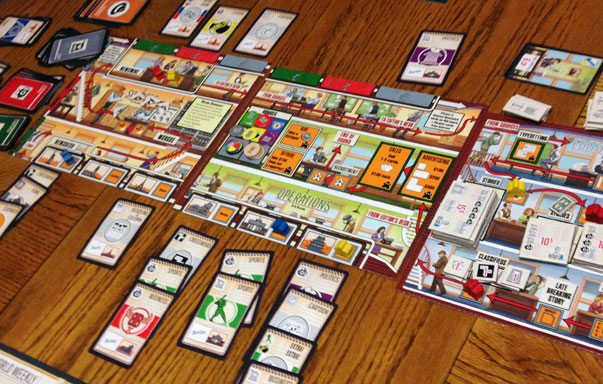
Extra! Extra! comes in a bookcase box with a large quantity of components, including cardboard boards, cardboard tokens, and cardstock cards.
 | |
 |  |
Quality: The cardboard is all thick and glossy, though the board was a little disappointing: it comes in three sections and they show perforations on the edges. The cards are all good quality and nicely linen-textured. 4 out of 5.
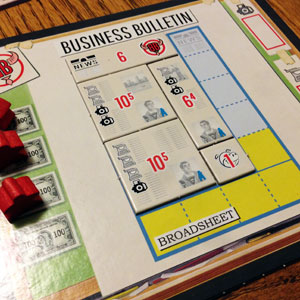
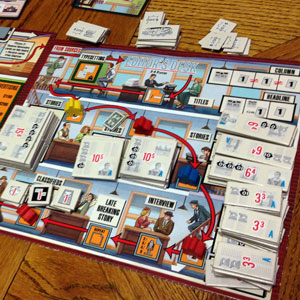
Beauty: The game is mostly graphically understated. The cards are the best graphical design: though they're simple, they're iconic and attractive. The story tiles, which are the other major component of the game, land on the other side of simple, and are just plain. The boards have the most art in the game … and they end up being too busy. 3+ out of 5.
Usability: The game is about collecting colored cards, turning those sets in for story tiles, and laying those tiles on player boards. There's some good iconography to draw this all together, but also some flaws. The cards, for example, have colors and icons showing what "suits" they fall into. Have if you stack the cards so you can only see their tops, it's almost impossible to make out the colors. The cards also feature cameras and typewriters, which are used to fulfill requirements on the story tiles. Unfortunately the gray typewriters are much lighter than the black cameras, which makes them hard to see from afar. The game also loses some Usability for size: the three-part board takes up a lot of table-space and forces things to be quite far from some of the players. Overall, the iconography of the cards and pieces definitely helps the game play, which is what Usability should do, but it also could have been better. 4 out of 5.
Theming: I was thrilled by the theme, which is about creating stories to fill a newspaper. Unfortunately, it comes off very abstractly. The colored cards for topics like World and Home don't feel very evocative, and when you turn them into beige Story Tiles, you get the opposite of evocative. I was looking forward to placing articles on my newspaper's front page, but instead just put dull-colored tiles on a board. The theme does certainly come across in the worker placement spaces and some other parts of the design, but it doesn't come through in the central activity of building your paper. 3 out of 5.
Overall, Extra! Extra!'s style is somewhat above average, particularly due to generally good production and generally good usability. I've let it eke in a low "4" out of "5" for Style, because there's no "3.5" rating.
Summary of the Gameplay
In Extra! Extra! the goal is to fill your newspaper with great stories.
Pick the Scenario: To start Extra! Extra! you pick a scenario to play. There are nine total, but they mostly vary by how many spaces you need to fill in your newspaper, which mostly impacts game length.
Other Setup: Each player starts with a handful of cards, a special copy editor, and a Stringer card — plus a newspaper page to fill with stories
The Cards. The cards are the heart of the game's set collection. A Photo deck contains Photo cards in the game's six specialities (topics like sports and business; they're essentially suits). A Copy deck contains Copy cards in the game's six specialties. A Features deck contains a bunch of special cards: headlines, newswires, interviews, Extra! Extra!s, and stringers.
Starting a Turn: Each turn starts with new cards being placed near the board. Some go to the Newsdesk and some go to the Newswire. Meanwhile, players get money, but must pay reporters.
Afterward, players can use Stringer cards to grab individual cards that they like. Then, the main play begins …
Placing Reporters: Players take turns placing their reporters (workers) on various action spaces on the board. There's a twist: you can put money with reporters to protect them, and you can pay more money than someone else to bump a reporter from their space!
Taking Actions: After all reporters on settled on their final spaces on the board, the players get to take the reporter actions. They're broadly divided into three categories:
- Sources. These actions give players cards (from the newsdesk; or from the newswire, in exchange for newswire cards) or else "cuttings".
- Editing. These actions allow players to turn cards and cuttings into stories. This is done by turning in a matched set of cards with a certain count of Photo cards and a certain count of Copy cards; cuttings may substitute for some of these. Players get bonuses if they play appropriate Extra! Extra! cards or if they play cards in their particular specialty. The result is a "story", which is a tile from 1 to 6 blocks in size, which is then placed in the players newspaper. Additional spaces on the Editing board let players place special "headline" or "column" stories, or make stories more valuable with an interview, or flip stories around to fit better.
- Operations. Some final, miscellaneous spaces let players raise cash (by selling cards or placing ads in the paper) or increase their number of reporters.
Ending the Game: The game continues until a player is able to fill his entire newspaper. The round ends, then everyone earns points based on their stories. Bigger stories, specialty stories, Extra! Extra stories, and interview stories earn more points … and the player with the most points wins.
Relationships to Other Games
Extra! Extra! is a worker placement game, following in the footsteps of such classics as Caylus (2005) and Agricola (2007). Its big innovation is the ability to bump workers by paying money, which essentially mixes worker placement with auction mechanics (and is quite clever!).
The Game Design
Extra! Extra! is a pretty classic mixture of worker placement and resource management. You put down your workers, you gather resources in certain types, and you turn those resources into victory-point-scoring tiles. There's a bit of cleverness here in the aforementioned use of auctions and in the way that tiles have to be (slightly) carefully placed. But beyond that, there's not a lot that feels new.
The game supports a few different strategies. You can work on collecting quick sets or on gathering sets that take longer to create, but which score more points. The use of wild-card clippings and score-doubling interviews also adds to the game's options.
As a whole, I feel like I've seen the elements of Extra! Extra! before. However, if you're particularly won over by the (light) theming or by the (longer than usual) game length, then it might be the game for you.
I've given it a "3" out of "5" for Substance.
Conclusion
I adore the idea of a newspaper-making strategy game. I'm not convinced that Extra! Extra! makes the best use of that theming, but it's nonetheless a fair worker-placement game that offers some fun gameplay as part of a relatively standard set-collection mechanic.

