

 Search
Review of Flea Market
Players: 3-5
Playing Time: 30 minutes
Summary of the Components
Flea Market comes in a small box with a board, various cardboard tokens, and dice.
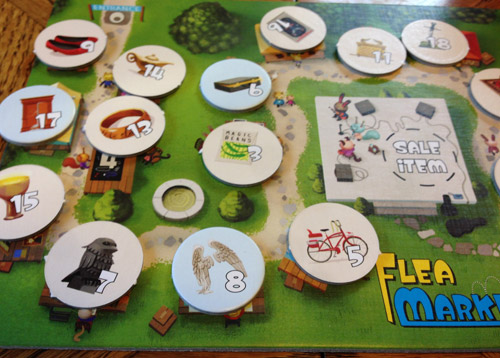
Quality: The cardboard is all sturdy, linen-textured cardboard. I also quite liked the dice, which are plain plastic dice, but appear in a variety of attractive colors. 4 out of 5.
Beauty: The art is mostly OK. It's colorful but sometimes sparse and sometimes small. 3 out of 5.
Usability: The game is pretty simple and doesn't need a lot of usability … but there are still some issues. The money is the biggest problem because it comes in three denominations which are very similar looking. I also had problems with the rules, which don't do a good job of explaining who gets to do what. 2 out of 5.
Theming: This is a pretty abstract game, but the idea of a swap meet comes across surprisingly well, as you're buying thing, then putting them back up for sale. The items for sale were also really cute, because they're all iconic items from movies and legend, from a certain Kane-esque sled to Pee-Wee's bike and the sword in the stone. We never could puzzle out what #16 is though, because it's printed too small. 4 out of 5.
With fun theming, good quality, and some usability issues, Flea Market averaged out to a "3" out of "5" for Style.
Summary of the Gameplay
The object of Flea Market is to earn $45 by buying and reselling goods.
Picking a Good: Each turn a player rolls 3d6 to determine which numbered good goes up for sale. This could be a good from the board or it could be something that a player has already purchased and is now being re-sold.
The Player Bonus. If a player resells one of his items, he immediately earns a cash bonus that gets larger the later it is in the game.
Rolling the Dice: Now all the players roll 2d6 to see what their bid will be that round. Each player gets to reroll one of their two dice if they want. This allows some control over what a person might pay for an item.
(This was where we had the problems with the rule. Does the "auctioneer" get to bid? Does someone selling his own item get to bid? I think the answer is most likely "yes" on both of these questions, but they create weird dynamics, so without rules to clarify the questions, we were somewhat puzzled.)
Buying a Good: Now each player gets an option to buy the good, starting with the player with the highest roll. A player either pays the amount that he rolled or else passes, giving the next player the opportunity.
The Player Bonus. Usually the money goes to the bank, but if it's a player's item being resold, he gets the cash instead.
Winning the Game: Based on reselling goods and collecting bonuses for doing so, a player eventually sums $45 and wins.
Relationships to Other Games
Though it might initially look like a fairly random game, Flea Market is actually about valuation in purchasing. Players have to examine goods being sold and determine (based on their number from 3-18) whether they're likely to resell, and what the bonus will likely be by the time they resell. Together this analysis (and a lot of table group think) helps the players to assess what they should pay, and thus whether they'll make a profit in the long term. As a group-thinky valuation game, it reminds me the most of Reiner Knizia's Modern Art (1992).
Conclusion
When I initially read the rules to Flea Market, it seemed like a pretty shallow game. And, it certainly is a light filler, but there's some depth too.
First, you have the die rolling, which is clever. Because you get to decide whether to reroll one of your dice, you're making a decision about whether to try to bid higher or lower … and you're taking a risk as you attempt to get there. This type of decision-making is important in dice-rolling games, and it's done well here.
Second, you have the pseudo-auction, which is also clever. It's all about evaluating the merchandise and then trying to acquire it for a reasonable price, but there's enough group think in the valuation (since you're buying and rebuying goods again and again) that there's no easy answer. You instead have to constantly assess the ever-changing waters of how the other players are bidding and how much time there is left in the game.
Overall, Flea Market is an OK filler with some interesting design elements. I've given it a "3" out of "5" for Substance.
Summary
Flea Market is a simple filler with some enjoyable and well-nuanced dice-rolling. Die fans might enjoy it as a game to start or end the evening.

