

 Search
Review of Mission St. Mary: Lemurian Treaty Port
 Goto [ Index ] |
Action takes place on Lemuria, the locale that is said to be old when Eden was young. Seductively this is a primordial land of high adventure. Where ancient kingdoms and European powers contend for hegemony of the land and its peoples. Lemuria is a flourishing land, but unforgivingly cruel at times, jam-packed with treasures undreamed of. Prospects for Fortune and Fame present itself at every turn. However, only worthy adventurers dare to seize the opportunities that reside here.
Nobelongga is the eastern opening point to Lemuria. Positioned on the other side of the island continent, away from the enlightened and polite side, Nobelongga permits all to pass into the continent by way of Mission St. Mary. Mission St. Mary is the principal Treaty Port on the east coast. It is a settlement where the European nations have their embassies and manage trade; all under the tacit approval and observant eyes of the local Nobelongga tribes.
Mission St. Mary: Lemurian Treaty Port is a separate game that goes well together with Larger Than Life – Director’s Cut, the Pulp Adventures game also produced by 2 Hour Wargames (and reviewed earlier). It is an adventure game for use in the Victorian Era (Steampunk and Colonials) in addition to for Pulps. Players can be an explorer, soldier, native, caveman, or even a dinosaur. Character lists for generating 20 different types of characters for the players to choose from. Ranging from “standard adventurers” to those with Steampunk aspect, to Cavemen, Cultists, Dinosaurs and much more in between. There are more than18 Attributes that you can mix and match to make your characters unique. That either characters improve or gently forced into retirement should they fail.
A complete country to adventure in that includes a civilized town, a Lost World, jungles to explore, and rivers to navigate. The workings of the game allow Mission St. Mary to be played alone or cooperatively in opposition to the game, in addition to head to head versus fellow players. There are ten distinctive set-ups that can be played over and over with completely different outcomes.
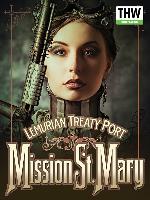
Once again, it is hard as this is a strange hybrid wargame-RPG. It is not really set with the rules of BRP or other rule systems that they state it is. That said, the rules are the underlying skeleton common for all RPGs, that you can see how rules are built upon. There is lots of Roll Playing, miniature simulations and a wide open sandbox of play. Other than the gorgeous cover there is no illustrations or art. However, the rules are not redundant or repetitive. Whereas, with the previous volume, I questioned the high price tag for a book of Tables and Charts – this is more value for the money. It might not be quite worth the price point, but, if your passion is miniatures gaming and detailed simulations then this is the game for you. However, if your game more narrativist there might be something in here for you. All-in-all a very interesting addition that takes you back to the early days of our hobby yet surprisingly fresh and innovative of many so called Indie Games.

