

 Search
Review of A Quick Primer for Old School Gaming
 Goto [ Index ] |
Why is that so? The author explains this in four chapters called "Zen moments" for the players followed by another four "Tao of the GM" for the Dungeon Master. The first "Zen moment" is called Rulings, not Rules. Here, Finch claims that old school games don't use rule most of the time but instead player creativity and stuff that the game master makes up on the fly. The example for this is... disarming traps. This adds the OD&D Greyhawk supplement, where this iconic thief skill was officially published first, to the list of modern games and makes the author's definition of old school the most narrow and conservative I have ever heard of.
What follows are two examples of play. In example one, the group tries to deal with a pit trap; in example one, a player does an attack with an improvised ninja jump. Both situations are described twice, once by a modern and once by an old school DM. In the modern examples, everything boils down to "I make a die roll" whereas in the old school example, everyone describes everything in detail and make it sound awesome. Finch admits that he deliberately made the modern DM sound as boring as possible and then admits that he thinks most modern DMs aren't actually that boring and he doesn't want to make them look bad - and yet he insists on presenting them in a bad light. Couldn't he have used two old school DMs, one only using the rules, one being creative?
The second "Zen moment" is called Player Skill, not Character Abilities. The message is that old school player don't rely on the hardcoded abilities their characters have but instead are (once more) creative and describe everything. Of course, the dichotomy here is false one - having a skill on your character sheet doesn't prevent you from describing what your character does. The examples gives (spotting, bluffing, sense motive) are again poor ones. OD&D has both rules for spotting secrets like hidden doors and a whole chapter on social rules. The latter isn't found in Swords & Wizardry in is entirety, so I assume that Finch doesn't use these rules at his table. However, this also means that he enters hourserule territory, and once we do that, all discussions about what rules we have and which ones we use becomes pointless because every game can be houseruled.
The third "Zen moment" is called Heroic, not Superhero. Here, the authors describes that old school games are gritty, with player character that don't have "super-abilities". I guess being able to fly, bringing back people from the dead or teleportation don't count as superpowers. The example here is that players don't become Superman, they become Batman. How Finch could overlooked that the abilities an OD&D character (especially the mage) can gain include flight, X-ray vision and being able to deal with a dozen mooks at once is beyond me. These aren't just Batman-level abilities. This is literally Superman territory. The other examples aren't any better: Apparently an OD&D character will never become "stronger than a dragon". Considering that an OD&D white dragon has no more than five hit dice, this is (again) ridiculous and makes me question whether the author is familiar with the content of his own retroclone.
The last "Zen moment" is called Game Balance. He first message here is that old school games shouldn't scale encounters according to the party's power. They should be random and deadly. D&D has random encounter tables in all editions up to D&D 3e and nothing forces a DM to balance encounters, so once more, I fail to see what's specific to OD&D about this. Maybe this is supposed to refer to D&D 4e, but that seems unlikely - later on, the author admits that he has barely played D&D 4e. The second message is that the DM isn't forced to use all rules as written. This is something all D&D editions (with the exception of AD&D 1e) have in the first chapter of either the Player's Handbook or the Dungeon Master' Guide, so nothing new or "enlightening" is brought to the table here.
After the "Zen moments", we get some tips for the players. This includes stuff like scouting, protecting the mage (which, ironically, is called a "nuke", contradicting the third "Zen moment"), and asking the DM question about the area. This advice is so general it can be used for a large number of RPGs. It's not specific for D&D, let alone OD&D.
The second part of the Primer has advice for the game master in form of four "Tao of the GM". The first "Tao" is the The Way of the Ming Vase. Imagine the following situation: There is fight going on, and there is a priceless Ming Vase in the middle room. Now what is the chance of the vase breaking? The intended lesson here is that the DM has to decide what the chance is because there's no specific rule for it. Once more, the reader is treated like an idiot who needs to be force-fed this "wisdom" because his style too "modern". However, this chapter is also the most amusing one, because it implies that post-2e D&D actually has specific Ming Vase breaking rules. I will admit that I'm sure that some company released a third-party d20 book like The Complete Guide to Object Shattering, but the idea that post-OD&D rules are so specific that we need to devote an entire page to explaining that there might be a situation not covered by the rules is just bizarre.
The second "Tao" is called The Way of the Moose Head. The message is the same as the one of the second "Zen moment" and we get another example of play that highlights the lack of creativity and slavish adherence to the rules of modern players and DMs.
The third "Tao" is called Your Abstract Combat-Fu Must be Strong. The message is that in old school combat, you can be creative and do everything you can imagine whereas in modern games, specific skill is need for everything. There are two problems with this claim. The first problem is the common misconception that D&D 3e feats are need for each and every combat move, ignoring that they most just make a character better at what he can already do (with a few exception such as Natural Spell or Whirlwind Attack). The second issue is that pre-3e D&D editions have restrictions of their own. The OD&D mage, for example, can't use any weapon except for the dagger and the staff. He can't wield a sword. He can't even pick it up and profit from its spell-like abilities, if it happens to be a magic sword. Of course, that can be hourseruled - but as mentioned above, so can any D&D editions and the debate becomes pointless.
The last "Tao" is called Way of the Donner Party. This part is about OD&D's focus on resource management. For once, Finch is correct: OD&D does have a strong focus on resource management, even though all later editions have this option build-in too (D&D 4e less so, though).
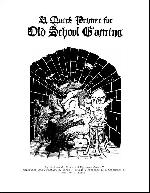
The final verdict: The Primer gets a 3 for style. It has a nice cover illustration, but no interior illustration, very basic formatting, and could use a couple more line breaks. For substance, the Primer gets a 1. It is written for post-2000 D&D fans, but insults them in the book's very first paragraph. It says modern D&D editions aren't terrible, yet includes multiple examples that highlight the supremacy of the old school play style. It talks about "modern" and "old school" a lot, but fails to explain what these terms mean. The explanations it does give either exclude D&D editions that are widely considered to be old school or include all editions, making the modern/old school split pointless. Lastly, the author doesn't seem to be very familiar with post-OD&D version of D&D and at times not even with the product he advertises.

