

 Search
Review of Murano
Players: 2-4
Playing Time: 90-120 minutes
Summary of the Components
Murano comes with a gameboard, lots of wooden bits, lots of cardboard tiles, some glass gems, and a small deck of cards.
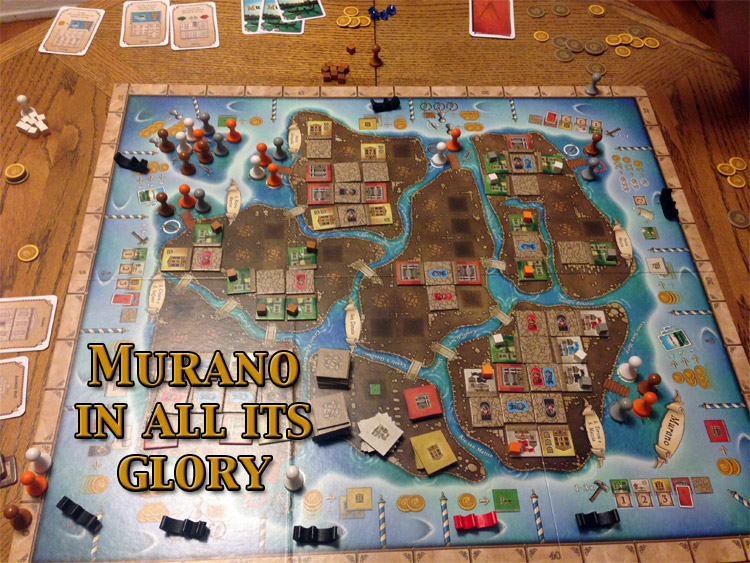
Quality: Everything is great quality in the game, including sturdy gloss cards, good linen-textured cardboard, and nicely crafted wood. 5 out of 5.
Beauty: Very attractive artwork is used throughout Murano, including on the mostly unique character cards and on the tiles. The board itself is also very beautiful. 5 out of 5.
Usability: Much of the gameplay centers on an action-selection mechanism; these actions are very carefully laid out with icons that not only identify what they do, but also remind you of subtleties (like how many cards to draw and how many victory points to take). Character cards and building cards are also heavily iconified, to make it clear what each does, and in this case the icons are backed up with text. As a result, Murano is all around easy to play, and if there's ever confusion, a great glossary at the end of the rules helps to clarify things. 5 out of 5.
Theming: Murano is largely a game of city-development, though it's not clear exactly why the city needs to be developed. More generally, the game focuses on the glass-blowing and maritime trade of the real island of Murano, and both of these themes come across well through the gameplay. 4 out of 5.
Overall, Murano is a beautifully produced game that earns a full "5" out of "5" for Style.
Summary of the Gameplay
The object of Murano is to earn the most points primarily through the satisfaction of goals on individual character cards.
Setup: Eight ships are laid out on the "action roundel" that surrounds the board. Each player is given 5 gold and 5 gondoliers.
Taking an Action: On his turn, a player takes an action by moving one of the ships on the action roundel counterclockwise to an action that he wants to take. There's a catch: a player can't move a ship to an action space that's already occupied by another ship. If he really wants to take that action, he must move the blocking ship (or possibly several ships, if there's a traffic jam) in order to free up the space that he wants. Unfortunately, each extra ship moved costs gold.
Eventually, the player is able to settle on the action that he really wants to take. There are several possibilities:
Taking Gold. There's one space that allows players to earn gold. It's a pretty bad option, but a necessity if the player is out of money.
Buying Tiles. Four different actions allow players to buy tiles, which will later be built on the board. A player can buy a glass-blower (which generates money at a cost), a shop (which just generates money), a palace (which just generates victory points), or a special building (which generates a building card).
Building Tiles. When a player has tiles in hand, he can take this action, which lets him build up to three tiles. He'll probably need to build streets to connect his tiles to, then he can place his tiles on some of the various islands of Murano. The palace immediately generates victory points, while the special building immediately generates a building card that grants the player an ongoing special power. The glass-blowers and shops are instead marked with ownership cubes, so that the player can use them on future turns.
Blowing Glass. A player can activate as many of his glass blowers as he wants, but each one costs him victory points(!). These generate glass beads (plastic gems) that can be traded in for money.
Selling from Shops. A player can activate one to three of his shops of different colors on an island. Each earns money based on the number of like-colored customers on the streets of that island.
Buying Characters. Character cards are very important, because they're how you earn victory points. Each one will score points based on the exact conditions of a specific island. Some earn for how many glass-blowers there are on an island, others for how many shops you have on an island, etc. Still others earn for very specific conditions on the island, such as whether there are the same number of special buildings and glass blowers.
Placing Gondoliers. However, you can only score a character card if you place a Gondolier on the island in question! And, there are limited spaces!
Buying & Selling Gondoliers. The last action lets you buy or sell Gondoliers, earning a bit of money or else giving you more gondoliers to place.
Ending the Game: The game ends when a couple of piles of tiles are expended. Players get a last turn, then points are scored based on pairs of gondoliers and character cards (adding to scant points already won by placing palaces and other tiles). The player with the most points wins!
Relationships to Other Games
The action system in Murano is a far-flung variant of the roundel system found especially in the board games of Mac Gerdts. Those games tend to allow players to slowly move around a menu of actions; Murano's system is quite different (and innovative) because players effectively block actions from each other when they take them.
Beyond that, Murano joins a bazillion other releases as a city building and tile placement game. However, it really distinguishes itself from the field with its goals (character cards), which create a sort of fun SimCity-like development mechanism where players are trying to mold neighborhoods (islands) in certain directions.
The Game Design
Overall, Murano is a very tight and thoughtful resource management game. You never have enough actions or enough gold, and there's constant tension, as you worry about people taking your building spaces or your action spaces or ending the game prematurely. Together these elements successfully create a fun game.
Murano's most innovative mechanics also work well.
The action system is interesting because it creates puzzles for your gameplay. If an action that you want is heavily blocked, then you have to decide whether to pay (lots) extra to get the action or to do something different. (There's also the possibility to block actions needed by other people, but this doesn't come up that frequently; instead the gondolier placement ends up being a semi-random obstacle for players to overcome.)
The goal system is also terrific. The wacky and specific requirements that you might face give you very specific goals to work toward, and this is exactly what's required for a city building game to be fun.
None of this was exactly ground breaking, but the new mechanics are interesting and just different enough. Besides that, I enjoyed watching the city organically grow over the course of the game. On the whole, I give Murano a high "4" out of "5" for Substance; it's a superior game for serious strategy players.
Conclusion
In Murano, strategy and tactics combine in a tense arena that allows for plans to blossom or go awry. An innovative action mechanism and an interesting goal system help to keep the game fresh and produce innovative play. All around, Murano's a game that should be appreciated by serious players.

