

 Search
Review of apocalypZe Card Game
Playing Time: 1-2 hours
Players: 2-4
Summary of the Components
apocalypZe is a card game that's overpackaged with just a rulebook and 304 cards in a much-too-large box.
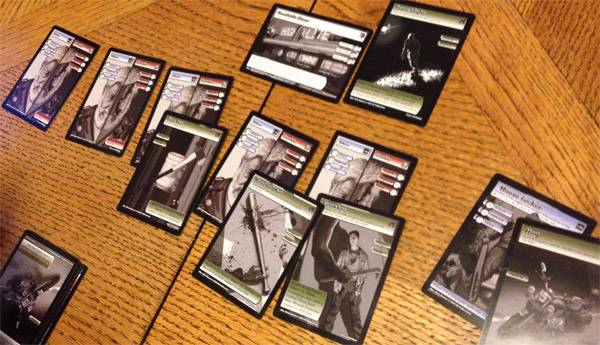
Quality: The cards are a medium-weight gloss, and the rulebook is similarly glossy. 3 out of 5.
Beauty: The cards all feature attractive grayscale art. Unfortunately, the decision not to go full color on the art hurts the game, which seems rather plain as a result. The layout and graphic design of both the rulebook and the cards is also somewhat primitive; they look like first-time graphic designs. 3 out of 5.
Usability: Unfortunately, the rulebook is one of the worst that I've ever read. It misorders things, omits rules, and otherwise makes it hard to learn the game. (An online rulebook is somewhat better, but still not good.)
The cards try to call out some important numbers, but they're too small and as a result hard to read from across the table — which is something you need to do.
About the only thing I can say good about the game's ease-of-use is that different types of cards are helpfully color-coded. Other than that, it's a mess, making the game extremely hard to learn and not easing the difficulty of play at all. 1 out of 5.
Theming: The idea of a zombie apocalypse where survivors are fighting against each other comes across well here. Sometimes, the gameplay interacts with the theming in a funky way (e.g., why are you playing zombies and survivors alike?), but other than that, it's a strongly themed game. 4 out of 5.
apocalypZe falls apart in usability, but the theming helps to average things out. I've let it eke in an average "3" out of "5 for Style.
Summary of the Gameplay
In apocalypZe, players try to stockpile their supplies while also raiding their opponents.
Each player plays through five rounds each turns: draw, occupation, scavenging, combat, and consumption.
Draw: A player draws back up to a hand of eight cards. This hand will contain survivors, raiders, equipment, special occupation/event cards, and out-of-turn "trump" cards.
Occupation: The player either: chooses his stronghold and plays survivors and equipment there; or plays a scavenging location and moves survivors there; or chooses an enemy's location and plays raiders and equipment there.
Scavenge: The scavenging locations are special locations that allow players to recover discarded cards. When they're played, the active players put a set number of discarded cards under their location. During the scavenging phase, these cards can then be recovered, one per scavenging survivor provided there are no raiders at the location. Any characters or equipment that are recovered get played, while anything else is discarded again.
If all of the cards at a scavenged location are recovered, then the scavengers return home and the player gets some bonus cards back from his discard to the bottom of his deck.
Combat: A player activates all of his raiders who are attacking other locations. At each location, the player splits up his raiders to cover "access points" at the location. Blocking all of a location's access points can prevent people from coming from the location.
In response, the defender divides up his survivors among the attacking groups. Then, combat occurs. Attack and defense values are compared and excess damages goes to characters' life values. Wounded characters are recycled to the bottom of the draw deck while killed characters are discarded.
If a stronghold was being attacked and wasn't sufficiently defended, then the attacker applies damage to the defender directly. This occurs via "consumption": the defending player will have to pay a value of consumption based on how many attackers got through and on the statistics for his stronghold.
Consumption: At the end of the round, a player must pay 1 "consumption" for each survivor at his stronghold.
Consumption can be paid by discarding cards from the draw pile or discarding cards from the hand (at a lower value) or discarding live survivors (usually at a higher value).
Ending the Game: If a player ever can't pay his consumption, then he's knocked out of the game. The last player standing is the winner.
Related Games
apocalypZe is a member of the increasingly popular category of zombie strategy games. Probably the best known member is Zombies!!! (2001). Recent entries have included Zombie Dice (2010), The Walking Dead: The Board Game (2011), The Walking Dead Board Game (2011), Zombicide (2012), The Walking Dead: The Best Defense (2013), and The Walking Dead Card Game (2013). Most (though not all) zombie games have been American-style games, heavy on randomness and aggressive take-that play. Though apocalypZe has some resource management via its clever card ecosystem, it's still largely an American-style game.
The Game Design
The biggest problem with apocalypZe is that it's a combative 1980s-era take-that game that was published in the 2010s. So, you've got big pile-ups where opponents all go after the weakest player, pounding him into the ground. And you've got player elimination, where someone is knocked out of the game, then has to sit around while his friends continue to have fun. And you've got a card draw right at the front of the round, which drags everything to a halt as a player examines his new cards. More recent games have tried to solve these various problems even if they maintained very aggressive play, but they're still front and foremost here.
Unfortunately, apocalypZe's problems go deeper than this. It's an unpolished design that has unnecessarily complex rules that are full of special cases that do little for the game. The worst is the combat system, which is hard to explain and hard to understand; despite that, its system of dividing up attackers into "access" ports doesn't do a lot to improve the game's tactics. The whole occupation system, which restricts who can be played where and who moves where similarly feels like its complexity damages the game. I will admit that some of my problems with both of these rule systems might have been with the poor rulebook and with the cards that don't really support the use of the systems … but I can only review what I actually see.
Finally, the game's mutliplayer systems seem entirely tacked on, which makes me wonder if it started off as a two-player design. The printed rule book doesn't really address what to do when multiple players want to attack someone; while the updated rules online provide a page of guidelines, it still feels like a mess, particularly when you try and figure out when raiders should attack. Worse, there's no easy way to see which cards should go back to which deck afterward.
Beyond that, apocalypZe is a fairly rudimentary design. It's all focused on relatively simple take-that attacks that don't have a lot of room for tactical innovation.
The design of apocalypZe isn't without merit. Its card management system is probably its biggest strength, because of the way that cards cycle through your hand, discard pile, and draw pile as you alternatively consume and scavenge. It's a clever design, though again not one that has much tactical depth.
Overall, apocalypZe had far more weaknesess than strengths, so I've given it a "1" out of "5" for Substance. If it were just a two-player game, it might have risen to a "2", since some of the problems were tied up in the multiplayer play.
Conclusion
apocalypZe is an aggressive take-that game of the sort that was popular in the '80s. Unfortunately, its design seems stuck in that time period, so there are lots of problems that more recent games have solved that apocalypZe still suffers from. If you like older war games, you might still like apocalypZe, but if you like more recent games, this will probably be a miss.

