

 Search
Review of Hot Tin Roof
Players: 2-4
Playing Time: 30-45 minutes
Summary of the Components
Hot Tin Roof comes with a board, cat meeples, and lots of cardboard bits.
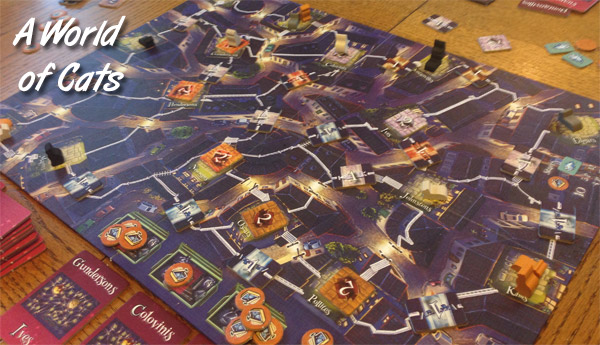
Quality. All of the cardboard is thick and linen-textured, and the game gets kudos for choosing to use cardboard tiles instead of flimsy cards for the "home tiles". The board is similarly good quality. 5 out of 5.
Beauty. The board, which shows dark streets and lit patios is a bit muddy and doesn't add a lot to the game. The various player tiles (shelters and catwalks) are cute because they show a variety of different shelters and crossings, one per player. Finally, the cat meeples are super cute. 3 out of 5.
Utility. The main utility of the game comes about through the "home tiles", which show players where to place cats (who must then be united). Each one shows the network of patios with cat pictures demonstrating where cats should be placed. Some of the players found these tiles a little hard to interpret, but they're definitely the sort of thing you want to have in a network game of this sort.
Unfortunately, the game scores some negative utility too: each player gets four cat meeples and nine cardboard tiles (showing shelters and catwalks) and the color matching between the cardboard and the wood is quite bad. The cat colors are orange, black, grey, and white, while the cardboard colors are orange, brown, blue, and whitish-purple. I'm actually not sure which cardboard bits were meant to go with which wood bits. In general players were able to memorize what their shelters and catwalks looked like, but it did cause some problems. We also had some minor issues with the dumpster spaces not being big enough for the large piles of coins stored on them. 3 out of 5.
Theming. The rulebook says the game is about uniting gangs of cats, and that doesn't really make much sense, because you're actually uniting pairs of cats, not gangs. All of the illustrations suggest you're instead uniting cat lovers, which is more in line with how the game works. The discontinuity is a little annoying, but the rulebook theme actually can confuse players by making them think they can unite any cats, not just the pairs. 3 out of 5.
Hot Tin Roof is a well-produced game, but some issues with theming and utility cause those elements to be more average. I've given it a rating of "3" out of "5" for Style.
Summary of the Gameplay
The object of Hot Tin Roof is to unite cat lovers, stocking up on fish in the process.
Setup: Each player gets some fish, some cats, and some shelters and catwalks that they'll be able to build on the board.
Order of Play: On his turn, a player pays fish, takes fish, gets a fish-related action, then races cats.
Paying the Fish Tax. At the start of his turn, a player tosses five sardines into five different dumpsters.
Dumpster Diving. Afterward, the players chooses a dumpster and takes all of the fish from that dumpster. He then gets to take an action associated with the dumpster.
Cat Dumpsters. Most dumpsters have an associated "home tile". This lets the player place a pair of cats on two different rooftops. He'll later try to unite them.
Catwalk Dumpster. This lets the player place a catwalk on a gap between buildings. They're good for moving your cats.
Shelter Dumpster. This lets the player place a shelter on a roof. They're good for charging tolls to other cats.
Moving the Cats: Finally a player may move any or all of his cats, with the object being to unite matched pairs of cats. He does so by running them across roofs, through shelters, and over catwalks. The catch is that a player must pay for the use of catwalks and shelters owned by other players!
If a player unites two feline lovers, they come off the board and the player gets a big fish as a reward. Presumably the cats have a dinner date, and those are the leftovers. If needed, the big fish can be split up into sardines for use in the game, else it's victory points.
Ending the Game: The game ends when a set number of big fish are collected. Players have to pay for any cats remaining on the board. Then each player adds up their sardines and big fish, and the player with the highest total wins.
Relationships to Other Games
Colovini is best known for making somewhat abstract puzzle-like games that play in 30 minutes to an hour. Player interaction tends to be limited to reacting to what the last player did. Games in this category include Atlantis, Cartagena, Clans, and Go West!. Hot Tin Roof definitely fits right in.
The Game Design
Hot Tin Roof is a fairly simple game that combines an action system, a financial system, and route-building. Of those elements, it's the action system that's the most interesting. Because players can't take some of the actions if they have all of their cats on their board, interesting brinksmanship in possible when you decide which actions to take.
The route-building and the rest of the finances are a bit more staid and involve a lot of counting, as you figure out which routes to move your cats along, when to pay your opponents, and when not to. There's some interesting balance here, as you trade off money with the possibility of wasting turns, but it's not necessarily deep.
Throughout all of this, there are a few different routes to victory, as you decide whether to concentrate on catwalks, shelters, or just moving your cats as quickly as possible. There's also a lot of measuring of short-term versus long-term gain, particularly when you're deciding what actions to take.
Overall, Hot Tin Roof is a fair, light game of building routes and using them, with just enough nuance to keep things interesting. I've given it an average Substance rating of "3" out of "5".
Conclusion
Hot Tin Roof is a typical Leo Colovini game with abstract puzzle-light play. I don't think it's going to become a classic like Cartagena or Clans, but it's enjoyable for light and casual play.

