

 Search
Review of Fight! The Fighting Game RPG
 Goto [ Index ] |
I first heard about Fight! The Fighting Game RPG (from now on, just Fight!) on the RPG.net Forums where it was recommended to me for a project of mine, combining the mystical martial arts/fighting game genre with AD&D's Spelljammer campaign setting. Being a huge fan of fighting games, especially the Street Fighter series, and Street Fighter: the Storytelling Game, this seemed right up my alley; I made the mistake of complaining that I couldn't afford it, and a friend of mine (not affiliated with Divine Madness Press) promptly bought the core rulebook for me, bundled with the Round 2 supplement which I'll get to later.
I'm going to tackle Fight! chapter-by-chapter, describing both the game itself and my impressions of it as I go. Every mechanical system in the game is accompanied by a clear and thorough “Example of Play” section, which I'll be relying on heavily since I've only read through the rulebook once before writing this.
Introduction
Fight! is a game designed to do one thing and do it well, and the author wastes absolutely no time in telling you exactly what that thing is. The Introduction forgoes any kind of flavor text or “what is an RPG?” explanations and instead tells you that this game emulates fighting video games and the stories they tell. It then goes into rich, loving detail about the common themes that bind those games together. Reading this section made me stoked, not just about the setting I was trying to design, but about the fighting game genre as a whole; not only do I want to run a fighting game RPG campaign right now, I want to dust off all of my old fighting games and pick them apart for ideas.
Chapter 1: Character Generation
Here, Fight! starts by telling you to come up with a clear character concept, because the system is strictly point-based and doesn't include classes or fighting styles or anything else to guide your decisions. The key points the game tells us to figure out are Appearance, Martial Arts Style, Training Background, and finally, the character's Reason For Fighting, which is pretty much their Reason for Everything. The game also suggests looking at other stuff, such as age, profession, and even blood type to help define your character.
Once you've got your concept firmly in mind, you start with Basic Qualities (like ability scores) and then proceed, step-by-step, through Qualities,Weaknesses and Quirks (unlike Basic Qualities, these are keyword descriptors), then your Skills, and finally your Special Moves. The chapter walks you through this, explaining each step as you go, and as always clear examples are provided at each step; until you get to Special Moves, there's nothing really complicated here, but the examples make teaching the game to new players a snap.
Finally, after the Character Generation process is explained, we get the Power Level chart and character advancement system, based on earning (or losing) Glory in combat. Power Level grants extra Qualities (but not Basic Qualities), Skills, Moves, combat bonuses, Life Bar (hit points), and Fighting Spirit, which allows characters to exert extra effort in combat. Beginning characters start at Power Level 1 and PCs can get to Power Level 8 over the course of a campaign; campaign end-bosses might be Power Level 9 or even 10, but no higher. Like 13th Age, I think the game suffers for this, as while the levels might be bigger, it just doesn't feel like there are enough of them.
Chapter 2: Skills
Petty nitpick here, but in Character Generation you pick Qualities first and then Skills; the fact that Skills are Chapter 2, while Qualities are in Chapter 3, irritates me. It irritates me a lot.
Skill checks in Fight! are simple. You roll 1d10, add your Skill rating, and compare it to the Difficulty Level (DL). Done.
Skills are divided into Combat Skills and Non-Combat Skills, and you get separate skill points for each so everyone is more-or-less equally capable in and out of combat. There are five Combat Skills: Defense, Evasion, and Tactics (the “DET” defensive skills) plus Ki for ranged attacks and Combo; their normal functions are detailed in the Combat chapter, but they can be applied out-of-combat using the standard skill system.
That leaves us with the Non-Combat Skills, which are further divided into “Mechanical” and “Narrative” skills... “Mechanical” skills have game rules and sub-systems attached to them, while Narrative skills are only used for skill checks. Otherwise, the game treats them exactly the same. There's also a quirk of the system here, in that “Combat” only refers to one-on-one combat with other Fighters, and a couple of the Mechanical Non-Combat skills are used in the Thug Thrashing and Dramatic Combat systems. (More on those later.)
The skill list itself is unusual, in that it's tailored pretty heavily to the fighting game genre. It combines standard adventuring skills like “Perception” and “Shadowing” with supernatural skills like “Magic” and “Sense Ki” and wholly unique skills like “Property Damage”, “Receive Wisdom”, and the aforementioned “Thug Thrashing”. Dodging gunfire is covered by the Non-Combat skill “Agility”, which has no effect in real combat, because most real opponents have no use for guns. If you qualify, you can take skills like “Magic” or “Gadgeteer” to represent your supernatural (or super-science!) abilities. Finally, there's a “Specialization” skill that allows you to improve your skills beyond what your Power Level allows; instead of adding them, you get to roll both skills and take the better result.
The chapter wraps up with optional rules for Action Sequences, which allow for complicated action scenes to be resolved with a series of skill checks that multiple PCs can contribute to. We've all seen this before in other games, but it's well-handled here and comes with examples for using it in play.
Chapter 3: Qualities, Weaknesses, and Quirks
Like I mentioned earlier, these are keyword descriptors that help differentiate your character from others. They range from modifiers to character appearance, to rare talents, to supporting characters. The rules here provide a lot of advice for using Qualities and Weaknesses to define your character and to help the GM understand what kind of game you want to play.
Some of the appearance-based Qualities for female characters are problematic and the author admits some players are going to be uncomfortable with them. (And that they're kinda ridiculous.) They're not systems-critical, and the game doesn't suffer from removing them entirely. Individual tolerances may vary, but the absolute worst this game offers is some implied cheesecake and fan service, comparable to the standard fare offered in the video games it's based on.
Weaknesses, of course, are the opposite of Qualities; nobody is required to take Weaknesses, but each Weakness you select allows you to pick another Quality. Most of these are pretty standard fare, from combat-specific weaknesses like “Glass Jaw” and “Style Weakness” to skill weaknesses, to psychological limitations like “Haunted” and “Honorable”. Quirks are basically very minor Weaknesses; every character is expected to take one or two Quirks, while three or more Quirks counts as a Weakness.
Since many of the Qualities and Weaknesses refer to Story Points, either spending or gaining them, the rules for Story Points are included at the end of this chapter. Story Points do about what you'd expect them to do, allowing players to re-roll skill checks and exert some minor narrative control over the scene; they're only usable in combat at the GM's discretion, when the battle is deemed sufficiently important to either the character or the campaign.
Chapter 4: Basic Moves, Special Moves, and Super Moves
While your Skills and Qualities might define who your character is outside of combat, your Moves define who your character is inside of combat, and as the game keeps emphasizing, that's what truly matters. While there were other martial arts video games released before Yie Ar Kung Fu, it was the introduction of separate characters with unique moves that created and codified the fighting game genre as we know it.
There isn't much to say about Basic Moves. They're all mechanically identical, with a base damage of 1d4 and a Control cost of 1; narratively, you describe them based on your character's fighting style. There's an optional rule to give characters foot sweeps and throws for free. Special Moves are different. Instead of picking from a list of codified Special Moves, you assemble each character's Special Moves yourself. There are a lot of sweet things about this game, and this is one of the sweetest. Every Special Move has a level, with the idea that the Level is the number of controller inputs necessary to perform the move; just pressing an attack button is a Basic Move, while a direction plus an attack button is an L2 Special Move. Special Moves have a base damage of 1d6, cost Control equal to their Level, and have a number of Elements to the move equal to its Level + 1. Elements range from straight numeric bonuses to Accuracy or Damage, to fairly mundane tricks like “Hits Low” or “Knock Down” to stuff like “Ranged”, “Teleportation”, and “Juggle”; you can add additional Elements to a Move by taking Liabilities that make the move weaker or more difficult to use.
There's a section for GMs trying to replicate 3d fighters like Tekken or Virtua Fighter that replaces Special Moves with Attack Strings, preset combos with a limited selection of Elements that can be applied to them. These rules do exactly what they're supposed to do, which is to make the game more grounded and less fantastic; this would be a good option if you were trying to use Fight! to play a campaign that was, say, more wuxia than shounen.
And then there's Super Moves. Holy hell, there's Super Moves. A Super Move has to be at least Level 5, the Fighter has to be at least Power Level 3 to learn one, and you have to spend Super Energy to use them in combat. In exchange for these limitations... a Super Move's base damage is 1d8 and the move has Elements equal to twice its level, plus Knock Down for free. There are some limitations on how you construct them, but these moves are hot-buttered awesome.
There are rules here for two different Super Move systems, a single-tier system and a 3-tier system. In the former, characters have a maximum Super Bar of 10 and performing a Super Move costs 10; in the latter, you can build up to 30 Super Bar, and every Super Move comes in three versions, one costing 10 Super Energy, one costing 20, and one costing 30. If you're familiar with Street Fighter Alpha 3, these are your X-Ism and A-Ism modes, respectively.
Finally, there's an optional rule for characters to transform into monstrous or bestial forms, as a supplement or replacement for the Super Move system. It's pretty cool, but it's also pretty specific, and it's too powerful to work as an option for individual characters.
Chapter 5: Combat
Combat is the longest and most complicated section in most roleplaying games, with the possible exception of magic; combat is the heart and soul of Fight! and absolutely no effort was spared in making the combat system as robust and varied as possible without sacrificing ease of play. In short, the combat system rocks on toast.
Fight! has three combat systems. That's cool and all, but I've seen it in other games before... except for the fact that they're not optional rules variants. You're expected to use all three, because they're all designed for different kinds of combat. Standard combat is for (mostly) one-on-one fights between Fighters, the kind of fighting that happens in the games this one is based on. Thug Thrashing is for Fighters to prove their superhuman prowess by beating up dozens of lesser foes at the same time. Dramatic Combat is an elegant system from a more civilized age; it's for anime fights instead of arcade fights, when the circumstances call for more drama than action.
I've mentioned it already, but I'm going to say it again because it really stands out in this chapter: Fight! doesn't give you anything without showing you how to use it. This book has the most useful Examples of Play I've ever seen in an RPG rulebook, and some of the most useful GM advice for getting the most out of the system and getting the themes and tones of the genre just right.
This chapter introduces Fighting Spirit. It's a pool of points, based on your Power Level, that represents your character's morale, confidence, and ferocity; you get a lot of this stuff, and you're going to spend it like water. It enhances just about everything a character can do in combat.
I was going to describe the whole combat system, but this review's getting a little wordy. Like most games, you roll Initiative to determine who gets to go first; unlike most games, everyone rolls Control to determine how much they get to do this round. Attackers roll 1d6 (or 1d10 if they're on Full Offense) plus their accuracy modifiers versus the defender's Defense Total, and if they hit they roll damage and inflict all manner of unpleasantness on the poor bastard. Getting hit before your action in a turn reduces your Control and you might lose the whole thing. There's rules for Combos, dizzying, tech rolls, cornering, and ring outs, and those rules are cool. There are no rules for dying.
Chapter 6: The Worlds of Fight!
My friend spent $10 buying this for me. If I never run a Fight! campaign, if I never use a single rule from the first five chapters of this book, Chapter 6 would still be worth the price of admission. You get more discussion of the fighting game genre, with its similarities and differences with wuxia and shounen, advice for building NPC Fighters for your campaign, and advice for constructing the campaign itself. You could apply this to any game with themes similar to Fight!
Of particular note is the section on Example Campaigns. It's about three pages long, and each paragraph is its own separate campaign idea. None of them are all that detailed, but they're all imaginative and evocative and they really show off the range of stories that can be told in this genre. Meta-genre? Whatever. This chapter is all about tweaking the various rules and options in Fight! to get the absolute most out of it, to enhance the enjoyment of every campaign and to spark ideas for many different campaigns, and it knocks it out of the park.
Appendices
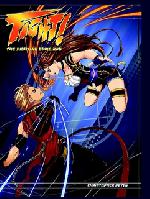
So yeah, there's this stuff. None of it's exciting, but all of it's useful. We get a handful of Example Characters, including the couple on the cover art, a page reiterating the chargen process and Power Level chart (which can be printed out), and reference sheets for all the various things you select when building a character. Big thing you get here is a nice list of Example Special Moves: twenty moves that your character can learn straightaway or use as a basis for their own unique Specials. Very handy. Plus you get a combat cheat sheet, a Glossary, and the author's own private Appendix N with video games instead of books.
Overall Impressions
Fight! was clearly written to be played rather than read; it's not an ugly book by any means, but there are no fiction bits or flavor text, there's little art, and the layout is a simple two-columns with sidebars. What art exists is really inconsistent and mostly forgettable, but a few of the pieces really stand out beautifully, and if it were all that good, this book would easily score a 5 for Style. The book suffers from some organization problems, with rules feeling “out of order”, especially in the Combat chapter.
On the other hand, again, Fight! was clearly written to be played. It's thoroughly and logically bookmarked from beginning to end, and the author does not present any new rules system without a clear description and copious examples of how to use it in play. The rules text is simple and easy to follow, and the sections describing what Fight! is and how to use it are evocative and compelling. This game begs you to pick it up and play it, and I would happily recommend it to anyone even remotely interested in the source material.

