

 Search
Review of Key of Destiny
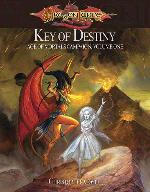 Goto [ Index ] |
The adventure background revolves around an ancient elven music box crafted long ago in the Age of Dreams. Quinari was a priestess of Paladine who helped mend the grievous wounds of dragons during the Third Dragon War. Impressed with her service, the leader of the Gold Dragons granted her the title of "Dragonsinger" and taught her the secret location of the Dragon's Graveyard. She would take away the bodies and souls of dead dragons to this location so that those of wicked hearts could not exploit them after battle. Eventually the gold dragon leader wiped her memory, as the information was too valuable for any non-dragon to possess. The song she sung to open the portal still lingered in her memory, taking the form of a child's lullaby and instilled unknowingly in an unassuming music box known as the Key of Quinari.
The music box reappears in the frontier town of Pashin, after the minotaur invasion of Silvanesti pushed out the elves and Dark Knights, the latter taking many elven treasures with them looted from the cities. It is destined that the PCs would come upon the Key, told to them by a legendary bard visiting the city that it must be kept out of the hands of evil. In fact, the Dragon's Graveyard being what it is means that prominent evil factions on Ansalon want access to it themselves. One of them, an elven spirit named Lothian, subtly manipulates the PCs with prophecies through the adventure so that they'll be better equipped to vanquish the other factions also seeking the Key.
The adventure itself starts out in Chapter One: the town of Pashin, where the PCs help wrest the Key from a renegade Dark Knight and gather information on it in town. The bulk of this Chapter is open-ended chasing of clues, getting involved in the various machinations of Pashin's faction and earning some allies in the process, from a hidden cell of the Legion of Steel to elven refugees. The encounters and town layout do a great job of setting the scene and giving players room to pursue interesting leads. It's the most open-ended chapter of the book, and no two groups will have the same experience. Overall I really like it.
Eventually they're led to the hidden refugee colony of elves underground, whose leader can tell them that they must travel to the ruins of Hurim for more answers. She delivers this information via a trance.
This regrettably is the most common means of propelling the PCs forward. Vague prophecies, the ghosts of women telling of their destiny, and hag oracles are the primary holders of information on where to go next and what to do. Unfortunately a lot of the information is vague and not specific, so in many cases it doesn't really feel like a good answer. I personally was more specific in my answers in my own games, as it can easily wear on players who feel like they're going on a wild goose chase.
Chapters Two & Three:
Eventually the PCs cross the deserts of Khur, meet up with a nomad tribe, and venture into the cursed ruins of Hurim, and learn to seek the Shard of Light in the Shattered Temple via Lothian's machinations. His beloved, Kayleigh, takes the form of a ghostly girl named Uleena, instructing them to seek out the Shard of Light in the Shattered Temple in Hurim. Here the PCs come across a formerly holy temple desecrated from an ancient curse after one of their priests betrayed the order to an ogre horde. Through spectral visions retelling the incident, the PCs learn of how the high priest Caeldor masterminded the slaughter in the name of Chemosh, God of Death, and how a lay priest managed to kill him with the Shard of Light, a sacred blade with powers to destroy the undead. Caeldor is actually one of the people seeking out the Dragon's Graveyard at the behest of his dark god, and the PCs arrival is watched by Chemosh.
This part of the adventure is weaker in that it over-relies upon the spectral scenes, which take the form of boxed text and the PCs cannot interact with them. A lot of it is unnecessary, detailing individual atrocities by ogre soldiers instead of focusing upon Caeldor (who is the start of the show in this bit, after all). There are also a lot of divine magic items for the PCs to find, a few of them overpowered and subject to some egregious abuse (Candles of Invocation). The chapter is more than made up for with the encounter of two fellow explorers, an aranea named Anasana and her mimic companion. They're traveling scholars who seek out cursed locations to remove their taint. The interaction with Anasana was an enjoyable one for my group, as she gave straightforward answers to questions and the novelty of do-gooder "monster adventurers" was what inspired us to try out monster PCs later on down the road.
Chapter Four:
After retrieving the Shard of Light, "Uleena" tells them to seek out the Peak of Malystryx and the ruins of Kendermore, where the Shard of Light will help them find what they seek.
After reuniting with the Mikku, the PCs must venture to the Port Town of Ak-Khurman; from there they'd sail to Port Balifor and enter the Desolation, home to the ruined city of Kendermore. Unfortunately, the only ships in Ak-Khurman are merchant vessels, and competition is fierce for people gaining the "right" to sail. As the PCs don't have crateloads of cargo and aren't known merchants, they'll need to get a letter of writ in order to sail to Port Balifor. This part of the adventure is open-ended, as there are 3 sub-plots where the PCs can get letters from the city's major factions. And if they fail in one of them, they can try again with another. Just like Chapter One, this is another strong point of the adventure.
Port Balifor's a seedy, rough and tumble town, home to a community of afflicted kender and Dark Knight Patrols. If the PCs end up causing trouble or have information from Ak-Khurman's factions to pass, they meet up with the leader of the kender, Kronn Thistleknot. He's part of a cause to drive out the remainder of Malystryx's forces from the Desolation and reclaim it. He'll happily assist the PCs venture with the help of an elf named Elijayess. From there the party travels into one of the most dangerous and forlorn regions of Ansalon, the Desolation.
Chapter Five:
This is a very good section of the module. Not only is it evocative in outlining the terrain of the Desolation, it's characterization of the landscape really drives home how much has been lost. The ruined city of Kendermore, home to monsters, the desperation of starving bandits (both humanoid and monstrous) attacking PCs in encounters, and the many dangers of heatstroke, quicksand, and lava floes add additional setting flair beyond just random encounters.
While in Kendermore the PCs learn that ogre slavers are rounding up Kender and taking them to the Peak of Malystryx, coincidentally the same place the PCs must investigate. Elijayess opts to stay behind with the rescued Kender, waiting for them in the ruined city.
Chapter Six:
The final chapter, where the PCs must climb the Peak and infiltrate its interior to find the kender. Beyond the main plume there are other entrances into the mountain, which they can learn from kender and gully dwarf NPCs back in Kendermore (although they'll need to earn their trust, as they're afraid of newcomers). Unfortunately a lot of the places are undetailed and beyond the scope of the adventure, including an interior jungle cavern and a village of dragonspawn and ogres. Despite its large size, the way forward is linear.
This chapter is a sudden spike in difficulty in comparison to the rest of the book. Beforehand genuine spellcasting enemies were rare, and low-level martial enemies (thugs, bandits, savage humanoids and predator monsters) predominated. The Shattered Temple had oozes and undead, though. The Peak is home to aerial opponents, including most dragonspawn and a red dragon named Soulburn. This can be hard for PCs unused to such tactics.
In order to find the captured kender, the PCs must earn the trust of a colony of Phalanx Ants, creatures created by Reorx (god of the forge) to tend to the bones of the earth. They're lead down a tunnel to the lair of Grigolthan and Sindra, leader of the ogre and dragonspawn tribes respectively. They're killing kender in a ritual believed to grant them the power of Malystryx inside the afflicted kender (this is pure conjecture on their part). The final battle involves a 3-part fight between a dragonspawn jailer, followed by Grigolthan and a legion of undead zombie kender, and finally Sindra. These battles can be tough as they don't really have room for resting up, but my player groups managed through. In the armory of the room lies the legendary Dragonlance of Human Dragonbane, the very same weapon used to banish Takhisis (Tiamat) from Krynn. Kayleigh visits the PCs in her normal form, congratulating them for finding the lance and encouraging them to pick it up and embrace their destinies.
The adventure ends with the PCs going back to Kendermore. The second book, Spectre of Sorrows, picks up from here.
Overall Key of Destiny is a good adventure, although its flaws prevent it from being more accessible to many groups. There were quite a bit of things left on the cutting room floor (later put into the errata), and the prophecies are too common and too vague that they can easily get on players' nerves. Despite its linearity the book captures the essence of Dragonlance very well and is very detailed in both characterization of NPCs and the realms the player characters visit. A lot of the encounters might be too easy for experienced gamers who know how to build characters effectively, especially the ones in the cities.
I'd recommend this adventure for Dragonlance fans, DMs willing to make some changes, groups who enjoy evocative setting detail, and players who want something more epic and storybook-like than the typical dungeon crawls. If the aforementioned problems are taken care of, this adventure's high points really shine and can make for enjoyable sessions of gaming.

