

 Search
Review of Outbreak: Undead
 Goto [ Index ] |
The last is one of the major reasons I picked it up. The young lady from the GenCon booth it was being sold at who came over to talk to me about the game when I started looking at it told me that they had an online evaluation you could take that would give you stats for yourself as a character. She also said that the game had systems for taking a map of your town and information about it, and using that to generate your setting and scenarios.
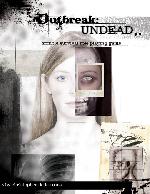
This all sounded like it would be very cool, and a lot of fun. Who doesn’t love a good zombie apocalypse? What gamers haven’t imagined what they would do in one? Actually flipping through the book gave me a bit more trepidation - most of it is typeset in a handwriting font, against a background meant to look like a notebook. There are parts meant to look like newspaper articles and photos have been taped into it, and it’s designed to look stained, blood-spattered in places, and so forth. Unfortunately, this means the book has a very low text density. Even those parts typeset in more normal fonts use larger sizes than typical in RPGs. Worse yet, quite a few pages are either blank, or mostly blank, with only a quarter of the page or so occupied by anything. And these aren’t just section ends or the like - quite a few of these occur in the middle of sections.
Thus, while the game has a high page count (454 pages), that’s misleading. I’d guess that the book would be half as long in a more traditional layout, with a smaller font and using two columns.
In spite of that, though, I bought the game. As long as the system was decent and it actually did the things the young lady told me it would, it should be fine.
That evening, I took the book out, and started looking for information about the online evaluation she’d mentioned, thinking I’d go ahead and take it and see what I looked like as a character. It took some page flipping, but I found out that the test they have is called SPEW-AI (SPEW are the game’s primary stats - Strength, Perception, Empathy, and Will. The “AI” part is “assessment instrument”), and that it would give me my core SPEW stats and a recommended skill set. It also informed me that I might wind up with more or less than the 120 points a Template Character (i.e., one you make up by the rules for making characters from scratch rather than basing on yourself) would have, and went on to say that when making myself as a character, I should not apply attribute bonuses given from my character type or skills, but that instead, I would get something called “Gestalt Dice” which I could use to create new skills or boost my stats.
What it didn’t tell me was where to find this test. A few minutes of flipping through the book didn’t turn up any mention of that, nor of what the game’s web site address might be. But that was okay. I had Google for that, and a search for “outbreak undead spew-ai” gave me a link to it. I clicked that link and… nothing happened.
Okay, maybe the test had been moved or something. I went to the game’s main page instead, which did come up. They didn’t have any link to the test there, but I found the link after a few clicks, clicked it, and… again, nothing. A blank page.
I was doing this from my iPad, so I shrugged. Maybe it was a Flash application, or something else that wouldn’t work with it. I’d try it later, from an actual computer. When I finally did manage to do that, it did turn out to work, and I started the test.
The test wasn’t what I expected. Every question on it was subjective - things like “Do you consider yourself a people person?”, “How quickly and accurately do you pick up on other people’s emotions?”, “Generally, how healthy are you?”, and so forth. Many of them ask you to compare yourself to “an average person”. None of them actually ask for anything with a hard number - for example, you’re asked how your vision compares to an average person, but not what your vision is. You’re not even asked if you wear glasses, which opens the question of “am I supposed to be answering this with my vision with or without glasses?”
Given such “squishy” measures, it seemed likely that people’s scores would vary greatly depending on their self-perception… and that’s exactly what I found to happen when I had my players evaluate themselves. I wound up having to tell two of my players to take the test again, and to be more generous with themselves (it being easier to tell people “I think your scores should be higher” than “I think your scores should be lower”).
It also turned out that all the assessment gives you is the four core ability scores. It doesn’t give you the “suggested skill list” that the book says it will. It doesn’t even bother to calculate the secondary attributes that the system uses from the four primaries, even though adding that should be ridiculously simple.
And speaking of that… in addition to the four main attributes, you also have Cargo Capacity, Movement, Melee Attack, Ranged Attack, and Defense, which are calculated from the main four, and then can be modified by your character type and skills. Several minutes of flipping through the book did not tell me which way I was supposed to round when calculating these. “Okay,” I thought, “I’ll look at the sample characters and figure it out from them.”
Except that there are no sample characters in the book. There is the section with zombie stats, and a section with NPC stats - but zombies and NPCs use a different way of figuring their stats, and don’t have all the same stats that PCs do. This is particularly bad with Movement, which the book tells you is your height, rounded up. Unfortunately it doesn’t bother to tell you what units you should be using, and there are no examples to find out from.
Having SPEW-AI calculate these for you would have given me my example, so I could maybe figure out how they want you to do it. But it didn’t, so I had no example.
This became an ongoing theme in my usage of the book - incomplete or missing rules. For example, on the plane back home, as I was flipping through the book looking for interesting bits, I found a bit that mentioned friendly fire as a problem in combat. That sounded like a fun thing to hit my players with, so I started looking for the rules for that. I couldn’t find them. I checked the index. It doesn’t list “friendly fire”. It had “ranged attack”, and some subentries for that, but nothing for friendly fire, firing into melee, or anything else that seemed like it might be related.
At this point, having had the book for about six weeks, I still have not found any rules for friendly fire. I don’t think the book actually has any, even though it mentions it as something that can happen in the text.
Further, while there is an index, to date, the majority of things I have looked for have not been in the index. Or possibly they are there, but I can’t find them, since the index is broken into many, many subsections. For example, one thing I looked for which is there is “Molotov Cocktail”. I looked under M, and it wasn’t there. I looked under W, for weapons, and there was no weapons entry there. I tried thrown weapons and ranged weapons, and found neither of those. I found “Flame Weapons and Fire”, went “Aha!” and looked there… to find it wasn’t there.
At that point, I actually just started flipping pages, and eventually found it. As it later turned out, though, where I should have looked is “Equipment”, subsection “Weapons”. You’d think they could have included a cross-reference from “Weapons” to “Equipment, Weapons”, but they did not.
While I’m on the subject of the index… some page number references are wrong, being off by two or three pages (not just in the index, but also ones in the text itself). Many are correct, and the ones that are off seem to be toward the middle of the book, with them becoming right again toward the end. I can only figure that someone didn’t update page number references before sending the book off to press.
These sorts of issues crop out throughout. For another example, a critical success in the game is called a “headshot”, which would seem to imply that some sort of special damage rule should apply. But the damage section doesn’t mention anything about it. Oh, and “headshot” isn’t listed in the index, so I can’t easily look through all the mentions of it to find if any of them discuss headshots in relation to damage.
Perhaps the most egregious example is in character creation. On the plane trip home, I came across this sentence: “If you wish to play yourself as a character refer to the section entitled ‘Yourself as a Character’.”
So I searched for that section. I didn’t find it. A few days later, at home, I finally did find it. As it turned out, the section titled ‘Yourself as a Character’... is the section in which you are told to refer to that section. The section refers you to itself. And this isn’t some multi-page section referring you to go back to the start of it. No. The section titled that is about a page long, spread across two pages that are facing each other… and the sentence that tells you to refer to that section is the last sentence of the first paragraph of the section.
To dip into Internet lingo for a moment,
All right. Enough with the layout and missing rules issues. What about the rules that are actually there? How are they?
Well, the core system is a simple percentile system. Take your relevant attribute plus any modifiers, and try to roll under that with percentile dice. Simple and time-tested. There are degrees of success and failure: each 10 points you get under what you needed to roll adds a degree of success, and each 10 points over a degree of failure. Five degrees of success or a natural 01 on the dice is a “headshot” - and that 01 always succeeds. The same applies to failure, where the term is “catastrophe”, and the natural roll is 100. A little bit oddly, you start counting degrees of success/failure from zero rather than one. You treat that zero as if it were a one when calculating weapon damage, though.
There are also difficulty levels. One level of difficulty is a penalty of -5 to your chance of success. That feels a little odd - it would seem more natural to match the degrees of difficulty to levels of failure and success - but it’s okay.
Then, however, we start to get to application of the system. Let’s look, for example, at Lifting. We are told that “Difficulty is roughly based on the amount of weight being lifted”. Then, “Lifting = 1 Difficulty per 10 pounds over a character’s Strength”. Now, average strength is 25. This means that, according to this system, an average person has only a 20% chance of being able to lift a 35-pound weight when they try. For perspective, that’s the weight of an average 4-year-old child.
Now, maybe that’s supposed to be under combat conditions, or something like that… but if that’s the case, the rules do not make that clear in any way. Nothing is mentioned about a minimum cutoff, such as not having to roll if the weight is less than your Strength. Given that an average person only has a 20% chance of lifting 35 pounds, it doesn’t seem like they should have a 100% chance of lifting 25. That would be a mighty steep drop for a difference of 10 pounds.
So how high does Strength go anyway? Well, the rules say that average is 20-30. For a 31-45, “generally, if your Strength is this high then you are an athlete of some kind”. 46+ is considered “Olympian”, with the note that it takes daily training and exercise to keep Strength that high.
So… by these rules, an Olympic weight lifter (46 Strength) has a 41% chance to lift a 56-pound weight. More than half the time, they will fail to lift it. Let’s say you’re trying to lift someone into a fireman’s carry - a task most reasonably strong people can do (which is why it’s the recommended way to carry someone in an emergency). Given a 160-pound person, someone with high average Strength (30) is operating at a 13 difficulty. That’s a -65 penalty, meaning they have a -35% chance of success. Indeed, the greatest weight someone of high average Strength can normally lift in this system is 89 pounds.
You can lift more by using an Adrenalin Boost. That lets you ignore up to your own weight, which is a huge boost… but that does actual damage to you. Not a lot, but it’s still something you can’t do over and over.
According to SPEW-AI, I have a 28 Strength. I weigh 195 pounds. I can do six pull-ups. By the rules, I can’t do a pull-up without an adrenalin boost. With the boost, I can do it automatically… but if I take six adrenalin boosts in a row, I’m going to take 6d3 damage, rolled as 1d6/2, round up, but with 6’s re-rolled and adding (it’s not clear whether the re-roll is also halved). On the optimistic assumption that the re-roll is halved, I should take an average of 15 damage from doing something that I do twice a day, every other day. Natural healing in this system is 1d6 per day… and I have 35 health points, according to this system.
My normal workout routine should kill me in three days, according to this system. Indeed, my normal workout routine should kill an Olympic athlete (46 strength) in a week or so. Even if we count all the pull-ups as one boost, I’m still doing damage to myself equivalent, by the rules, to what I would likely take from an average person shooting me with a .22 pistol and hitting. (Which seems to be remarkably underestimating the pistol - an average person can fully heal from a .22 pistol shot in one day?) Funny, I don’t even feel sore half an hour after doing those pull-ups….
Okay, lots of systems have problems with their lifting rules. But this is a zombie apocalypse RPG. Carrying a wounded person is something that’s likely to come up frequently. And the system bills itself as a “simulation” that you can use to test your zombie survival plan. I think it’s reasonable to expect that normal people be allowed to do things they can actually do. And certainly Olympic weightlifters shouldn’t have problems carrying a person around.
In the course of running the game for two sessions, I’ve already found a lot of problems like this. Let’s take combat for a moment. If I pick up a baseball bat and try to hit an average person with it, I have a 20% chance of actually doing any damage. Against a zombie, I have a 35% chance to take it out. However, against that same zombie, I have a 36% chance of breaking the baseball bat each time I try to hit the zombie with it. Against the living person, my chance of breaking the bat rises to 51%, since it depends on how much I miss by. That’s right - if I try to hit an average person with a baseball bat, I will break it half the time.
Not only that, but weapons never break when you hit with them. By the rules, if you pick up a clay flowerpot and try to conk someone on the head with it, if you actually do damage to them, the flowerpot will not break… but it almost certainly will if you don’t do damage to them.
Another example. There are rules for edged weapons dulling. According to these rules, however, edged weapons made of steel will never dull. Since the vast majority of knives and swords are made of steel, no one will ever have to sharpen them, making the dulling rules virtually useless. Further, steel weapons can’t ever be broken through use, according to these rules, unless they have a non-steel component that could break.
Last one: slashing/cutting weapons cannot cause bone injuries. Ever. That’s right… it’s impossible to cut off someone’s leg or hand with an axe or a sword, according to this system. Under these rules, you can break a leg with a baseball bat, but not with a fireman’s axe.
Oh, and everyone’s favorite anti-zombie weapon, the chainsaw? Well, it’s very effective at killing things, with one of the highest Lethality ratings in the game - higher even than a shotgun loaded with buckshot at close range. However, the rules are strangely silent on what sort of damage it does. If it counts as slashing or piercing, it can’t break bones or sever limbs… but if it counts as bludgeoning, it can’t cause bleeding wounds.
But don’t worry about that anyway. You probably can’t start it in time to help anything. It takes a Strength check with a difficulty of 1d6, so if you’re an average person, you have about a 7.5% chance of starting a chainsaw in one pull. On average, it’s going to take our poor average person nine pulls to start it (the threshold at which they have more than a 50% chance to have successfully started it). By that time, he’s probably already been bitten multiple times.
With all that said, there’s a lot of great stuff in here as well. There are rules for panicking, where a panicked character in a fight either tries to run away, or attacks at the maximum attack rate of their weapon, most likely wasting ammo. Also, if you are panicked, you lose the bonus that Will normally gives to your attacks and defenses. There are rules for calming panicked people, so the PCs can try to snap each other out of it. All good, and very appropriate for the genre.
The combat system requires pre-declaration - everyone declares their actions, then you start rolling. No one’s allowed to change their action, with the exception that you can make a Trigger Discipline roll to stop shooting at a target that’s already been downed. If the zombie you were going to shoot has already been shot by someone else, you’ve wasted your action.
I like this a lot - it does a good job of bringing some of the confusion of real combat into the game. Unfortunately, however, the system doesn’t specify the order that actions happen after declaration, except to say that the living go before zombies. When you’re only fighting zombies, this isn’t that big a deal… but a major aspect of the game is fighting what the game terms ‘vigilantes’ - other survivors who are hostile. They’re also living, and the system doesn’t tell us how to determine whether a vigilante shoots first, or the PCs do. Sure, any GM worth their salt will be able to come up with a way to determine initiative… but they shouldn’t have to. Especially not in a game that bills itself as an accurate simulation.
There are rules for noise and how it attracts zombies, which is a great idea. Unfortunately, a lot of these are spread out, placed in individual item descriptions instead of collected in one place.
The campaign rules are another good idea, and a major reason why I’ve still tried to run the system, even with the problems it has. Characters have a Stronghold, which is rated on several aspects. There are Missions that you can undertake to boost the Stronghold’s ratings - you can search for and rescue other survivors to increase your population, search for supplies, build a garden, shore up your defenses, and do all sorts of other things. No other zombie apocalypse game that I’ve looked at has anything like this, and it’s a great idea. It gives the GM and players major help with the “okay, now what?” side of things, giving them goals and methods of achieving them that can be measured in game terms.
My campaign hasn’t gotten far enough to give those rules a good playtest, though, and I’m somewhat afraid that they’re going to turn out to be like the action and combat rules - way out of whack with what it seems reality should be like. One thing that’s sorely missing is a list of missions and their types, to help the GM find the appropriate one for what the players are doing. Indeed, some some missions have other missions as prerequisites, this could have been worked into a whole flowchart sort of affair, giving even a beginning GM and players solid guidance of “the players should be doing one of these things next”.
Speaking of GM tools for campaigns, another disappointment has been the campaign creation rules. There are some hints and ideas about how to stock places with resources, but there’s nothing close to what I would call a “system” for doing so… which is one of the major things that the young lady at the booth told me the game had that made me decide to buy it.
Overall, I’m disappointed by the game. Many of the concepts seem to have great potential - an evaluation instrument to help you make a character based on yourself, the mission structure, the panic rules and pre-declaration in combat - but almost all of them seem to be poorly implemented. On top of this, the book’s layout and organization is confusing, and causes the book to be bloated in size, which both makes things harder to find (since there are more pages to flip through) and undoubtedly contributes to the $50 price.
My players’ chief complaints so far have been the skill system - which essentially has a set of special rules for each skill, much like spells in older versions of D&D - and action resolution. In the latter, since this is a percentile system and there are a lot of modifiers, those who aren’t whizzes at doing math in their head are frustrated with it. Thankfully, I am a whiz at doing math in my head, so I just have them roll, then tell them the result. However, the system is built so that when you’re rolling against a difficulty, you want to roll low, but when you’re rolling against active opposition, you want to roll high. This confuses the players, since what they thought was a good roll is a bad roll, or vice-versa. I’ve wound up simply telling the players before each roll, “you want to roll high on this” or “you want to roll low on this”. But honestly, it’s very frustrating - I’ve gotten confused a couple of times, telling the player they need to roll the wrong way. Then they roll and get happy about their roll, and I realize I told them the wrong way… and rather than take away their happiness, since I am a math whiz, I reverse the system and count the success or failure levels the other way. But having to do that is both taxing and frustrating for me - I’d much, much rather have a system where one direction for the roll was always the good direction, and so would my players.
As it stands, I’m probably going to convert the campaign to another system that focuses on realism - perhaps GURPS or CORPS. I’ll keep the pre-declaration, and lift out the mission structure and Stronghold rules (which are essentially their own minigame, and thus, should be easily transferred), and adapt the panic rules to whatever system I end up using.
In the end, I give the game a 2 on Style - the choice of fonts, backgrounds, and layout is an actual hindrance in reading, understanding, and using the game. On Substance, I’m split - there are wonderful concepts, but there’s far too much clunkiness in the system. If I could, I’d give it a 4 on concept/idea-mining value, and a 2 on the actual game system, but I can’t, so I’m splitting the difference and giving it a 3.
All I can really recommend the game for is idea-mining… but honestly, I’m not sure that’s worth the $50 price. If the stronghold/mission rules were broken out as maybe a $20 generic supplement for other zombie games, I’d call it great. But the rest of the system it’s attached to is verging on train wreck territory, with a detailed, complex, nit-picky system that gives results in many places that are ridiculous.

