

 Search
Review of BASH! Sci-Fi Edition
 Goto [ Index ] |
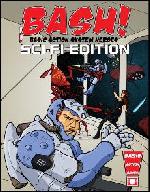
BASH! stands for Basic Action System Heroes, with an exclamation point, because it’s just that awesome. It’s a generic rpg system, ready to take you on interstellar voyages of spacey adventure! With no real setting, BASH! can be used to design your own galaxy, or possibly emulate your favorite sci-fi show or movie. The system is simple and crafted for quick play, with an eye towards cinematic, space opera - style romps through the stars.
You could conceivably play any style of game using these rules instead of just science fiction, but the authors have published several other rule books catering more specifically to those genres, such as BASH! Superheroes and BASH! Fantasy, or BASH! Haberdashers.
I may have made that last one up.
Anyhow, let’s dive right in and check out character generation…
CHARACTER CREATION
BASH! heroes have only three Attributes:
These are all self-explanatory, right? So, PCs have seven points to allocate to these three attributes, ranking them between scores of one and five. (Your species will impose maximums on your initial skills; for example, humans cannot have an Agility or Brawn higher than four, but some aliens or robots may.)
You then choose your species. If you don’t want to play a human, there are eight or so examples of alien races to portray, each with a paragraph giving a basic description and some cultural highlights. The offerings are your standard generic B-movie fare, including a lizard race, an insect race, some human lookalikes, that sort of thing. And any similarities of the Wokana to Wookies, the Ifurians to Ewoks, and Vekar to those doofuses in Battlefield Earth are purely coincidental, of course. Wink wink nudge.
If none of these choices cranks your capacitor, it’s easy enough to invent your own aliens using the material presented later, so don’t worry about it.
Let’s move on to the next step of our PC process: the Advantages and Disadvantages. Now, you don’t need to have any of these for your character, if you want to just play a vanilla human or unexceptional extraterrestrial. However, choosing an Advantage can make you a Cyborg, or give you Contacts such as business associates or criminal accomplices, or a Companion to assist you. Maybe you’d like to be a Quick Healer or a Techno-Wizard.
There are about twenty or so Advantages to choose from, each giving you some nifty … um… advantage… for your character. Some are physical traits, some are social, and some are mental, but they all tend to be inherent personality or background traits (learned skills will be covered in a minute). And the listing is really just a set of examples; you can make up any Advantage that your GM will go for, as long as it’s reasonable.
You can theoretically have as many Advantages as you want. The catch is (and you knew there’d be one, right?), that in order to pick an Advantage, you need to also choose an accompanying Disadvantage. You might be Aged, or have a Compulsive Behavior, or just a case of Overconfidence. It’s conceivable that you have a Powerful Enemy, or are an Outlaw.
These Ads/Disads, while not mandatory, tend to make a much more colorful character, while providing the PCs with some nifty abilities or resources they’d otherwise not have access to.
There’s a shorter section on species-specific Disadvantages, which come in handy when designing your own alien races, as mentioned earlier. These are the traits used in the pre-gen aliens in the core book, but again, feel free to make up your own weird crap for your campaign’s xenoforms.
Now, even if you decide to forego any Advantages, you’ll definitely want to grab some Powers. These are more heroic traits that separate the PC heroes from the nameless everyday space rabble. You have a very limited amount of points to spend to acquire Powers during char-gen, and each Power has a power point cost to acquire. Some come in various levels of proficiency, so the potency and scale of your Powers can vary a bit from even another PC in the party who has the same Power.
Powers include combat goodies such as having Armor Familiarity, or being a good spacecraft Dog Fighter or an Expert Marksman, or being trained in Paired Weapon Fighting. But let’s not forget the choices from the more social end of the spectrum as well, such as having Inspiring Leadership, or being Exemplary in your field, or possessing a military or political Rank. There are many to choose from, and of course, if you can’t find just the thing you’re looking for, make something up that meshes with your character image.
There’s a sub-selection of Special Powers as well, if your game includes things like psionics, cybernetics, or gnarly alien voodoo. This is where you can pick up some cool special effects for your extraterrestrials, such as making them Amphibious or Venomous, or giving them extra Appendages. Your android might have Built-In Tools or Built-In Weaponry, or the weird guy in your party wearing the robes and carrying the flashlight handle might possess Danger Sense and Telekinesis.
The final phase of PC gen is picking your Skills. Skills are broken down into two categories: Physical and Mental, which coincide with your Agility and Mind attribute scores. (Brawn doesn’t get its own skills, because the physical skills will be used with Agility.) You get one physical skill per point of Agility you have, and one mental skill for each point of Mind you have. The starting score for each skill you choose is equal to the corresponding Attribute score, meaning that if you have an Agility score of 4, all your physical skill scores start at four as well.
You can also spend skill points to buy specializations, or bump up the scores of particular skills beyond their corresponding Attribute number. So you might buy the Pilot skill, and then spend an extra point to specialize in “tricks”. By spending the skill point to specialize, you’ll now have one less skill in the mental category, but you’ve made up for it by being able to bulls-eye womp rats in your T-16.
Physical skills include Animal Riding, Stealth, Craftsmanship, artistic Performance, and such eyebrow-raisers as Escapology. The number of mental skills is almost double that of the physical selections, and includes Commerce, Computers, Foreign Cultures, Humanities, Starship Operations, Deception, and Streetwise. As always, if something’s missing, or you’d like a specialty not listed, just get the referee’s ok, and slap ‘er on your PC sheet. (“So, GM, would tribble farming fall under the Domestic skill or the Outdoor skill?”)
You can try skills you're not trained in, within reason, but there are of course penalties. No one's going to stop you from leaping to the table and performing emergency neurosurgery on your party's engineer if there's no alternative, but no one's going to be surprised if it doesn't really go that well for the patient, either.
For the record, there are no specific personal weapons skills. Attacks, be they ranged or hand to hand, are simply made using the Agility score, and the rules kinda’ assume that anyone can just pick up a phaser pistol or nunchuks and start blasting or flailing away without training. (Although, one does need the Military skill to properly use vehicle gunnery or capital ship weapons.)
Now, if you want to acquire advanced skill with a particular weapon, you’d have to buy the Power called Weapon Technique, which gives bonuses to using your favored combat tool, be it shotgun or laser rifle or energy whip or the totally bitchin’ Frisbee o’ Death thingy from Tron.
You’re done! Well, almost. You need some adventurin’ gear, my cosmic friend.
Naturally, most players will want to arm their character, because what fun is a space adventure unless some horrific species eventually pops up to try to eat your PC’s face? Included to choose from are armaments from throughout various historic Tech Levels, from spears, axes, and blunderbusses to more modern flamethrowers and assault rifles. Of course, let’s face it, most players will want to load up on the futurific weapons that go pyew! pyew!, so there’s no shortage of blaster pistols, EMP cannons, plasma grenades, vibroknives, and heavy quantum rocket launchers.
There’s a section on other personal gear, but it’s shorter than you may expect. Again, there’s a nice mix of standard equipment (scopes, rations, GPS gadgets) and hi-tech gizmos (artificial organs, robotic prostheses, nanobot injections), plus a selection of black market goodies to make things interesting. (“Embalmed face-hugger? What’s that?”)
MECHANICS
So, once you’re ready to boldly go someplace with your space hero, here’s how to resolve everything that happens in the big bad cosmos.
Basic task resolution is rolling two six-siders and multiplying them by the appropriate Attribute, and trying to beat a Target Number.
So, if my intrepid Imperial Trooper is trying to pry open an airlock without the passcode, I’d roll 2d6. My rolls might be a 2 and a 3, for a result of 5. Forcing the doors open is a feat of strength, so I’d use my Brawn score (which is a 3.) Multiplying the roll of 5 by my Brawn of 3, my final task result is 15.
Rolling doubles on the dice allows you to roll and add an extra d6 to your dice result, and if that roll comes up a matching number again, you just keep on rolling and adding that extra d6. So it’s possible for even the guy with the poorest Attribute score to crank out the occasional awesome result, with this exploding dice mechanic.
Whether you ultimately succeed at your task depends on the Target Number. Easy stuff has a Target of “10” (so if prying open the airlock was Easy, my Trooper would have pushed his way through). Standard difficulty is “20”, and Tough is “30”. Theoretically, the Target Number can be anything, but “50” tops out the suggested range at Nigh Impossible.
If you’re working against an opponent, such as wrestling a star pirate for control of a laser gun or trying to outwit a Wokana in a game of 3-D chess, whoever rolls the highest result wins.
Attacks plays out thusly: If you successfully hit your opponent with any weapon, the weapon is rated with a Dice Modifier, which is a number added to your roll before the result is multiplied by your appropriate Attribute score to resolve the damage. (Melee attack damage is multiplied by the Brawn score, ranged damage by the Mind score.)
For example, my Imperial Trooper fires a submachine gun at a Dune Raider during a disagreement. The attack succeeds, and my Trooper then rolls a damage result of 8 on the 2d6. However, the submachine gun gives my Imperial a damage modifier of +3, so that bumps my result up to 11. Multiplied by my Mind score of 2 for a ranged attack, my final damage score is 22. The Dune Raider sucks lead for twenty-two points of damage.
Hits. So how many bursts of gunfire can you sustain from a blaster Gatling gun before becoming a corpse floating through the vast emptiness of space? Most BASH! heroes, like the PCs and major opponents, have around with 100 “Hits”, indicating they can take 100 points of damage before they’re dead, Jim. (Accumulating damage does impose penalties on task checks, though.)
However, less important NPCs, referred to as Minions, may have much fewer Hits, with some as low as 10 or 20. In the case of the Dune Raider above, assuming he wasn’t an important leader or anything, he would probably be smoked by the 22 damage points he took from the submachine gun fire. Also fun to note is that while minions tend to go down fast individually, it’s possible to drop several minions during one melee attack or using fully automatic weapons fire thanks to the “Domino Effect” game rule. This makes the PCs much more heroic when facing hordes of nameless goons in the villain’s asteroid lair.
Obviously, more hi-tech weapons tend to dish out more damage. Damage can be soaked by armor or special Powers, lessening the amount of carnage you receive, and finding cover is always a good idea, especially when the energy grenades start appearing. Trust me.
That’s it, really. You’re good to go, my little cosmonaut!
The rest of the book is full of stuff for the GM, and includes info on creating worlds and aliens, including random generation tables. Guidelines for hazards such as vacuum exposure, variant gravity, poisons, and simple fatigue are provided. There’s an entire chapter on land and space vehicles (with an excellent selection of examples for each) as well as Mecha, and rules for creating or modifying your own vehicles using Vehicle Powers and Advantages, much like creating a PC.
Need to wipe out an aggressive hostile alien race intent on invading your domed lunar base? You’ve got rules for conducting mass warfare. There’s a selection of creatures, robots, and other opponents to fill the galaxy with. The book wraps up with a chapter describing the tenets of various game genres a GM may want to use as the setting for their campaign (space opera, space pulp, cyberpunk, time travel, etc.) with some specific details and rules tweaks for each genre.
You know what? BASH! Sci-Fi rocks. It’s a simple system that lends itself to fast-paced space hijinks and heroics. And because it’s so generic, you can easily model your game on whatever sci-fi show, book, or movie tickles your tachyons.
The mechanics and flavor of the core rules inspire plenty of incentive for exciting and action-packed escapades from a group of players, and there are some mechanics in place to encourage and reward players for heroic deeds that I didn't mention in the review. (Hey, buy a copy of the game, already!)
The genre suggestions and their specialized trappings are a sweet touch. A lot of support and material is given to help the GM craft a fun universe to explore.
Except…
Seriously, there’s like, less than a dozen items in each section of the personal equipment chapter, and that’s it. I suppose the basics are covered, but I think even providing a simple list showing prices for a lot more common goods and services would have been helpful to give GMs an idea of how much money stuff goes for in the BASH! universe.
The book is filled with good examples of almost everything needed to run a sci-fi adventure amongst the stars, except for basic day-to-day widgets. How much for a set of clothes? How much for lanterns or glow sticks? How much for a meal on a space station? How much do computer programmers earn? Dunno.
The only other thing “missing” that makes a space sci-fi game complete in my mind is a section on trade (or smuggling). There are stats for how much cargo starships can carry, but not much in the way of what to do with that info. I would have liked a chart or a few paragraphs discussing the opportunity for PCs to be merchants instead of mercenaries, with some guidelines as to how a profit could be made by moving various cargoes hither and yon. If your characters want to be Space Marines dropping from orbit to battle giant arachnid invaders, BASH! has you covered… but if your dudes want to play Firefly, you’ll have to do a lot of work yourself to come up with an economic infrastructure for your galaxy.
The worst I can say is that the book could have used another going-over for typos and occasional bizarre grammar, and maybe a layout issue or two. Some important info took a while to find because it was buried in the midst of a paragraph containing other material, and caused a furrowed brow until I hashed the meaning out with a few more re-readings. There’s nothing here that’s going to cause the game to be unplayable, but it could have been smoother and clearer in parts.
So, that’s the scoop. I’m impressed with BASH! Sci-Fi Edition, and if you’re in the mood for a light system with great potential, consider checking it out. I have a physical copy of the book, which seems hard to find, but it appears that it’s still readily available as a PDF download at both Lulu.com and RPGNow.com.
Now get the hyperdrives cranked up, because some guy in the Corellion Sector wants to hire us for a smuggling run to Kessel. I think I have to explain to him what a parsec is, though...

