

 Search
Review of Snakes On A Plane: The Roleplaying Game
 Goto [ Index ] |
Before it was released, however, the movie was already anticipated by many movie-goers. One of them, Deacon Blues, actually went out of his way to write an RPG based off the movie. And thus, we have Snakes on a Plane: The Roleplaying Game.
The Snakes on a Plane RPG was perhaps one of the first RPGs I ever got into when I was young. I was linked to it on a Tokusatsu forum. In fact it's the first RPG I ever ran a campaign from start to finish, though it had to take major liberties with the system, effectively turning it into a universal system. Naturally, it's the first RPG I'm gonna review. Let's dive right into it.
Style
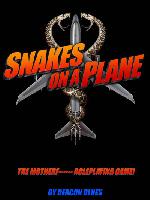
For notability's sake, the PDF I had was made by another user on the RPG.net forums by the name of georgeb, and this was a PDF that was made from a forum post, so I'll cut a bit of slack for this. There's a near lack of art to be had, about three pictures, two of them are almost identical. I did like how the subtitle in the cover managed to match that of the movie poster, and how they managed to do the closing image for the PDF.The layout, on the other hand is essentially a forum post made into a PDF. It's neatly spaced out though, so you know where one mechanic ends and another begins. It reads really great, and you can get the rules easy without having to re-read the text just to get the gist, or even having to read back to get something you may have missed.
The way this was written is probably a 50/50 for me. On one hand, it captures the feel of the Snakes on a Plane movie and it feels like Samuel Jackson (possibly as Jules Winnfield rather than Neville Flynn) is telling you the rules. On the other hand, I could say it overuses the iconic phrase and its variant. Though then again, who didn't watch the movie just to hear it?
Because of this, I'm a little mixed on this. It seems right for average.
Substance
Player Content
Right off the bat, the game starts off with Character Creation, which is perhaps the simplest of character creation processes. You have five stats that rank from 1 to 9 that you must allocate 25 points to. The stats are...
- Guts, which shows how strong your character is.
- Nerve, which shows how fast your character is.
- Cool, which shows how likely your character is of keeping their cool in the presence of a snake.
- Wits, which shows how smart your character is. And lastly...
- Charm, which shows how charismatic your character is.
The stats are rather simple to remember and easy to apply different task resolutions, with the exception of Cool, which only has a few scenarios I could think of. You also have a reason or story of why you're on the plane in the first place. The game doesn't say that you have to accomplish a task stated in your story until near the end of the PDF, and so this led to some characters who have no goal to accomplish on the plane, as their story is that they were just traveling for vacation or to unite with family, something that's done out of the plane rather than in the plane.
The creation process is rather simplistic and you can produce one within five minutes, so there's no hassle in the creation process. However, outside of writing out a reason to be on the plane and a name, there's nothing to make your character stand out mechanics wise, so you're gonna have to rely on roleplaying to flesh him out, which to me isn't a problem at all, but I believe it may be to other people, hence why I noted it.
If you like a super easy creation system, this is the game for you, but if you want more options to make your character stand out, then look elsewhere. It earns a point for me.
Game Content
The gameplay begins with a rather interesting stage called the "Before Goddamned Snakes" stage. Here, you get to establish your character and there's no need for task resolution. I find this interesting because it allows the players to roleplay a bit and get a feel for the game. After a while, the game's second stage, the "After Goddamned Snakes" stage, begins, in which the snakes are loose and you must do a task resolution for every action you take outside of talking, unless you're trying to persuade someone, obviously.If you played Ghostbusters: A Frightfully Cheerful Role-Playing Game, then this may sound familiar. Task resolution is done by rolling the number of six-sided dice equal to your rank in the stat you are testing.
For example, my character wants to punch a guy out. He has a Guts stat of 5, so he rolls 5d6.
Here's where it gets different from Ghostbusters, however. Instead of targeting a number, you just need to make more successes than you do failures (or equal if you tied). Rolling a 1 is still bad, though, especially in this game, since if you rolled more failures (which are always ones) than successes (which are 5s or 6s), you have an encounter with a snake, which leads to one of your randomly decided stats to be decreased, with 1-5 being the five stats listed above, and 6 being a reroll, but with double the amount of points lost from the roll. If you lose all the points in one stat, your character dies, presumably of the snake bite.
Going with the above example, my character rolled a 2, 1, 4, 6, and 4. Since I equaled my success with my failure, I succeeded my task resolution and punched the man in the face. Had that 2 been a 1, I would have to roll 1d6 to lose a stat. Assuming that happened, I rolled a 6, and thus I rerolled and got a 1, which is connected to my Guts. And so, I lost two points from Guts. If I lose 3 more points, I'm dead.
This is a very interesting way to get hurt, since it means you have to plan where you put your points in the stats carefully, as if you had a 1 in one of your stats, there'll be a 1 in 5 chance you will die within the first failed roll. It also means you will be less likely to succeed in a roll if you lose stats. The only benefit is that you're more likely to get successes than failures.
A problem, though, is what happens if you rolled nothing but 2s, 3s, and 4s. There's no mention of what happens in the rules, and so it's left to interpretation. Do I reroll the dice that come up with those numbers? Do I assume it's a failure? Do I do nothing? Or does a random event happen? There's also no rules indicating a competitive task resolution, something that most other RPGs have as a rule.
The game continues for an in-game set amount of time ranging from 2 to 12 hours that advances depending on whether you accomplished a task resolution or get attacked by a snake. At the end of the trip, anyone who accomplished the task in their story is a winner, whereas anyone who failed will have their character die via snake bite. It's interesting how the game has a timer and how it advances.
The only problems I find with this is that's basically all there is to it. There's no use of items, special abilities, or anything that other RPGs have, though I understand that this is trying to go for a more realistic approach. The other problem I found with it is that this seems to be made for one-shot games in mind, with no indication of if it could be expanded for campaign play. However, the rules are simplistic enough and easy to get used to, so it may be a double edged sword. It gains a point for me.
GM Content
Boy howdy, this is where the game falls flat. It's like you don't even need a GM for this game outside of presenting the game and possibly playing NPCs. The GM section (or Snake Master section) is about three paragraphs long, and the only thing it advises is to keep the players moving and not have them sit in a chair and go "oh my God, we're going to die!".However, Snake Master advice is laid a bit over in the gameplay section, but it's also just advice, such as what to do to present the idea of being crammed in a plane with tons of snakes. Nothing really for the GM to go about. It would be really cool to see more advice given to the GM, like having an optional rule to have a snake attack on anyone who does anything in reference to the Mile High Club. Because of the lack of GM-related info, I'm gonna have to not give this section a point.
Setting Content
The only setting-related thing it gives the GM is that 1) there's snakes, and 2) the flights have to be trans-oceanic. It does give the GM some other ideas, such as the snakes killing the pilots or there being a gigantic snowstorm, but it doesn't really offer anything else.It also doesn't offer any scenarios, or reasons the snakes are attacking. It's just that: snakes are on a plane. Now, I understand that 1) the movie's scenario was more or less just a reason to have snakes on a plane and 2) who cares about why snakes are on a plane, we're doing it for rule of cool, but a few ideas for the creatively starved GM would work.
I would also note the lack of NPCs, but considering how the character creation system is easy, I won't harp on it. One last thing I would say, but won't bring any detriment to the score would be that there's also a lack of snakes. By which I mean there's no actual different kinds of snakes, like King Cobras or Rattlesnakes. The reason I bring up that it doesn't bring any detriment is because it's not really important in the scheme of things, but having a pseudo-monster's manual on snakes would be cool and seeing what snakes would do what sort of damage, like poisoning players and have them lose 1 stat point every thirty minutes in-game.
Because of the lack of a setting, I'm gonna have to not give this a point.
Final Analysis
Now, I believe the game's substance is sparse, which would earn this a 2, but the racked up points would bump this up to a 3 (since there's no fifth section to give a point to, I would skip 1), so I decided it earns the extra point for having just enough rules to run a game that there won't be any problems outside of the few that I mentioned in the Game Content.And thus, it results in a 6 out of 10. I liked this RPG, but there wasn't really enough to promote this into a full out epic campaign RPG, but I highly doubt that was the creator's intention.

