

 Search
Review of Il Vecchio
Players: 2-4
Playing Time: 60-90 minutes
Summary of the Components
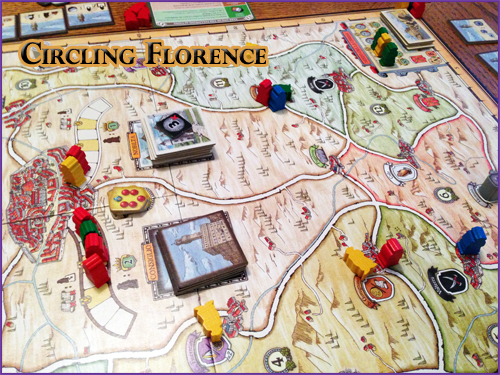 Il Vecchio is a bookshelf game that contains a game board; some dice; and a variety of wooden and cardboard components.
Quality: The cardboard is all linen-textured and thick, and the wood is all good quality. This is a top-rate game component-wise. 5 out of 5.
Beauty: The game contains attractive period-appropriate artwork by Andreas Resch combined with terrific graphic design. Everything is quite good-looking. As a nice bonus, the wooden middle-men markers even have stickers that make them more attractive in play. 5 out of 5.
Usability: Il Vecchio is a game with a lot of different elements, and so the designers have made a real effort to make that complexity easily accessible. This comes across well on the board, where it's easy to see things like the cost of taking over the provinces and the powers of the various towns -- all at a glance. Unfortunately, the icons used to represent the special powers of various province, city council, and noble tiles are a lot harder to figure out. Everyone had to constantly look them up in a first game, though on a second game I found that I could read at least 80% of them at a glance -- so they do get better as they're used. Overall, it's an excellent effort that works as often as it doesn't. 4 out of 5.
Theming: The theoretical theming of Il Vecchio is that of powerful families in 15th century FLorence vying for power. The beautifully detailed components certainly speak to the theme, but I'm not convince the mechanics do; they feel more abstract in actual play (especially how the family members and middlemen move around the board). 3+ out of 5.
Overall, Il Vecchio is beautiful and well-produced and puts great effort into its usability -- sufficient that a complex game becomes pretty easy to understand after a second play or so. That's enough to eke in a full "5" out of "5" for Style.
Summary of the Gameplay
The object of Il Vecchio is to earn the most "power points" before the Medici family falls.
Setup: Setup for the game is somewhat intensive. First, special power tiles are laid out for the provinces, the city council, and the nobles. Then, five middle men are laid out on the board: one for each of five different sorts of towns. Finally, the players each put four workers ("family members") on the board.
Each player also gets a carriage token, a bishop token, 2-4 coins, and a city council tile to start the game.
The City Council Tiles. The city council tiles are permanent special powers, each of which tends to make one of the actions in the game more efficient. When a player gets a city council tile he can then determine an optimal direction of play as the game goes on.
Order of Play: On his turn, a player takes one of five actions: take a town action; take over a province; take a Florence action; reinforce; or recover.
Town Actions. This is the heart of the game. A player moves a worker to a town, paying 1 or more coins (or a carriage) for his movement, then he takes the appropriate action for the town.
A player can play a bishop for the action.
Alternatively, the player can go to a town with a middleman, take the action, then lay down his figure (which keeps it from being used until it recovers). The middleman also moves to the next town of the same color/action.
There are six possible towns/actions. They are:
- Take an assassin follower.
- Take a knight follower.
- Take an abbot follower.
- Take 5 coins or a scroll.
- Take 2 bishops or 2 carriages
- Take 3 coins.
Province Actions. These are the main source of VPs. A player moves a worker to a province (paying coins or carriages as usual), then pays 1 or more followers and several coins to "take over". The worker is then permanently placed in the province where he'll earn victory points at the end of the game. The province spaces notably go up in cost and down in value as they're taken. Each one also provides a tile that gives the player a one-time special power.
Florence Actions. Alternatively, a worker can be permanently ensconced in the city of Florence. The player pays to move the worker (as usual), then pays 2 scrolls and maybe 3 coins to place a character in the city council or in the nobility. Both seats provide minimal amounts of VPs at game end. They also give the player a tile: either a city council special power or a nobility special victory point condition.
Reinforce. A player puts a new worker on the board from his supply.
Recover. A player stands up all of his workers which are lying down due to town actions.
Ending the Game: The game ends after sufficient workers have been placed in provinces, the city council, and the nobility. Players get a final double turn, then everyone scores their points. Most points come from province placement, city council or nobility placement, and the conditions on nobility tiles. Players can also earn bonus points for having the majority in the provinces and Florence or for spreading their workers out among all the regions. The player with the most points wins.
The Game Design
Il Vecchio is clearly a descendent of the worker placement genre of games that kicked off with Caylus -- but it's more of a worker movement game, since you place your workers on the board, then move then around. EDO is another recent game with similar mechanics.
The Game Design
One of the best elements of Il Vecchio's game design is that it plays very quickly. Sure, the overall game runs a respectable 60-90 minutes, but the turns go rapid-fire since each player only gets one action; this keeps everyone involved and the game flowing very quickly.
Il Vecchio also has a very carefully balanced resource system where it feels like you're constantly short of everything. You're trying to figure out how to get more coins, more followers, and more scrolls all the time, and never able to do everything. This allows for great strategy as you try to figure out how to do what you want within your limitations.
The middleman system is interesting, but what it really does is force the game into tactical play, as you have to assess the positioning of the middleman on your turn and see how that affects what you want to do (and how many coins you're willing to play to do it).
The interaction in Il Vecchio is fairly minimal. Unlike a more standard worker placement game you can't specifically block someone from an action, though you can make it less convenient if you take (and thus move) a middleman that a player was planning to use. There's also some interaction within the provinces, if you grab a place that an opponent was planning to purchase.
Overall, Il Vecchio is a dense and thoughtful worker-placement game that keeps everyone interested. It earns a "4" out of "5" for Substance.
Conclusion
Il Vecchio should appeal to eurogame fans of all sorts, especially those looking for a new take on worker placement. Its a well-polished, well-designed, and beautifully produced game.

