

 Search
Review of Heroes Wear Masks
 Goto [ Index ] |
Before diving into the review, I just want to be straightforward and say that I was one of the writers for Heroes Wear Masks. By default, I received compensation and a free copy of the finished product. I generated characters with it with no problems and played the sample adventure at the end.
Layout
With that out of the way, here is the basic information about Heroes Wear Masks (HWM after this). HWM uses a modifed form of the Pathfinder system for the superhero genre. It is a PDF only product with 220 pages with 10 pages of ads. There is a table of contents but no index or hyperlinks. The book is divided into nine chapters which are character creation, core classes, skills/feats, powers, resources, expanded game rules, superheroes and rpgs, heroes inc., and the included adventure "Brownout."
The editing isn't prefect. I found some pursuing the PDF recently. They aren't there a lot but just enough to occasionally poke their head up. I forgive errors more readily but I know others who would find a single error jarring. I know I sound like an apologist here but Avalon has a done a much bigger job editing here.
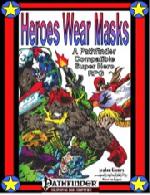
The artwork is consistent in terms of quality and theme. It features original artwork and stock art. Look at the front cover. It will show the quality throughout the book.
Character Creation
If you are familiar with Pathfinder, then most of this will be very familiar. The first different is picking origins, which serve like races in HWM. There are humans but they are give a bit more than in Pathfinder along with enhanced humans, mutants and strange vistors. The origins don't cover all of the possiblities for heroes but they have the most common ones. (They have released more products with more origins since the corebook has been released).
Human - Most Feats (more than in Pathfinder) to start out with. Enhanced Human - Well rounded with an attribute increase, power point, feat. Mutants - Good attribute increase, attribute decrease, some extra power points Strange Visitors - Most power points (attribute increase by point sacrifice)
Classes
They are the same in both Pathfinder and Heroes Wear Masks. They define the role that the character will fill in the game, at least in terms of potential. All of them have abilities to choose from and are separate from feats (which multiple classes can choose). The classes are listed below along with a quick summary of their niche.
Acrobat - Best Defense, Movement, quick attacks Brick - Most strength and ability to take damage Combat Expert - Most combat feats, uses training vs raw ability Detective - Most skilled, most resources, some special abilities Energy Manipulator - Power specialists, has unique class abilities for their powers Super Human - Most power points
Skills and Feats
Both categories are very similar to Pathfinder. The only difference is additions of new feats (examples including being able to add or subtract power activation rolls, speaking to the dead, gun feats, and more) and new skills. The subtractions are mostly in magic-oriented feats. There are no real rule changes otherwise for skills and feats.
Powers
The big one is between powers in Heroes Wear Masks and magic in Pathfinder. Pathfinder uses the Vancian system for their magic while HWM uses power points. They are used to gain new powers or learn more about old ones. Once a power point is used, then it is gone. Sometimes, the power points are restricted in the terms that can only be used to learn more about a power already obtained by the hero while other times either learning new or old powers is allowed.
Some powers require an activation roll to be made while others are "always on", which means a power activation roll is never needed unless you choose a flaw to make a roll necessary. If you spend a single skill point in power activation, you get the +3 class bonus. The power activation skill is based on wisdom. If you choose to use this rule, it is a good idea to use a feat to get a higher skill score. If all of this is done, then the chance of failing the skill is VERY low.
If you fail the skill roll, you can either choose to not use the power for a round (losing an action in the process) or your character can take subdual damage equal to the level of the power being used. i.e. if you had wanted to use your power at level three and failed, then you could choose to lose an action or take three points of subdual damage.
I have my own defenses for this rule but I have also heard of people "handwaving" the rule away and some choosing to keep it, so the jury is still out on this rule.
Power and Effect Templates add even more to the Power List. The power template is free and when added, describes the power in more detail. The power gets some more oomph but only one can be added. For example, a air-based blast will work differently from a fire-based blast. Only one power template can be added to a particular power
The effect template is optional and costs one power point to add to a power. The power gains a special ability or increase in basic ability. It is harder to use a power with an effect added; the power activation skill DC goes up when the special ability is used with it. However, the user can choose whether or not to use the special effect. By doing so, they control how hard the power is to use. You could purchase more effect templates for the same power if you wanted to do so.
They are complications that can be chosen for powers. In exchange for taking one, the power with the complication has more power points put into it. In other words, you can't take a complication on your super leaping ability and put the extra points in blast. You would have to put the extra points in super-leap.
Resource Points
Resource points covers equipment and money in the game. HWM assumes heroes are not in it for the money. Resource points go up by level and used to either get permanent equipment or temporary tools. Either way, the resource points are tied up until the equipment is given back, dismantled or however you explain giving up the equipment. The different comes in time required before the resource point(s) are given back. Temporary tools get the resource points sooner than permanent equipment. Permanent equipment are the special tools or devices the hero always seem to have with them while the temporary tool is only used to get through a particular challenge.
Within this chapter, there is a system for flavors/flaws. There are bonuses and penalties that can be taken by the PC. Everyone gets one flavor for free and more favors can be chosen in exchange for getting a flaw on a one-on-one basis.
Expanded game rules
They deal with the common events seen in the comic books. Specially, knockback is addressed and is based on the amount of damage done. Area attacks and makeshift weapons are touched upon since super-strength is option here. Breaking things has its own section here as well. Advanced classes are also in this section and they are a mixed bag for heroes and villains.
Superheroes and rpgs
This section starts off with describing hero and villain types before diving to other topics about superheroes and how to run an RPG in that vein. Once heroes and villains are covered, they talk about encounters and the campaign. It finally ends with a history of super hero sub-genres and the movement within comic books.
A lot is covered in thirty pages. I feel that there is a lot of good advice for the beginning and intermediate level GM for running a superhero game. Heck, a lot of the advice could be used for running any type of RPG.
Heroes INC.
This section gives you premade npcs of heroic and villainous stripe. Some of them are original creations while others come from other Avalon Games products and are converted for use in HWM. There are also seed ideas for campaigns/adventures within the NPC writeups and a list of alternative dimensions which could spark your imagination. Each of them could at least you give one to two nights of superhero fun.
Brownout Adventure
I don't want to give away too much here but it is a bit heavy on investigation. Having a detective in the group will help out. An alternative would be to have a character with a decent Diplomacy score. The title gives you some hints as to the type of villain the PCs will face. This adventure is about eight pages long and is arranged in somewhat traditional layout. The initial part will look the same as a Pathfinder adventure but from there, it concentrates on likely actions the PCs will take and goes from there. There is a map for the end and writeups for the villain.
After that, you have the Pathfinder legal page and the ads for other Avalon Game products.
Ratings
Style - I give it a "weak" 4 since there are no half points here. As I mentioned, there are a few errors and there are no index/hyperlinks.
Substance - I give it a solid 4 to 4.5. A lot of heroes could be duplicated with this system but a few of the powerful couldn't be...at least not with 20 levels. All of the basics are covered and further products have hit others that weren't covered in the core book.

