

 Search
Review of Shadows of Esteren 1 - Universe
 Goto [ Index ] |
The Good
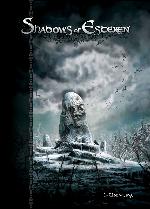
The artwork, first and foremost makes an exceptional beautiful book, as the illustrations create the atmosphere and mood – of something dark yet in the form of lengthening gloom not necessarily post-apocalyptic but of something brewing and brooding just out of the light of civilization. If one had to find a comparison, it is with the HBO series – Game of Thrones (not really the books but the TV series which captured the right elements from the books). There are forces of magic, although not high magic rather elemental magic channeled through quasi-Druids or believers in the one true God. There is also a steampunkish class of “magicians” whose industrial revolution is powered by a quasi-magical substance that allows them to create hitherto unknown wondrous ponderous machines. Strutting side-by-side, one has Bards, Warriors and Wanderers combing the narrow roads that connect thousands of little villages and big cities together – beyond the confines of the towns and tapered roads lays dark forests, murky waters, soaring mountains and raging seas where fierce and terrible monsters (the mysterious Feondas) lie. It is this rich tapestry woven together with lavish beautiful illustrations and splendid purple prose that makes this an exceptionally beautiful and collectible item.
That said, the rules are very light and driven by the atmosphere of the book which is that Game Masters (called Game Leaders) and Players role it, not roll it. If a solution can be found without rolling of dice then both Game Leader and players are encouraged to do so. Thus, things, like interpersonal skills and narration ability are more important than combat. For, indeed, combat is fast and lethal – players attempting to taking down a monster should think twice – this is no D&D kids. That said, the rules are there to support the player, in building a fully rounded character. Like Cubicle 7’s Doctor Who Adventures In Time and Space, players are do not have characteristics but attributes in which they can build personas – which does not detract players from using existing skills in different ways, which is usually when the dice rolling does come into play. Most rolls are solved with the similar mechanic of 1d10 plus attributes against a target number set by the Game Leader. This simple mechanic then applies damage which can be quite surmountable to the player and even the healing can lead to damage taken – for this is very much grounded a real world approach to fantasy – whereby, knowledge is scarce and conditions (of a quasi Celtic Middle Ages) are pretty horrific.
The other thing that is welcome is that well this world is incredibly detailed and rich; there are lots for the Game Leader to fill in with their own creations. Thus, one can do the traditional dungeon crawl type adventure or could choose to the route of dark fantasy of some sort of Passion Play in which twisted fates (romance, insanities, revenge, etc) could all come into play as the players must weave their way through intrigues at minor and major Courts. In many ways this game reminded me of Conspiracy of Shadows but is much more detailed and atmospheric thus owing some of its allegiance to Call of Cthulhu than D&D. I also like the “magic system” basing on druidic, clerical and technological gave the game a stronger background rather than magic as a technology substitute thus giving the game more early Runequest vibe. However, this task may be daunting for many a Game Leader, thus it is appreciated that the creators are committed to a multi-book (and more impressively multimedia) universe with lots of support going to an unfolding universe of products aimed at a slow reveal of the gaming world for players and Game Leaders alike. That said there is enough in this primary book for both to sink their teeth into and go with it. This is a game that very relies upon mutual narration of Game Leader and players – thus, it is not for the timid nor the newbie, it is more for the seasoned group of role players or at least, there must be seasoned veterans in their midst (one of which would have to be the Game Leader).
The Bad
Shadows of Esteren is a weighty tome, both in terms of its page count, but also its language (undoubtedly because it has been translated from French**) has only four considerable chapters, every chapter is then broken down into less significant un-numbered sub-chapters and sections. The first three chapters: Tri-Kazel, Lifestyle, and Factions cover 173 of the 290 pages, and describe the setting. The fourth chapter which explains the game system only encompasses 117 pages.
The writers of the book keep these sections completely detached and watertight, as a result there are no gaming mechanics whatsoever in the first three chapters, it is strictly purple prose. These chapters are also written as a collection of disjointed letters and reports made to a noble. These sections are very enjoyable, and they read like a travel gazetteer. However, they are dense and sometimes leave one wondering how to apply this amount of knowledge. If, were not for the disjointed feeling caused by multiple authorial “voices” then this could be passed off, as a repeat of splat books from the past, but because they are written from a multitude of viewpoints, it reads not like literature or prose but stylistically it is all over the place.
Then, in contrast, the writing in chapter four is a great deal more technical and mechanical in its arrangement, and has very few cultural references, as they were covered in the previous chapters. And, it is this clear separation that is a little problematic. When you reading the purple prose, one is left, wondering how this would be in actual play and the technical writing comes across as very dry.
Thus the first-time reader (as I read through the entire book twice for this review) is both overwhelmed and underwhelmed by the content. If you are the type of Game Leader or player like me who likes to just jump in after a few facts have been established – you are going find it tough to do so. For the game has to be digested slowly, in this, way it is comparable to the unfolding of the World of Darkness campaign, save this introductory text leaves the reader guess more about how to fill in those shadows rather having a great revelation in which they can proceed to construct their own universe. That said, everyone’s gaming universe is bound to be different but I do get a distinct feeling that Agate does want to keep a firm lid on the underlying narrative structure of the universe by purposely keeping Game Leaders and players in the dark about certain aspects of the game. So, I come away thinking that this akin to a jigsaw puzzle except someone else is handing me the pieces one-by-one – luckily the reference picture is so large that one need not feel lost or unhappy that the pieces do not immediately click together. However, I like jigsaw puzzles but I know that not everyone does. However, I do look forward to future releases that will do more unveiling of this rich universe.
The Mechanic
As noted above, when dice do need to be rolled the process is simple and quick with a single d10 utilized and then modified by bonuses or penalties. The result is compared to a difficulty number in order to determine success or failure. It is that simple. The chargen in Shadows of Esteren is one of the best parts of the whole system. Rather than a bunch of the traditional characteristics like Strength, Dexterity, Endurance, etc. characters have five Ways:
Combativeness: This Way is not a measure of your fighting ability but your persistence to fight. Creativity: This is a measure of one’s cunning, ingenuity, and inventiveness Empathy: This metric is a gauge of how attuned your character is to the surroundings that they are in, as well as being perceptive of the needs of others and their emotional well being. Reason: Measures the contemplative or self-reflection based upon judiciousness. Conviction: This Way indicates gauges how strongly the character holds to a set of beliefs or morals.
These Ways are scored one through five and unlike many game systems having a low number is not really a disadvantage. There are advantages and disadvantages of scoring high or low and this Way and the game gives a lot of thought into making the player become conscious who their character is instead of what they are.
Then comes the important question of classes or professions, in which eighteen templates (that could cover almost any conceivable medieval/fantasy professions are included without repeating the familiar trope of Fighter, Thief, Cleric, Magic User along with copious of ways to create your own from either modifying the template or mutual negotiation between Game Leader and player. One’s profession establishes your primary and secondary skill sets and then your character will have enough points devoted to a skill one will also pick up the opportunity to pick out a subsidiary specialty of that skill. The initial skill is called a Domain while the subsidiaries are called Disciplines. Disciplines normally provide an additional bonus. Each Domain is also tied into a Way. As I already mentioned above the system tries to be as diceless as possible so even in that given situation if the player role played well enough the Leader should reward him with success without the die roll.
Furthermore, incorporated in the character’s stat package are Strength, Armor, and Defense – and these are calculated by amalgamating different Ways; Advantages and Disadvantages; Sanity; and Health. For the reason that the focus and vibe of the game is on a grittier and more realistic game world, characters will become superhero/ines on their way to divine ascension. They begin as humble folk, and incrementally get stronger but physically weaker and older as they age, thus very much akin to Traveller than D&D but wiser hence where that is where the experience points get spent in pursuit of mastery of one’s inner attributes not over the worldly domain.
Combat is determined just as any other task in the game with an assortment of combat stances to be used by the character. Just a few dice rolls will on the whole conclude the skirmish and if you are used to D&D, one can suppose that combat on the whole to be a great deal further dangerous and deadly than a traditional fantasy game.
All in all, this is an excellent game and I cannot wait until future products come out to illuminate new areas of the game world. However, in full illuminations, there are bound to be new shadows created. So if you are looking for a low fantasy but incredibly comprehensive and in-depth world with a simple mechanic.
**French is a wonderfully beautiful language but incredibly detailed and sometimes obtuse for even native speakers. And, this is a magnificent translation.

