

 Search
Review of Ticket to Ride Map Collection 1: Asia
Players: 2-5 for Legendary Asia; 4 or 6 for Team Asia
Playing Time: 30-60 minutes
Summary of Components
Ticket to Ride Asia comes with game elements for two new maps: a double-sided map board; two sets of destination cards; 9 extra trains in each of the 5 standard colors (for the Team game); four wooden card holders (also for the Team game); and two full-color rulebooks, each printed in 10 different languages.
You'll need either Ticket to Ride or Ticket to Ride Europe to make use of these bits. (Ticket to Ride Marklin has a weird distribution of cards and Nordic Countries has the wrong-colored trains to use the extra Team-play locomotives, so they aren't included on this list of compatible games).
Quality: Thick boards, sturdy cards, lots of linen-texture, full-color glossy rules, and wooden card holders. What more could you want? 5 out of 5.
Beauty: Days of Wonder has long combined beautiful artwork with top-quality graphic design, and Ticket to Ride Asia is no exception. In fact, if anything it improves on the beauty of previous Ticket to Ride games. The two game boards are particularly stunning, with graphical nuances including Asian-themed score tracks and city icons, plus appropriate line drawings for the two settings ("Legendary" Asia and the more modern Asia that's used for the Team-play map). 5+ out of 5.
Usability: The formula for the usability of the Ticket to Ride games is pretty set, and appears as you'd expect here. That means the board has colored spaces that match up with colored cards--with symbols backing those colors up for the color blind. Meanwhile, tickets describe destinations by not only naming the cities but also depicting them on a shrunk-down map on the card. I actually did have some troubles finding my cities in Team Asia, primarily due to the very large number of cities on the lower half of the map, but that was a minor bump in an otherwise well-designed usability scheme. 5- out of 5.
Theming: The Ticket to Ride games are pretty theme light. They're clearly about building train tracks across a map of some location, but that's as far as the theming extends. Ticket to Ride Asia improves on that a little bit with the increased number of decorations on the map, but that's pretty minor too. 3+ out of 5.
I often don't talk about price, but here I was shocked to see this Map Collection retailing for $30. I expected $40 and think the price offers a great deal.
Overall, Ticket to Ride Asia is a great quality and beautifully produced game. It earns a full "5" out of "5" for Style.
Summary of the Gameplay
Read my Ticket to Ride review for a discussion of the game's core gameplay. What follows is a description of how the individual maps differ.
Legendary Asia: This map has a dense mesh of cities in the south with longer routes only appearing to the north of the board. It also features two special types of track--ferries and double routes--as well as some special rules for tickets.
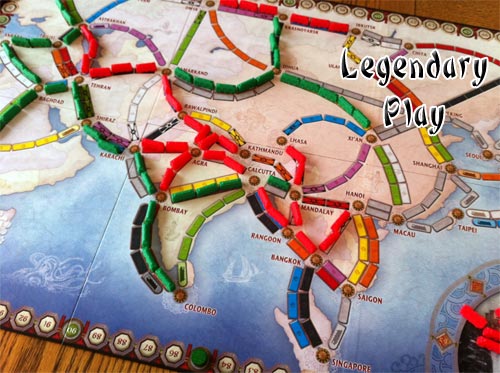
Ferries. These are routes that require one or more locomotives instead of regular, colored cards. They've been seen previously in some of the other Ticket to Ride expansions.
Mountain Routes. These are routes that require you to sacrifice 1 or 2 additional train cars. You get 2 points for each train car you spend, but you'll then have fewer trains to actually complete routes. In the north, some double routes have a gray route on one side and a colored, mountain route on the other. This can add considerable tension to the game, as the first route is pretty easy to play, while the second is more difficult and more costly.
Long Tickets. As in Ticket to Ride Europe, each player gets one "long" destination ticket at the start of the game, while other destination tickets are all drawn from a pile of "short" routes.
Team Asia: This map covers some of the same area as Legendary Asia but is nonetheless totally original. It's got a really tight web of cities to the southeast and another closely connected web running along the west. The only long routes run along the top of the board or around a notable gap in the center. Besides rules for teamplay, this game also features tunnel routes.
Team Play. In this game you always play with a partner, who you sit next to. Each of you gets a supply of 27 trains that are all his own. You'll earn points and win or lose as a team, but you only share about half of your routes and train cards in common. (You actually have to make a decision about which cards to put on your common rack whenever you draw them.) You're also not allowed to talk strategy; you instead have to signal what you're doing through careful play, collection, and usage of cards.
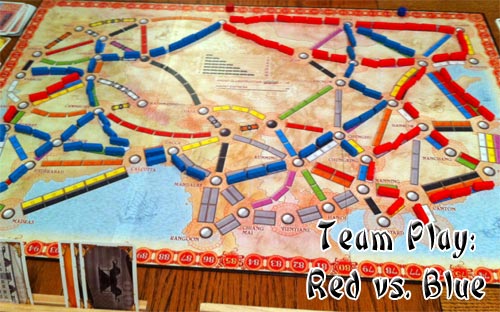
Tunnel Routes. Some routes in this game require you to draw 4-6 cards when you play them, then to pay for any cards that you drew that match the color of cards you were playing. These tunnel routes have been seen in other games, but in previous games you only had to draw 3 cards.
Relationships to Other Games
As already noted, you need either Ticket to Ride or Ticket to Ride Europe to play this game. The two maps in the Asia map represent the sixth and seventh official maps for the Ticket to Ride game, following USA, Europe, Germany, Switzerland, and Nordic Countries.
This new Map Expansion represents a few firsts for the series. To begin with, it's the first of a series of "Map Expansions" which each include two maps. The second, featuring India and a reprint of Switzerland is due out soon. It's also the first game to feature team rules, thanks to Alan Moon's Team Asia map. This marks a notable change for the game. Finally, it features the first official map designed by someone other than Alan Moon, who spearheaded every other Ticket to Ride expansion to date. That's the Legendary Asia map, by Francois Valentyne
The Game Design
Legendary Asia: The main changes in the Legendary Asia game come about from the map. The clutter of small routes to the south can make for some rapid-fire building, while the predominance of colored routes around the edges requires careful card selection. I've already commented that I like the arrangement of double colored/gray routes at the top of the board, which really encourages early buildings.
The ferries have been used in other sets, and as with those sets, they add a little difficulty to some of the routes, and also help to increase the value of locomotives--which were sometimes not sufficiently worthwhile in early Ticket to Ride games.
The mountainous roads, which are the totally new element of this board--requiring the discarding of trains--turned out to make a big difference in gameplay. You have to constantly think about this secondary cost, and really weigh if you want to pay trains instead of taking a different route. On the flipside, if you're trailing other players in train usage, they're a quick way to turn in a couple of trains for bonus points, which can make a difference in a game.
Overall, this is a nice board, which will be fun to play for those who have played too much on their gameboard of choice, but its main advantage comes from that--not from a radically different view of the game (though mountainous roads do change things somewhat). I've given it "4" out of "5" for Substance.
Team Asia: Quite simply, Team Asia is the best version of Ticket to Ride that I've ever played, and I've always been a fan of the game. The heart of Ticket to Ride has always been (for me) tension. You worry about whether you can get the cards you want and the routes you want. Team Asia just ratchets that up, as you have to put part of your fate into the hands of your partner, who doesn't even have all the information that he needs to make good decisions.
As a result, communication becomes a very crucial skill. You're not actually allowed to communicate strategy, but as you place some cards in your hands and others in your common tray, as you take certain routes and build toward certain locations, you can try to express what you're doing and what you want your partner to do.
The end result, combining limited information, non-verbal signaling, and cooperative play is entirely delightful. My first try at Team play was literally my favorite game of Ticket to Ride ever.
With that said, the limited communication aspect can be troublesome. Is communication so limited that you can't even make strategic suggestions that wouldn't require knowledge of your own cards? What do you do if a team of players come up with a system for placing cards on their trays, which distinguishes which ones an individual wants to use and which can be jointly used? I think that you need to have players that you trust to play fairly and that you need to really clarify the rules beforehand.
Beyond that, the map is interesting and once more plays differently from others to date. It's nice to have the tunnels, so that Team Asia includes another aspect that slightly different from most other boards. But, it's the team-play that's really the heart of Team Asia, and it's a home run. I've thus given Team Asia a "5+" out of "5" for Substance.
Overall, I give Ticket to Ride Asia a full "5" out of "5" for Substance, as it combines a very good map with a superb one.
Conclusion
Ticket to Ride Asia offers two new and varied maps which will add some nice variety to your Ticket to Ride play. It's well worthwhile just on that basis, given the very reasonable price point. However, Ticket to Ride Asia really knocks things out of the park with its "Team Asia" rules, which allow you to play as partners for 4-player or 6-player games. The result is one of the most enjoyable, stressful, and innovative ways to play Ticket to Ride since the release of the original game.

