

 Search
Review of Zanziar: A Game of Courage, Wisdom and Deceit
The Game In a Nutshell
"In Zanziar, mighty heroes roam the lands of Zanziar to regain their throne of power. The charismatic heroes guide their allied adventurers and armies through battles, adventures, and events to the victory: the domination of the lands of Zanziar."
Five years in the making, Dragon Dawn's Zanziar marries elements of roleplaying and wargaming, taking equal design cues from '80s vintage Avalon Hill and modern competitors like Fantasy Flight. The prevelance of RPG elements is no accident -- author Timo Multamäki originally developed the world of Zanziar for the Rolemaster-based Dor Amarth back in the '90s, and has been fine-tuning the setting ever since.
Since its release in 2008, Zanziar has picked up a small but devoted following; all the while, Dragon Dawn have been pushing hard to increase its audience, steadily revising the core rules while preparing Danish, German, Russian, and even Chinese translations. Does Zanziar have the goods to make the jump from cult classic to gaming mainstream? Let's find out.
Style: The Components
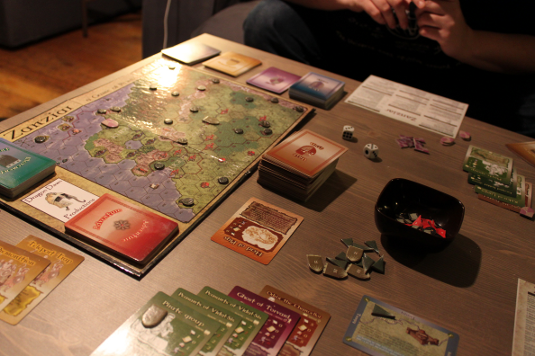
For a small press board game, Zanziar definitely boasts above-average production values. The physical quality of the components is good, if not entirely consistent; the main reference sheets are printed on textured cardboard, while the (apparently fan-made) supplementary sheets are just laminated paper and the setup example doesn't even bother with the lamination. Cards are glossy stock, which looks nice but bends just a little too easy for my liking; one good shuffle, and some of them already seemed a little bowed. The cardboard chits -- used to track control, adventure groups, health, magic, and more -- are easily the best of the lot: thick and attractively printed, with some of the game's best artwork.
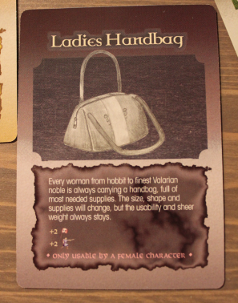
Speaking of art, Zanziar does have a lot of it, primarily pencil illustrations. It's actually quite characterful for the most part, but I can't shake a sneaking suspicion that most of these pieces were originally drafted for the Zanziar RPG -- some of the artwork just doesn't jibe with the descriptions.
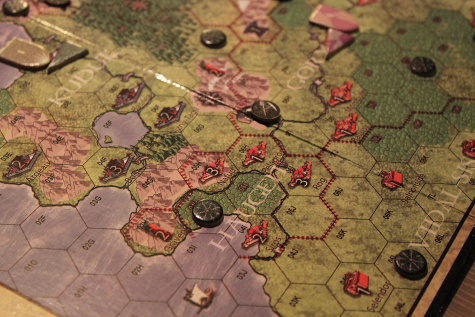 | |
However, there are some definite design issues. First and foremost is the board itself, almost astonishingly small for what's at least intended to be a six-player game. The actual map is only 9 1/2 by 12 1/2 inches, and all of those chits and counters are sized to match -- in other words, scarily tiny. (The remainder of the space is given over to stacks for the Adventure and Movement cards, but there's nothing for the equally-important Items and Units. It's odd to say the least.) I'm also not a huge fan of the actual map image, which looks like it was pulled raw and bleeding from Campaign Cartographer; it does the job, but key gameplay features like bridges and rivers are difficult to see at a distance and the hex coordinates keep blending into the background.
And that brings us to a recurring problem with Zanziar: layout and typography. For the most part, it's serviceable stuff, but from rulebook to reference cards, there's all the usual sins of a not-quite-professional hand at the wheel: images in the backgrounds of text boxes and tables, schizophrenic mixtures of serif and sans serif fonts, inconsistent spacing and content arrangement.
With respect to its small-press origins, I'd give Zanziar a Style rating of 3.5, rounded up to 4 for RPG.net purposes.
Substance: Rules and Gameplay
In Zanziar, players slip into the fur-lined boots of one of eleven heroes. Each comes with a back story, a brace of abilities, and their own unique objectives: Warchief Shuragub of the Orcs, for example, has to destroy ten points' worth of magical items, control four cities, and take over two mines to win the game.
To help you meet those goals, you can recruit up to three adventuring parties, consisting of one to five units apiece. Each unit is rated in four areas:
- Diplomacy is used to recruit new units, or avoid battles.
- Magic determines the effectiveness of your spellcasting attempts.
- Con is used to recruit units, persuade enemies to join you, and locate treasure.
- Combat is your fighting effectiveness, and doubles as your Hit Points/Life.
On top of this, each unit has one or more abilities that affect its performance in combat. Kudukian Peasants, for instance, gain +1 to their Combat skill while battling inside the borders of Kuduk, while the Legions of Gory will refuse to fight fellow Legionnaires.
These special rules do an excellent job of giving each unit its individual flavor, but in practice, they tend to be a bit overwhelming. The first reason for this is sheer quantity: a unit of 5 adventurers can easily have 10 or 12 abilities to keep track of. The second reason: the conditions required to trigger an ability can get pretty damned esoteric. Take the Mogba Tribe: they gain +4 Combat if they are standing in a forest hex in Haugen. Haideknut's Blackriders get +1 Combat if they are led by a Norri, but -2 Combat if they are actually facing Norri opponents. Extreme examples, but this is the kind of book-keeping you'll be faced with as you make your way across Zanziar.
To give your team a little extra punch, you'll also be given Item and Whenever cards. Item cards are about what you'd expect from a fantasy game, running the gamut from enchanted weapons to chainmail armor; the majority of them improve your skills or give you a one-off benefit. Whenever cards, meanwhile, might as well be called "Whatever cards" -- effects include teleport traps, epidemics, random reinforcements, and even unit swaps, all of which can be called on -- you guessed it! -- whenever you choose.
So now that you have your adventurers recruited and ready, what do you do with them? Zanziar has several locations of interest:
Cities allow players to draft additional Units or obtain Items. Both of these involve rolling a six-sided dice, adding the result to your Con or Diplomacy scores, and checking the results against the appropriate table; additional modifiers may also be involved. Some goals require you to control cities -- to accomplish this, you will first have to defeat or convert the city's garrison, then keep at least one friendly Unit garrisoned there after your party rolls out of town.
Mines are primarily used to gain Items, although some goals require you to control them. Unlike Cities, Mines have no garrison or defenders; you simply stroll up, claim them, and hope nobody else does the same after you leave. However, certain mines harbor treacherous Green Ore that damages your party, making Mine-hunting a bit of a toss-up.
Adventure Locations are dotted around the map, and allow you to draw cards from the Adventure deck. Each adventure has Diplomacy, Magic, Con, and Combat values; pick the one your hero is best at, roll a d6, and add your stat to the total. If you beat the adventure's value by 1 or more points, you are victorious and gain one random Item in addition to whatever reward the Adventure card dishes out. Fail, and you'll suffer a particular penalty.
To move around from location to location, select a hex within moving distance, then draw a card from the Movement deck and resolve its effects. Sometimes, nothing happens; in this case, you complete your movement as scheduled. Other times, you'll throw up random events that make your journey more complicated than expected -- rainy weather that reduces your movement or combat ability, bouts of disease, disorienting fog, wolf attacks.
 | |
Combat, inevitable as it is, is an interesting beast. Both sides begin by organising their units into three "rows" -- Magic, Con, and Combat -- and then proceed to face off. The attacker's Magic row strikes first, followed by the defender's Magic row and the attacker and defender's Con rows. Finally, the Combat rows strike simultaneously.
Attacks are resolved by both sides rolling a die and adding their relevant skills -- Magic, Con, or Combat. If the attacker beats the defender, the defending units take damage equal to the difference in scores; in the Combat row, whichever side has the highest score carries the advantage.
If the fighting is going south in a hurry, either group can choose to flee. In this case, you roll a die and remove that many cards (Units and/or Items) from the fight -- everything else is discarded. For most groups, this makes retreating an option of absolute last resort.
And that's Zanziar in a nutshell: rove around, recruit allies, beat up your foes, collect treasure, and jockey for dominance. The game ends when one player has succeeded in completing two of their objectives, uniting the Staff of Wyrmandalus (obtained by drawing all seven pieces from the Items stack or stealing them off of other players), or wiping out the competition.
How does it score, then?
Deciding on a Substance value has probably been the hardest part of this review. I definitely want to give the game a fair shake, but after several sessions, I have to admit that it's really not my cup of tea -- there's just too many things that prevent me from really getting on board with Zanziar. The biggest ones:
Complicated, Not Complex: At its core, Zanziar is actually a pretty simple little game. It helps that the rules are relatively consistent throughout, using the same resolution mechanic (d6 + skill) for most major gameplay actions. However, between Items, Unit and Hero abilities, lingering Movement effects, and Anywhere cards, there are a lot of little minutae to keep track of. Some players might enjoy the level of detail involved, but I kept wishing for a slightly more streamlined approach -- say, limiting Units to one clearly defined special ability apiece -- to avoid having to re-read all of my Unit cards before every movement or combat in case I was missing a bonus or penalty somewhere.
 | |
A Game of (Too Much) Chance: Zanziar isn't a game you play if you want predictability. Starting characters, starting positions, items, units, adventures, goals, even your ability to move from one point to another unmolested -- almost everything is settled by random draw. In some respects, this actually works -- the Movement cards, for instance, give you a lot of the whole "epic journey fraught with unexpected encounters" flavor without the need to introduce dozens of tables and special rules.
Thing is, this approach can do a real number on game balance. Take hero goals: some require you to annex an entire country, which takes a fair bit of military power, several turns, and a lot of indulgence from your opponents. Others, however, just require you to draw a specific Item or Unit from the stack.
And here's where it gets problematic. On our second ever game, my opponent drew Simma the Prophet -- a character with absolutely terrible stats, but three relatively easy goals: get one Hobbit/Dwarf unit, try three Adventures, and control two small towns and a mine. She drew Escaped Hobbit Slaves in her opening hand and rolled a small town for her starting location, meaning she'd basically completed one-and-a-third of her two required goals before the game had even started. Meanwhile, I had to annex four specific cities, take two mines, or have at least two Dwarven-made items in my possession, and was starting from scratch in doing so. Needless to say, I lost by a landslide.
This might be less of an issue with a larger group, where players can gang up to take out a character like Simma within a few turns. Certainly, with a good enough hand of starting units, you can do serious damage almost immediately, which brings me to my next point...
Win by the Sword, Lose by the Sword: Simply pursuing your own goals isn't enough -- eventually, you'll need to go after your opponents, too. And here Zanziar can be pretty brutal, even with the safeguards Dragon Dawn built into the rules. The escape rules allow you to always save your hero if he or she survives at least one round of combat, but the number of Items and Units you'll pay for a botched escape attempt are tremendous. Moving around opponent's adventuring groups doesn't always work, either, since an unlucky Movement card can leave you stranded or within easy striking distance.
Finally, if two or more players decide to team up to take out a weaker opponent, there isn't a hell of a lot that third player can do save his skin unless he's sitting at the head of a massively superior force. Even if you don't kill an opponent outright, simple attrition can often do the job for you -- replacing lost units is easy if you have a high Diplomacy or Con, but heroes who specialise in Magic or Combat will have a hard time finding new comrades to re-fill their ranks.
To me, this aspect of Zanziar is probably the least appealing. The games I enjoy playing -- European and Euro-style designs -- generally have limited ability to harm or disrupt another player, forcing you to focus on your own strategies instead. Even more confrontational titles like Smallworld don't give players the ability to knock somebody out of the game entirely. I'm not going to call it a bad design choice, but it's definitely one that didn't sit quite right with me.
Word Salad: In the end, however, what really deep-sixed our group's enthuasism for Zanziar was the editing. We started off with the v6.1 rulebook, which didn't really do the game any favors thanks to some almost aggressively counterintuitive organisation. For instance, while there's a list of Zanziar's markers on page 7, you don't actually get images and explanations of those markers until page 25. Page 27 explains what each map hex represents -- a good ten pages after the movement rules that actually reference this information. Game setup rules are followed by three pages of biographies, then dip back into explaining skills and stats. Page 21 offers "examples on certain points" -- an incoherent sample battle that's delivered before any of the salient rules of combat have actually been explained.
And then there was the stuff that's flat-out wrong or missing. Remember Warchief Shuragub? Remember how he's supposed to destroy 10 points of magical items? The rules never actually get around to telling you how that works. Need to find out what happens when you fumble Cure Plague? Good luck -- that information accidentally got merged with the Curse fumbles so you only have half the results for both spells. The starting cities table refer to a city (Angmar) that doesn't actually exist on the game board.
To their credit, Dragon Dawn have been appropriately proactive in addressing these problems via updated rulebooks, FAQs, and errata posted to the game's official website, zanziar.org. But the shaky editing also carries over onto the game board (one of the cities is missing size information entirely, another contradicts the information on its summary card) and the numerous cards, whose rule text is more vague than helpful. Deinrick the Dragonmaster takes half damage from "Dragon Magic". So what's "Dragon Magic"? Does it, say, include the damage you'd take if you fail a Magic challenge in the Female Dragon's Lair? The Whenever card "Enchanted Forest" has a 50-50 chance of trapping one of your units in a forest hex, which seems like something you'd want to play on an opponent -- except the card doesn't actually say you can. Then there's odd bit of genuinely cryptic language: "No revolts can take place in here due roll of 1"?
For five years of development, you would expect a little better.
In the end, I've settled on giving Zanziar a substance of '3'. It's not a terrible game, but it's definitely a flawed one; try as might, I could never quite work up enough enthusiasm to overlook that fact.
Conclusion
A quirky, Tolkien-inspired hybrid of fantasy RPG and wargame, Zanziar is your classic small-press labor of love. Players willing to overlook its rougher edges may find a fair bit to enjoy; unfortunately, I wasn't one of them.
Where To Buy It
Zanziar is currently available at a number of Finnish retailers. International buyers can grab the game directly from Dragon Dawn Productions at zanziar.org for 30 Euros.

