

 Search
Review of Blood Sacrifice: The Thaumaturgy Companion
 Goto [ Index ] |
Blood Sacrifice The Thaumaturgy Companion is a ‘Source of Magical Knowledge for Vampire: the Masquerade’. Blood Sacrifice describes 4 styles of Thaumaturgy, distinct from that of the Tremere. Each of the 4 chapters starts with background information, including the origin, history, and mystical arts. Then the chapter describes the style’s game mechanics, including 3 new paths and a series of new rituals. There is also an appendix for Storyteller eyes only.
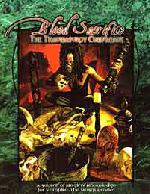
Physically, the book is a standard softcover rpg supplement. In general, I dislike the artwork prevalent in World of Darkness books. However, the cover of Blood Sacrifice is very well done. The interior art, like usual, is a series black and white indistinct smudges, which successfully takes up space. One slight annoyance is an illusion arising from the drawn borders of the pages. The two borders between adjacent pages merge into an apparent floating curved line in my peripheral vision. This distracted me from what I was reading at times. If you can’t see Magic Eye scenes, you’re probably immune. The layout of the chapters is clear and well defined. Each chapter is in essence a mini-sourcebook, and all 4 chapters follow the same layout. Thus the book is easily accessible when you want to reference something quickly, as sometimes happens during a scene.
Chapter 1: Akhu: The Divine Image
This chapter covers the blood sorcery of ancient Egypt. Akhu is mostly performed by the Followers of Set. The background information is broad, interesting, and full of facts. The three new paths are the Divine Hand (sympathetic magic), Path of Duar (Egyptian netherworld), and Ushabti (animated figurines). The paths are well described, with interesting effects. The rituals result in magical items, such as potions, amulets, and even the creation of a mummy. Akhu is thematically consistent and an intriguing alternative for Settites.
Chapter 2: Dur-An-Ki: The Demon-Haunted World
This chapter covers the blood sorcery of Middle Eastern vampires. Like the first chapter, the background is a wealth of information. The three new paths are Covenant of Nergal (disease), The Evil Eye (curses), and the Music of the Spheres (songs related to the planets). The rituals cover healing, divination, curses, and even time travel! While Dur-An-Ki is a good fit for Assamites, it need not be limited to them.
Chapter 3: Sadhana: A Meditation Upon Blood
This chapter covers the blood sorcery of the mystics of India. Again, the chapter provides much useful background information. The three new paths are The Path of the Blood Nectar (confer a Discipline upon another), Path of Karma (knowledge of past and future), and Path of Praapti (teleportation). The rituals are related to illusions, fire, possession, and even the ability to edit part of the world out of history and existence.
Chapter 4: Wanga: Legacy of the Caribbean
This chapter covers the blood sorcery of the voodoo-related religions of the Caribbean and South America. Have I mentioned how full the background information of each and every chapter is? This chapter succeeds just like the previous 3. The three new paths are the Flow of Ashe (draw power from sources other than vitae), Orisha’s Fortune (manipulate luck), and Voice of the Wild (animalism). The rituals cover boons and curses, and magical items related to them. Of the 4 new styles of blood sorcery, Wanga is the least-developed, as it is similar to other thaumaturgy, and is the other side of the coin from Necromancy.
Appendix: Mysterious Ways
This section is for Storytellers. It covers a few new rituals for magic described in Blood Magic: Secrets of Thaumaturgy. Then it describes, in abbreviated form, a new bloodline, the Tlacique, who are the few remaining survivors of the followers of Tezcatlipoca, the Jaguar, from ancient Central America. Finally, 3 spontaneous talismans are tacked onto the end of the appendix. Unlike the cohesiveness of the rest of the book, the Appendix is a hodge-podge of Storyteller material, whose only underlying principle is a relation to alternative blood sorcery.
Overall, Blood Sacrifice is an excellent sourcebook. It makes a strong point about how these are religions, and handles the dissonance a religion may cause with a Kindred. Much research has been done into the historical background of each of the religions and mystical practices. I must point out that the information given is an overview. It allows for the player to have a feel for where it comes from, and choose the right trappings for their blood sorcery, be it sand of the Nile, or the right loa to beseech for a ritual. Each piece of information it gives can also be used as a starting point for the player or Storyteller to research in detail. Thus, this sourcebook is great because it is full of reference material for the game, and directs those wanting to get more involved in a specific one of the styles. The new paths and rituals are flavored by their respective themes, but not overpowered or unbalancing. The only part of the book with limited use is the specific Storyteller appendix. Those 12 pages could have been better used to either flesh out Tlacique into its own chapter, or expand the other chapters.
Blood Sacrifice is a worthy addition to any Vampire: the Masquerade bookshelf. It is one of the better sourcebooks in the World of Darkness.

