

 Search
Review Editing
Review of Star Riders
 Goto [ Index ] |
Star Riders is one of those games, like Paranoia or Macho Women with Guns, that when you first open it, you groan in disgust for the first couple of pages. And then, depending on your sense of humor, you keep reading.
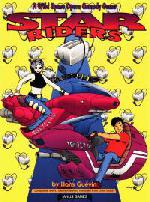
Featuring a cover with two people atop futuristic hover-cycles against toaster-covered yellow wallpaper, Star Riders is a roleplaying game nominally compatible with Teenagers From Outer Space, but completely playable as a stand-alone game. The premise is simple: characters are kids (human or otherwise) away from earth attending college. While they're away, the earth is "accidentally" plucked from its orbit and misplaced somewhere in Unknown Space. It's up to the characters, called Star Riders, to find their way back home.
It's all pretty absurd, but the book makes no pretensions otherwise. Characters can be several different types: Humans, Very Near Human, Not Very Near Human, and Real Weirdies. The human-o-meter approach is important because humans have an advantage over aliens in that they are admired as the "coolest" species in the galaxy. Of course, humans don't get alien powers, but when Real Weirdies stand back in awe when you enter a room, who needs to shapechange?
There are eight game statistics: Smarts, Bod, Relationship with Pals (RWP), Luck, Driving, Looks, Cool, and "Bonks." Most of the stats are self-explanatory, though RWP covers how well you get along with other races, and Bonks are the rough equivalent of hit points. Each characteristic is assigned a value of one to six, rolled on a six-sided die. After rolling the stats, players are allowed to move points from one statistic to another as long as the values remain between one and six.
Success in a skill is determined simply by rolling a die and adding the appropriate skill. If the roll is higher than a target number, the character is successful. Characters can compare skill rolls against other characters' rolls to determine who wins a conflict.
Bonks work differently than hit points only in the sense that no real damage is done to characters-they can only be knocked out (see stars and circles) for several rounds. The author reinforces the idea of nonlethal play by listing guns that do no damage whatsoever (except for perhaps tearing off a shirt or two).
In addition to the basic stats, players roll one to six "Knacks." Players may choose several Knacks at lower levels or put more points into fewer knacks. The knacks are amusing, if not always useful: "Dazzling Smile," and "Get A Killer Tan" are a couple examples; "Repair Hyperdive" is another.
The book goes on to list alien powers, mundane powers ("filthy rich"), ships ("shapeless box"), miscellaneous equipment ("MegaPlus(TM) Bang! Gotcha(TM) Cannon"), planets ("Megalopolopolis"), and sample aliens (the ubiquitous "Toasters").
Also included are referee tips, sample characters and a set of brief, amusing adventure sketches.
Insubstantial is probably the best word to describe Star Riders, and I have a feeling the author wouldn't disagree with me. It promises fastpaced silliness that players will no doubt forget as soon as they're done playing. This isn't necessarily a bad thing, but Star Riders suffers some of the same difficulties that Paranoia does, in that a humorous campaign is hard to sustain.
But that's not the point. Mr. Guevin has created a quick, fluff-filled pick-up game that leaves room for plenty of nonsense.

