

 Search
Review of Bureau 13: Stalking the Night Fantastic
 Goto [ Index ] |
1: Being A Brief Introduction Of Our Reviewer, And An Overview Of The Game
Hi, I'm Ed McEneely, and I'm new to this.
Since I think it's only fair that a reviewer share his background and biases with the readers of his review. So, to begin: I've been gaming for the past six years, beginning on the second-edition of the now defunct West End Games Star Wars roleplaying game, which is still the yardstick by which I tend to judge the other games I've enjoyed. To me, Star Wars was easy to learn, fun to play, and one of the few games whose combat system wasn't overly cumbersome and had roughly the right amount of detail for the genre it depicted. The D6 system is probably my favorite "cinematic" engine, since the die-code method of qualifying everything leaves just enough room for pseudoscientific vagueness. At the other end of the scale, I prefer GURPS with its plethora of numbers and (excessively)-detailed vehicle and equipment rules for running gritty modern-day or "hard science" games, and because I bought the darn thing, D&D3 is the game system I'd use for Fantasy gaming. (I haven't really played any fantasy games aside from Changeling , and it was a bad experience.) I also enjoy Conspiracy X , for a more action-movie-esque approach to conspiracy games, and when I'm slumming, I play Rifts . Hopefully, this should enable the reader to understand my frame of reference a little better than he might have by assuming me to be a somehow unbiased reporter. Now, on to the game.
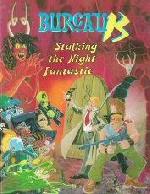
"Stalking the Night Fantastic is a role playing game of fantastic encounters with the supernatural in modern times." This premise is considerably more familiar to a gamer now---with the X-Files and the slew of RPGs it has in one way or another influenced---than it might have been when the first edition of the game was published in the nineteen-eighties. A certain amount of inspiration was certainly gleaned from other sources (indeed, there is a page-and-a-half of inspirations listed at the end of the book), but to my knowledge, the game's concept proper was a new one. In it, the players play agents of Bureau 13, the secret thirteenth bureau of the Department of Justice, operating under orders to locate, contain, cover-up, or destroy the supernatural without panicking the citizenry or causing large amounts of collateral damage. It's written in a tone that ranges from rather humourous to extremely terse, and it's copiously (if not well)-illustrated.
2: Being A Discourse Upon The Setting, Tone, And Writing Of The Game I find the way a game is written to be very important; since the amount of time I spend reading is, sadly, much greater than the time I spend playing it, I want to be able to enjoy it. The writing of the rules helps to set the tone of the game. Unfortunately, Bureau 13 is a game that isn't quite sure what it wants to be. Many of the passages are quite humourous, but all too-often (especially in the write-up for "bad guy" NPCs), they sacrifice the quality of the information given for a chance at a few glib remarks. This is especially true in the write-up of Goshnar of the Twelve Mouths, a psuedo-Lovecraftian alien god-type-thingy, who has no description provided of his appearence, a mere two sentences explaining how his spawn are created, no statistics for using him or his brood in the game, no information on his short-term goals, and no information on how to use him in an adventure. Out of thirteen Enemy write-ups, only two show any real promise. One, Senator Thurston Webber, is useful in any conspiracy or occult-conspiracy themed game, and the other, The Right Reverand Artemus Rotwood, could make for a genuinely terrifying adversary if run properly (and with slight a name change, so as not to spoil the surprise with his Restoration Comedy-style last name). The humor issue aside (and I will give them credit for at least not taking themselves too seriously), there are a large number of typos, punctuation errors, general poor layout choices, and simple misspellings, even more so than in this review. Furthermore, the book contains a total of only twenty-one pages of background, five of which are essentially equipment lists for Bureau "care packages", and a grand total of only four pages dealing directly with Bureau 13, which do actually contain useful information on what Bureau Agent are paid, who cleans up the mess, what happens when players decide to "jump the fence" as it were, and various minor details of tradecraft. One thing I especially liked is the reminder that blowing stuff up will get the PCs in trouble, and that GMs should always have a way to win that doesn't require the application of brute force. Unfortunately, there's nowhere near enough information, especially in comparison with, say, Delta Green , which has over four pages of information on key NPCs alone.
3: Being An Examination Of The Rules, As It Were Bureau 13 has a character creation system halfways between the worst aspects of Rolemaster and Rifts, with skill ranks that grant you +5% to a percentile roll per rank, an ungodly number of attributes to roll up (which, the book tells us in no uncertain terms Never To Re-Roll, No Matter How Bad They Were, On Pain Of Death), and an extremely confusing section on skills. Personally, I hate systems that give me little to no control over my character's attributes, because I enjoy playing certain types of characters, and usually buy a game because it gives me an idea for a character that I want to try out. The combat system, on the other hand, is incredible. That's not necessarily a good thing, but it is the most chart-heavy and complicated thing I've ever seen. It has tables for hydrostatic shock, a listing of major organs, how much damage will break the major bones in the hit area, what those bones are... For a game with a serious emphasis on stark horror and grittiness, this is a good system, and it discourages even tough PCs from fighting. It doesn't go with the tone of the writing very well, though; fortunately, an alternate and fairly cinematic quick-resolution system is also provided for those GMs who don't like to get bogged down in rolling on charts and explaining what happens to the PCs. ("Okay, Warren, a lucky shot clipped your skull. You're down, with [roll, roll, roll] eleven fragments of bone in your [roll] left lobe. Jeff, you take a slug to the chest. Break out a new character sheet. Tim, you trip, breaking a toe. You pass out from the pain, Mr. One-HP.") The rules for firearms are also overly detailed, which rather ties into the lengthy hit-charts. A lot of the game seems to revolve around tables; from the mother of all random encounter tables (starring God Almighty, Evil Food, and Hoaxes, along with four flavors of vampire, four fun styles of zombie, etc.), to the psi heredity table (hope Grandma was psychic, it improves your chances by +4%!) and the Military rank table to the Prayer Result Table. In an odd way, the system is strangely attractive to me; I think in the hands of a GM who knew the system well, it would be a great system to play in, but I wouldn't recommend running it for people who aren't comfortable with large charts and actuarial tables.
4: Being The Summing Of Up, And My Final Thoughts Bureau 13 is a good game that tries to do too much with too little. With a different system (say, Ghostbusters ), it would be a great comedy-horror RPG. With a better background, slightly more polished editing, better layout and expanded and revised NPC info, it would be a masterful Conspiracy-Horror game. As it stands, however, Bureau 13 tries to do too much with too little; 190 pages is dangerously close to the length of a typical sourcebook these days, and between its chart-reliant rules and encounter table (which should really just be scrapped; I'd settle for a qaurter of the entries if the information was better), most of that space is somewhat misused. If I were going to play a conpsiracy RPG tomorrow, I'd probably use Conspiracy X ; if I was the sort of person who wanted to fill a framework with a background of my own making and had a lot of free time to fix things, I might be inclined to play Bureau 13 . Despite all of that, however, I still like the game; it's not abysmal, and it has a lot of neat ideas.
To be honest, I'm not even sure if the game is still in print; I haven't heard anything about it recently, and the copyright date is 1992.
So there you have it. My first attempt at a review. Any criticism, compliments, or suggestions you might care to offer would be appreciated.
Style: 3 (Average)Substance: 3 (Average)

