

 Search
Review of Beyond Science: A Guide to FX
 Goto [ Index ] |
Even in death, there can be signs of hope. I know that seems a pretentious statement to make even under the right circumstances, never mind when reviewing a product bearing the motto "Kick Ass. Takes Names" on its back cover. Pretentious or not, it's somewhat apt, as I hope you'll see.
Beyond Science: A Guide to FX is a supplement for Wizards of the Coast's soon-to-be-defunct SF RPG, Alternity. Covering the realms of the impossible and the unexplained, Beyond Science expands upon the meager FX rules included in the Alternity core books. Put simply, FX (short for "special effects") are special abilities, like magic, divine favors, and super powers. In its effort to become a truly generic science fiction roleplaying game, the creators of Alternity touted FX as a simple system into which a variety of different effects could be plugged. The advantage of such an approach is that, in theory, it allows for endless expansion while maintaining a single underlying mechanic, thereby eliminating the need for new rules every time a new power or device is introduced into the game. While Beyond Science's reach exceeds its grasp, it points the way to the future in an encouraging way.
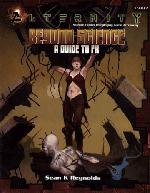
Physically, Beyond Science is much like other Alternity rules supplements, with an attractive full-color cover that contrasts markedly with its drab interiors. Thankfully, the black, white, and sepia chosen for the interior pages don't impede legibility, which can be a problem when a small dash of color is added to an otherwise simple layout (witness some of Last Unicorn's Star Trek books for a bad example of this). The interior art is decent but largely uninspiring. Most of it is also quite small in size, which probably diminishes its impact on the reader.
The text of the book consists of seven chapters and sundry appendices and charts. The first chapter covers rules, expanding on the FX system presented in the Alternity rules without invalidating them. Indeed, one of the nicest things about this chapter – and Alternity in general – is how remarkably consistent a rules system it is. While there's no question that some of its design choices (like the use of so many polyhedral dice) are questionable, I can't find fault with its overall execution. Alternity is a very stable, if cinematic, rules system whose expansions to date fit nicely within its framework. A gamer who understands Alternity will have no problem adding these FX rules to his game, as they expand upon the basic rules in a logical fashion.
The second chapter offers a few pages of advice on how to integrate FX into an Alternity game, along with several examples. I'm always pleased to see chapters like this in any game, but I'm especially pleased to see it in supplementary rulebooks like Beyond Science. RPGs need to provide more examples to neophytes if they're to succeed. Nevertheless, I must report that the advice offered here is much less than is warranted by a subject as wide-ranging and potentially chaotic as FX. Beyond Science would have been a much stronger book had it doubled or even tripled the mere 5 pages devoted to using FX in a campaign.
Chapter 3 describes "Arcane Magic," including examples as diverse as diabolism, mesmerism, and pyromancy. Each school of magic encompasses several different skills (or spells), as well as a brief discussion of the school's philosophy and source of power. Chapter 4 does the same thing for "Faith," showing how druidism, monotheism, and voodoo differ from one another (among others). Once again, each faith gets several FX skills and a treatment of its worldview. Chapter 5 gives "Super Powers" the same treatment. Overall, these chapters offer a decent sampling of the types of FX one could include in each category. However, they're only samplings and I suspect many Alternity players will find them somewhat unsatisfying as a result. I can't blame them, but, with only 96 pages, there's only so much that could be included, even the dense pages of Beyond Science.
Chapter 6 includes "FX Creatures." Everything from angels to ghosts to golems is detailed, complete with Alternity stats for them. Again, I'd have liked to see more than were included, but the author does a decent job of categorizing these creatures (e.g. demon, spirit, construct, etc.) and offering representative samples in each category. Chapter 7 is an exceptionally short one describing "FX Devices" and how to create them. We get a few examples of these devices, none of which have much flavor. To be fair, however, the focus of the chapter is on giving the GM the tools he needs to create his own FX Devices under the Alternity rules. That only a short chapter is required is in this respect a blessing. The supplement ends with (once more) a brief appendix that offers guidelines for creating new FX powers and skills beyond those included in the book.
It'd be easy to be disappointed by Beyond Science, since it doesn't cover its subject matter as thoroughly as one might hope. Of course, that's not really the point. I doubt the author ever intended the supplement to be an exhaustive treatment of supernatural abilities in the Alternity game. Rather, it appears to be a lengthy collection of examples, showing how the basic FX rules can be expanded upon and adapted to cover a wide variety of circumstances. In that respect, it succeeds admirably. The basic FX rules, while clear enough, provided few enough examples that a beginning (or even experienced) GM might quail at the prospect of having to adapt them to his own campaign without further illustration. Beyond Science provides that illustration in spades – all the while holding true to the simple core mechanics of Alternity. That's quite an accomplishment.
Sadly, Alternity is dead, "completed" by WotC at the conclusion of this year and remaining in print only as long as there is demand for the game. On many occasions, spokespeople from WotC have indicated that Alternity was a "dry run" for its D20 system, to be used in Dungeons & Dragons and Star Wars (as well as others – if rumors are to be believed). The simplicity of Alternity's single core mechanic obviates the needs for layers upon layers of Byzantine rules, each with its own logic and exceptions. I'm very much in favor of that. If WotC learned anything from its experiences with Alternity, I hope it's this. Knowing what I know about Third Edition D&D, it's safe to say WotC has learned this lesson well.
As sorry as I am to see the first generic SF RPG in years die only two years after its release, books like Beyond Science suggest to me that something like D20 might well be capable of adapting itself to other genres well enough to be a viable "skeleton" on which to build several game lines. Only the future will tell whether I'm being hopelessly optimistic or not.
Style: 3 (Average)Substance: 4 (Meaty)

