

 Search
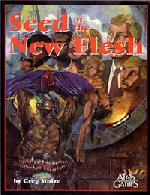
Review of Seed of the New Flesh
 Goto [ Index ] |
Near-future dystopian worlds are nothing new--science fiction readers, movie-goers, and gamers have libraries filled with dystopian settings to choose from--but what makes this one stand out is how the very existance of it is explained within the context of the game. I am simplifying here, but it comes down to this: without the Architect's control of the world's feng shui, none of this is possible.
This explanation performs four functions. First, it demonstrates to the reader just how important feng shui sites are. Second, it makes it easy to understand how the Architects established and maintain the extreme level of control that they possess. Third, it points out to the reader where the Architects are vulnerable- and where to attack. Finally, it explains the obscene stats for the two leaders of this nightmare future.
So, what's so bad about this future? This is a world where many of the ideals of our era--equality, security, and peace--became parodies due to the means by which the Architects achieved and maintain them. Sure, there's world peace- but it's the peace of the gun. When the UN created the Bureau of Tactical Management ("Buro"), it created the core of a standing army that became the instrument of world conquest. The globe is a police state that lies somewhere between Animal Farm, Brave New World, and 1984 in the general level of oppresiveness. After all of the world's private firearms became illegal, the Buro banned all weapons- include bare hands; all martial arts are illegal.
Sure, there's stability- but it's the stability of a hive. There is no free media of any kind, unless you count the free advertising channel. Not only is there no freedom of expression, but there is no free TV or radio either- if you watch anything other than ads, you pay through the nose. There is no debate, no democracy, no discontent, and certainly no protests. That's illegal, and if you're executed you got off lucky. If you're not politically correct, you're screwed.
Sure, there's equality- because no one is allowed to excell. There is no merit-based promotion in any field of endevor that isn't vital to the government. (You can excell at being a facist butcher, but not at being a painter or an accountant.) The result is that most people do their mandated time at work and nothing more; it's like the Soviet system all over again.
You have no control over whom you can marry, because same-race mating is a crime punishable by death. You have no control over your mind, because sadness is a crime. You have no control over anything but what consumer goods you wish to buy, and whether or not you want to actually watch a TV show instead of just free ads. You are a "Mc.", not "Mr." or "Ms.", if not "Consumer"- and there is little or no sense of gender identity. Don't ask about religion.
That's just the garden-variety dystopia. Now we get into the really villainous material. As one should expect, the Architects fought a lot of wars of conquest on the rode to world domination. Eventually, the pool of troops should force them to stop; the Architects didn't, thanks to the Cross-Disciplinary Convergence Association ("CDCA"). They hit upon Arcanowave technology--a dangerous mixture of magic and technology--shortly thereafter found out the side effect of mutation into demonic creatures.
These new shock troops filled the Buro's need for disposable troops just long enough for the Architect's to find the Netherworld. Once they had free access to the 69 CE juncture of the Eaters of the Lotus (and all the demons therein), the Buro began fielding the creatures called "Abominations" in mass numbers. Coupled with the supreme material superiority of the Buro, these cybernetically-enhanced slave troops gave the Architects the world of 2056.
Of course, this led to the Architects enter the Secret War. That's why this book-- Seed of the New Flesh--exists, so your heroic PCs can go fight the future of the Architects and prevent them from spreading their villainy into the past. Now that you have the basics, here's what the book gives you.
Chapter One: Welcome to 2056
This chapter covers the setting of 2056 above and beyond what you'll find in the rulebook or in other suppliments. This chapter, and all others, has a piece of fiction included. While I'm not a fan of this stuff, it does show the reader how 2056 works- even if the purple prose is thick enough to choke you. Many of the cultural absurdities of 2056 come forth here, and there is a handy set of comparisons between our juncture and 2056 for those who are a bit obtuse about it.
This chapter does its job, and I can't fault Mr. Stolze for that. It made me want to join the Jammers on a raid, preferably while at the controls of something that the Architects don't have in their arsenal- like a Gundam or a Heavy Gear. That's good writing for a setting-oriented piece in my mind, because it evoked the desired emotional response.
The new character templates show up here, and I don't like most of them. While I understand the need to show just what changed between now and 2056, I don't think it had to be done this way. The Uber-Kid and the Supersoldier never seemed to be more than a Scrappy Kid or an Ex-Special Forces template with juncture-specific tweaks. The Drifter and the Criminal Mastermind, while good, aren't (or shouldn't be) specific to 2056. (They should've been in Golden Comeback.) The Consumer on the Brink and the Free Sex Militant just don't seem necessary to me; standard templates cover these just fine. It felt like a lot of fluff where I expected some serious meat.
Chapter Two: Us vs. Them
More of the good (if eerie) setting material follows here, along with some suggestions on how to play a game with PCs from Buro TacOps, are the meat of this chapter. It's brief, so there isn't much to judge. It worked for me, and that's all I can say about it.
Chapter Three: Making History My-Story
This chapter covers all of the Secret War from the Architects view. It includes their plans to build Antarctic submarine bases in the 69 and 1850 junctures from which to mount operations upon the feng shui sites of those eras, and it includes the Transtemporal Communcations Cable plot to control the Netherworld via the insane feng shui control of 2056. (This is the premise driving the super-module at the back.)
Also included are the Architects observations that they can fill the void of the Silver Dragons by playing the part of the secret heroic organization to would-be Dragons in the contemporary and earlier eras- thus becoming a sort of not-so-heroic backer to the good guy dupes. This is scary, and one hell of a good plot hook. I like this chapter.
Chapter Four: R&D
This is the goodies chapter. Unfortunately, most of the toys here will be used on the PCs. Some of them are hardtech, and the rest of them are new Arcanowave Schticks. Beware that the Architects have a technology that, when applied martially, allows them to ignore and bypass the Toughness of the target; one such martial device is a psuedo-lightsaber, so all you Jedi/Sith fans can get your fix if you feel the need. There are toys for all occasions, and a sly player (or PC) can easily find the mischief potential in each one. Yup, I dug this chapter.
Chapter Five: Casting Call
This is the chapter that has all the stats for all the folks you love to hate, with the implied expectation that they all die in a fashion that their status demands. This includes the leaders--Dr. Curtis Boatman & Johann Bonengel--as well as noted NPCs like Dan Dammer and Desdemona Deathangel. There are also mook stats for the legions of human and demonic cannon fodder that the PCs must blow into fine red mist (or so) before getting the chance to blast the above-mentioned villains to so much chunky salsa.
By now, my enthusiasm for smashing them all with a Signature Baseball Bat rose sharply. That's good, very good, and I liked having all of those mooks ready for my PC to unload each and every last piece in his Bag Full of Guns into. (Hint: Buy up Willpower, or you'll never kill Ol' Johann.) I'm really hating the Architects by now, so I'm hoping to get something in the book that lets me.
Chapter Six: Blowing Up 2056
Imagine that! The very next chapter has adventure hooks galore, in the form of a handful of Architect-held feng shui sites that truly, madly, deeply need to be blown sky high and used for skeet-shooting. (Oh, and salt the remaining earth too.) Some of them are odd, like the original CDCA building, and others are just too much to pass up- like the MegaMall in Sydney and the Flying Fortresses. Oh yeah, it's time to put down the puddin' and go blow up them thar Architect sites!
From the set of Combat Shopping in Hollywood to the Buro's HQ in ol' Geneva, Switzerland it's all one long list of places to stage some excellant attacks upon the monolithic facist dictatorship of 2056. I am just pleased as can be with this happy little chapter. But, are there any adventures?
The Appendices
Appendix A is all about going to the underground city of New Des Moines to blow up the place where the Architects made an experimental loyalty drug designed to kill anyone who rebelled against the state- even in thought. More than that is a spoiler, so I won't say more. It's still quite the ambitious little module, so be careful.
Appendix B is a big, epic, and ambitious super-adventure that involves the Architect's weather-control sattelite- the Fist of Shiva. It also involves the Transtemporal Commincations Cable, and the fate of the Secret War. This one's got more than a little of Moonraker (the movie) going for, but that's fine by me. The only flaw is that any PC group worth their salt will immediately assign names to the 30 mook monks allied w/ them for this adventure; when you read through it, you'll understand why this is a very good idea.
And Finally...
I like this one. I'll use it as soon as circumstances allow. If you have a game that goes into 2056, you must have this gem of a book to do 2056 and the Architects justice. If not, then you can get by on the rulebook's information; get Golden Comeback instead for now and get this one when you need it.
I eagerly await the next suppliment.
Style: 3 (Average)
Substance: 4 (Meaty)

