

 Search
Review Editing
Review of Shadowrun Quick Start Rules
 Goto [ Index ] |
Purpose: The core of the Shadowrun game (Shadowrun, Third Edition) is over 300 pages long, and contains some very complex layered rules systems and interactions. This book (Shadowrun Quick Start Rules, hereafter SRQS) was designed to capture the impulse buyer that would normally pass a $30 complex RPG by; interested in the product but intimdated by such a long, complicated, and costly product just to try it out.
Does it accomplish this task? Yes. Impulse buyers are likely to pick it up. It's an attractive volume with a low price tag and a very simple, easy set of rules. As advertised, you can learn the distilled game rules and play the included mini-adventure in one evening.
But, there are problems. In that this isn't really a set of Quick Start rules as it is a Demo Kit. But we'll get to that later. First we'll look at each section and evaluate it.
*A Night in the Shadows:
The opening short story is a badly written knock-off of SR1's opening short, which starred Sally Tsung, Ghost, and Dodger. You can actually pick up lines from the SR1 story in this one. The writing is clumsy and story uninteresting, but I suppose it's primary purpose was to explain (in three pages) the game universe concept. It does, but the stale writing spoils the experience. The writer, Mike Mulvihill, is the best Line Developer Shadowrun has ever had, and he's done great things with the organizes and revamping the cluttered game. But, as a prose writer, he should stay a Line Developer.
*Welcome to the Shadows:
Your basic capsule "Here's what happened, in an incredibly vague, general sense". The game universe is explain in the one page, but without any real concrete details. We know their was a computer crash due to a virus and it resulted in the Matrix, but nothing of Echo Mirage. We know corporations as the true world powers, but know not their names. No mention, even generally, of recent events. No Arcology stuff, no Insect Spirits, no Great Dragon assassinations. If you've read the back of SR2 and those little paragraphs in the front of older SR adventures, you know what I mean.
No concrete information here for GMs to build adventures from.
*Game Concepts:
The intro says it right out. It says that once you've read the rules and played the mini-adventure, you're ready to go on to SR3. This is a demo kit thinly portrayed as a Quick Start set.
This chapter explains Success Tests, Meta Races, Gear, Attributes, The Rules of One and Six, Cyberware, the concept of Initiative, the concept of The Matrix, the concept of Skills, and so on. The "Action Pool" replaces your various dice pools. It's just there for simplicity, so the newbies aren't confused by the classifications of Combat, Matrix, Spell, Control (yeah, right). A fine chapter. Basic stuff.
*Using Skills
Self-explanatory. No mention of Knowledge or Language Skills, just Active. Basic defaulting. A fine chapter for a QS set.
(Note that we jump from the basics into Combat. There are no chargen rules. You are expected to use the 8 pregens at the back of the book: Combat Mage, Covert Ops Specialist, Investigator, Mercenary, Street Samurai, Street Shaman, Tech-Wiz, Weapons Specialist. Note the absence of a true Decker or any Riggers. The Matrix is barely represented in the SRQS and Riggers aren't at all.)
*Combat
Here's where things get into trouble. Initiative is presented as usual in SR3. The different kinds of actions have been eliminated. Using a skill is considered an action, and only one action per Combat Phase. It's when you move into the Ranged Combat that you begin to see the trouble with this "Quick Start" set. Experienced roleplayers and gamers will understand immediately. All TNs are precalculated for your pregenerated character, which means all weapon damages (even full auto) are preset. You keep no track of ammo in this game. The player has no free will in how many shots he will fire from a weapon, since everything is preset. This was done for simplicity, but it starts us off the path of the Demo Kit. The Matrix is shoe-horned into this chapter. Two options are only presented: Searching and Fighting. Matrix combat is played out as Melee Combat.
*Magic:
The Hermetic and Shaman traditions presented. Only two Shaman classes are given: Dog and Rat. Assenssing is given.
Spirits: Only one spirit given per magical option. Dog has Hearth, Rat has Sewer, and Hermetic has Fire Elemental. All spirits are preset at force. You have no option of choosing the force, since they've precalculated all the drain and summoning codes.
Spells: You are given a small spattering of spells. They are not divided into categories (no manipulation, combat, ect). They are all preset at Force and Damage Level. You have no option of choosing the force, since all spell drains have be precalculated on your character sheet.
Except for resisting damage of hostile spells, no rules are given for Resistance Tests. Thus, anything but Combat Spells and Damaging Manipulation Spells instantly succeed. The only question is how much you frag over the other guy.
No rules included for cirlces or lodges. A magician can only have one spirit at any time. Conjuring a spirit takes a Combat Phase.
*Street Gear
Descriptions of all the gear included on the character sheets. Nothing more. 5 pages.
*Mini-Adventure (Prototype: Envy)
A nice mini-adventure. Your basic "retrieve the prototype". A nice cyberpunk element enters the plot with the unauthorized implantation of a prototype piece of cyberware in a victim....I mean patient. I won't say any more of the plot due, but it's the highlight of this unremarkable tome. Mulvihill can't write prose, as I've said before, but he puts together great mini-adventures.
No Karma is given for the adventure (unless you switch to SR3's rules, and then you get 5GK). The reason for this is clear: There are no advancement rules whatsoever. Demo kit.
An Opinion On the Subject At Hand:
(1)This book is perfect. (2)This book is terrible.
(1)It gets the impulse buyer playing a (stripped-down) version of Shadowrun in one evening, and includes the adventure. It also aquaints the player to the basic ideas of the game, if not the true rules in most cases. (2)It is a mini-adventure with the supporting rules, not Quick Start Rules with an included mini-adventure. It is virtually impossible to play Shadowrun past the Prototype: Envy mini-adventure. You have no advancement rules, no Rigger or vehicle rules, no concrete information on the Shadowrun world (you know trolls are here, but not the complexities of the Awakening), no character generation rules, no gear except the gear they include with each character, no rules for said gear (like cost in Nuyen and Essence) should you even want to use the minor bit of equipment they include, no real Matrix rules, ect. I don't miss the GMing chapters that they obviously didn't include (read one, read 'em all, afterall), but the lack of a simple chapter on security measures the corps employ suggests FASA knew they were creating a Demo Kit, not a playable rules system beyond their mini-adventure.
There wasn't even a one-page of major players in Shadowrun, people and corporations and Other Things (like the Universal Brotherhood and it's dark masters along with the mess-up of Chicago, or the mystic horrors of cybermancy), and some plot hooks about them in one or two sentences. Just something basic like that could have helped make this a genuine set of rules you've plunked down your hard-earned cash to buy. This book gives the poor GM who tries to run a game of Shadowrun from it absolutely nothing about the SR world to weave adventures from. Everything's broad strokes (for instance, you know Trolls are among us, but nothing of goblinization, just that the world's "Awakened"). I can easily see GMs going down two paths here: either they start making their own plots from whole cloth and diverge completely from the SR history (Trolls come from beneath the earth from a realm of caves and fire rivers) or they fume at wasting $7 for a one-shot adventure (correction: mini-adventure).
My advice to the impulse buyer:
Don't buy this book. The $7 price tag is tempting, but it's really throwing away your money. Go and look for a store running a Demo of SR, and get all this for free. Lou Prosperi, the Line Developer for Earthdawn, was around back when this product was first put on the boards at FASA. Back then it was a Demo Kit. Someone, somewhere in the company, figured out people don't pay for Demo Kits, and changed it to "Quick Start Rules".
These aren't Quick Start Rules. They are rules designed to get you playing a limited version of Shadowrun quickly.
A number of game companies put up .PDF Quick Start Rules (genuine QS Rules) on their sites for free. These give you rules for chargen, character advancement, and enough detail in their Game History pages to let GMs run games for a while, to decide if they care for the game. The ones I know of are: GURPS Lite, Vampire:TM and Changeling, and AD&D. This is an excellent way of presenting rules with the purpose of generating interest in a game line.
The mere fact of the binding and the mini-adventure doesn't warrant the $7 price tag for a Demo Kit. Had FASA made a genuine Quick Start Rules set, and included the adventure and maybe that one-page of major players in SR with game hook tags, then this would have been well worth it.
As it is, I only recommend it for diehard SR fans who must have every product or want the mini-adventure.
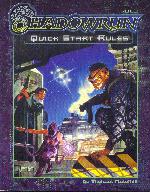
The 4 for Style is because the mini-adventure, art, layout, cover (from NAGRL, one of my favs), and for the inherent coolness of SR. The Substance rating of 2 is because, while they included the concepts of SR, none of the true rules really remain, except initiative. Everything is precalculated and streamlined and modified for your convience. Coming into SR3, you will recognize names but not the procedures.
A good idea, but executed badly.
Style: 4 (Classy and well done)
Substance: 2 (Sparse)

