

 Search
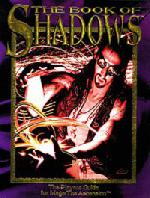
Review of The Book of Shadows
 Goto [ Index ] |
That isn't really being fair, truth be told. The immediate temptation is to judge this product by the standards of the 2nd edition, which was much less comic-booky, and has a much stronger focus on the personal struggle for Ascension. 1st edition, by contrast, was entirely about the fight between the Technocracy and the Traditions, with the Nephandi and the Marauders as distant threats. The Mage Player's Guide fleshes out all of the groups involved - and has the first view of the Technocracy as a rational, if corrupted insitution, as opposed to the all-encompassing nightmare that it was presented as in the 1st book.
But I digress. What, exactly, is in this book that makes it worth buying?
Very little. For one thing, there's the usual list of Merits and Flaws, which are a mix of the good (Throwback, Sphere Inept, Geas) and the standard (Blind, Deaf, Bard's Tongue and so forth.) There's some skills that I doubt anybody would bother waste spending points on - diplomacy is surely useful, but carousing? That's a waste of experience no matter which way you look at it. It also gets away from using a proxy skill - say, Manipulation + Initimidation - in the place of a specialized skill, which was a nice little perk in the White Wolf system. But if you have another Player's Guide, you can just borrow most of the merits and flaws from there and ad-lib any magickal flaw that seems appropriate.
Actually, it's a damned shame that the rest of the book is so weak, because the merits and flaws are useful. And it would actually be difficult to ad-lib some of them - there's specific effects that work well within Mage, and you're left hungry for more Mage-themed merits. I can think of a few off the top of my head - Tradition Grudge, Unwilling Umbra Skipper, Pawn, Weaver Connection, and so forth - that could be made to work, and I'm sure that White Wolf would have a dozen more waiting in the wings were they to try. It's not worth $20 to get a few decent quirks to your game.
The most painful part of the entire book, I would say, is the part where the Traditions are designed. As a matter of fact, when I was reading through them, I was literally inclined to stop playing Mage. Specifically, the Tradition writeups are marked by scanty factual information and way too much precious, pretentious writing - stuff along the following lines:
". ..We have always been and we always will be. We know that our power, our true beauty, comes from the connection to the All. By ourselves, we are less than the tiniest grain of sand, a lone drumbeat, but in opening ourselves to the universe, we are everything."
Or this:
"Attune to the All, and the All will see through you. Be your most efficient state. Lean into it. What are you trying to achieve? Be; do not do." This from the Akashic Brotherhood; the author apparently took inspiration from Yoda and Chinese fortune cookies.
Or this:
"Jay moaned as he felt endorphins roar through him, and felt something inside him change. He was changing just like a seed just before germination, like a plant poking its shoots up through the eart. She saw he had begun to accept his body and his blood, and she felt the life energy within him surge. "Let there be life, Jay..." she said, kissing him, her hair falling all around him."
GAH. That noise you're hearing is my eyeballs rolling so far back into my skull as to make a complete circuit. Game fiction, whether it be AD&D novels or the excerpts in Doomslayers, have always been a tricky business; when it works, it works well, but when it doesn't work, you get countless AD&D novels and the entire Verbena clanbook. Almost every writeup about the Traditions and factions are marked with pretentious, perfunctory and somewhat silly text vignettes, which conceal the genuine lack of substance about the Traditions. The Akashic Brotherhood spouts cliches; the Hollow Ones are the usuwal too-sensitive-for-this-awful-world Goths, the Nephandi corrupt a Celestial Chorister with sex, and the Cultists of Ecstasy are just Deadheads who can do magick. This is not what I envision when I think of Mage. As a matter of fact, after reading through these, I'm trying to pry some of the more dimwitted stuff out of my head.
To be sure, the author isn't entirely bad. Matter of fact, the Order of Hermes vignette is a good example of how the Technocracy can corrupt an otherwise stalwart Mage; the Marauders hint at the weird sacrifice that they've made; the Sons of Ether froth at the mouth and abuse their servants, although the second part of that seems uncharacteristic. (Even for mad scientists, the Sons of Ether always struck me as relatively gentle, more sound than fury. Then again, that's just me.)
Another thing that I particularly dislike is the way that sex is worked into the fiction vignettes; the entire Verbena vignette doesn't feature anything but a woman slowly trying to "wake up" a guy's body so that he can become a mage. Apparently, one of the side effects of being a mage is being able to have lots and lots of sex. Whoopee. It's treated like a handshake, apparently trying to deny the fact that sex could get you killed during that period.
Oh, but if something bad does happen - AIDS, or drugs, or scowling - that's the Technocracy's fault. The Technocracy pumps illegal "running-away from" drugs, while the Cult of Ecstasy promotes the good, nothing-bad-could-happen drugs like LSD and so forth. Responsibility for any faults in the world is neatly avoided by the Traditions in that manner. Hell, I'm beating a dead horse, here - this kind of nonsense was filtered out when the game moved into its 2nd edition.
One of the more lengthy sections of the book involves a revised version of the magick rules for Mage: 1st edition. The problem is that they're already out of date - and since the things that they change aren't that radical, they've already been incorporated into the second edition of the game. If you're still playing the first edition of Mage, then it's useful - but only in that case. On the other hand, there is specific information for the various foci that the different Traditions use, a rough sketch of the Umbra (fleshed out in more detail in the Book of Worlds) The idea of a unique foci - a specific item that you must have to do magick - thankfully died a swift death in Mage 2nd edition. There's a little bit of discussion about Paradox, most of which doesn't really say anything definite; it's speculation, and will probably be useful for dropping in-game hints and rumors and so forth.
I like the idea of child mages, although it does get into that whole "Kids aren't bound by the awful restraints that we adults live under all the time"; sure, maybe you can believe in things that don't exist, but you're also stone ignorant about so many things that it's not surprising if you come to an utterly wrong conclusion. (I had my mother pop a batch of Jiffy-Pop popcorn one time - hoping to get popsicles because the packaging declared "Pops in Package!" Then again, it was some tasty popcorn. ) The idea of child mages actually screams pretty loudly to have its own book, I think; there's a lot of examples in modern-day fiction of children who happen to be able to do magick.
There's rules for Do, the Akashic Brotherhood's specialty martial art - and I imagine that these rules have been supplanted a dozen times over, both by material in the Year of the Lotus and the Akashic Brotherhood's own splatbook. The option to do training flashbacks is an interesting one; if you're in a situation that demands a particular series of physical actions, you can have a flashback to your training, a la the old TV show Kung Fu. Fortunately enough, there's a balancing mechanism, and you can discount the entire event if anybody uses the word "grasshopper". Unfortunately, the martial arts rules are fairly brief and doesn't take into account the sheer variety of martial arts manuvers that can be performed with the aid of magick.
Familiars: You'd might as well just forget it and go directly to Ascensions' Right Hand, which has much more detailed rules for creating and using familiars within a Mage game. These rules are interesting - and certaintly functional enough to run a basic familiar - but if you really want one, then I can only suggest that book. (Especially useful is the fact that it's packed in with The Halls of the Arcanum in Mage Chronicles 2.)
Certamen: Magickal duelling. I don't know about these rules. They seem fairly coherent, but I don't have time to fully test them. Essentially, you throw your Quintessence into a box that your opponent is capable of upsetting, then form two Spheres into a weapon and a defense and go to town. It does strike me as a bit like Magic: The Gathering, but I'm sure that the resemblance is coincidental. (There's only so many ways that you can do duelling mages.) Since Certamen only comes up when friendly mages fight, the rules for Certamen may not come into play that often.
Probably the most useful part of the book is the Rotes. Hours and hours of useful fun, both for the rotes themselves and the ideas that you'll get for other rotes along the same lines. One of the more useful ones, Avatar Form, allows you to take on the form of your Avatar with the use of Life, Mind and Prime, creating four extra arms and allowoing you to bump up your armor - as a matter of fact, it might be too powerful for what it allows you. The problem with it is that the rote mentioned brought out that specifc mage's Avatar; and since Avatars are as specific as fingerprints, the idea of a rote that can bring out your Avatar in a predetermined form seems a bit silly. (I had a Verbena player who wanted to take on the roles of Mother, Maiden and Crone, and I wasn't sure as to how it was supposed to work out.) There's very few dog rotes, and some of them are quite vivid - the Euthanatos Bone Twisting Palm is nasty. There's even a Son of Ether rote for cutting off somebody's head and storing it, still alive, in a jar. Brain That Wouldn't Die, anybody? (Wasn't there another movie about villains who had saved Hitler's severed head in a jar?)
And, contrary to my earlier statement, there are Akashic Brotherhood/Do specific rotes that allow you to pull off some really nasty martial arts manuvers. Imagine the Flying Dragon Kick; as long as you can draw a straight line between you and your target, you can do a jump kick that has no effective limit on range. (The first use of it had a martial artist going some five miles to hit somebody on top of a mountain. Fun stuff!) There's also some useful Talismans; unfortunately, the Hand of Glory winds up with only its traditional powers, which is to paralyze people who look at it. In The Invisibles, by Grant Morrison, the Hand of Glory is essentially a very powerful artifact capable of breaking holes between the real world and the nastier versions of the Umbra; which sounds more interesting?
The parables: They're fairly useless. I mean, they're useful in imparting a particular message, but like a lot of parables, they're also preachy and pat. They don't really seem to meld with the unique atmosphere of Mage, unfortunately.
The stories. God help us, the stories. Some of them are decent, but what they suggest about Tradition society isn't great. A Celestial Chorister terrifies an Oprhan into accepting her mentorship by threatening him with the Tradition's enemies, and the threat of non-being. It's fairly silly - that's why there are Orphans in the first place, because Orphans are confident enough in their own abilities to exist without the help of the Traditions. Another story talks about Avatars, in the form of a dialogue between a pair of mages in a computer chat. I disagree strongly with the idea that the Avatar is a seperate entity that guides you along - I always figured that it was the "perfect self' that you were working towards, the highest part of yourself that had learned to do magick and had to give the rest of the soul a hand up - but other than that, it isn't bad.
There's a fairly useless story about the gathering of Tass and Quintessence - not that it's useless, but it's just not something that needs to be the subject of a story. Ditto a story on Paradox. It's deeply philosophical stuff, and it's interesting for Storytellers to drop hints about it - but it seems to repeat details from earlier in the chapter and doesn't add a whole lot, besides different views on their essential nature.
What I found the most useless was a story about a Seeking. Reading it sounds a bit like Lara Croft - a woman goes through various physical obstacles, almost all of them metaphorical in a sense. The problem is that when it came time for me to do a seeking with one of my players, the story was utterly useless in almost every respect. Rather than running a metaphorical obstacle course, a Seeking should be more interesting, more philosophical, more of a choice between magickal enlightenment and something truly valuable, like your life. There's no rules, like Harrowings in Wraith; there's no suggestions. I suppose that you could come up with something, but I wound up just eliminating the concepts of Seekings because they were too damned hard to run. White Wolf just doesn't help out on that score within this book.
And then I must bite my tongue and try to keep the venom to a minimum, because the dorkiness of the Traditions comes to a head in the next chapter; different views of the founding of the Nine Traditions. For one thing, the entire story was recounted in The Fragile Path, which I haven't read. For another thing, every Tradition mage in it happens to be both a raging idiot and an utter stereotype at the same time. The Cultist of Ecstasy is a guy who talks like somebody from Spinal Tap. (That's how he's described, not the way that I read him.) The Verbena is snooty. The Celestial Chorister is squeaky clean. And worse yet, the entire story is told in this exposition-as-conversation style that literally has different characters stepping out to add something new to the conversation, like an informercial. ("That's right, Deathlace; the Traditions joined together to fight the Five Conventions!") Oh, and they're also meanies to Deathlace about the Hollow Ones, which she figures she'll join.
Actual dialogue from this story: "Well, what would you say if I told you that I was already a Hollow One? Inside me, that's what I am. Hollow inside. Hollow like the Council of Nine, because you don't know the whole story."
Given a choice between joining these mutts and becoming the latest plaything for a Tziscme, I'd pick the Tziscme. At least the agony will have a point.
Thankfully, the Traditions have moved away from that viewpoint, away from the original goofiness of the game. In a sense, that's a shame, because one of the appeals of the first edition of Mage is the comic book nature of the fight; but I'm glad that it's changed. I don't like banging this hard on somebody's story, especially since it means well and isn't written that badly, but it is a bit hard to get through.
And then there's the best part of the book - the Technocracy's history, told for the first time by the Technocracy themselves, as opposed to the Technocracy's enemies. Rather than being the monodimensional Orwellian bastards of the first edition, the Technocracy explains for the first time that it's working for the betterment of all humanity - as a matter of fact, if it weren't for the fact that the Traditions dropped the ball during the Middle Ages, the Technocracy wouldn't even exist. It's some interesting stuff, the cornerstone for what would later become the Guide to the Technocracy. Here's where it started. Good stuff.
The final essays run the gamut. There's some useful information about Joseph Campbell and the archetypal history of the hero; but the problem is that adventure after adventure in the Joseph Campbell mold is going to get mighty boring before too long. I've seen so many authors claim to be inspired by Campbell that I can't help but to be suspicious, especially since a recipe list for an adventure seems to ignore the more unique aspects of each hero's journey. Enough of Joseph Campbell; let's do something different. But then again, the basic elements are there, and they'll be helpful for beginning Storytellers to sharpen their teeth. There's some interesting noodling about the nature of belief and Awakening; there's the standard Luddite nonsense about how technology is eeeeeevil, and the televiison is shooting mind-warping beams into our heads that make us want to treat women like objects and buy ludicrous amoutns of commercial crap. Sure.
In short, the Mage Player's Guide isn't worth buying. It's outdated, and most of the material is either painfully silly to read or purely outdated. The rotes are damned useful, but it's not worth buying a $20 book for something that has about $5 worth of information. I'm sure that it was more useful in its day, but it's about time that White Wolf took this sucker off the market and revised it for a 2nd edition; a game this popular deserves nothing less.
Style: 3 (Average)
Substance: 2 (Sparse)

