

 Search
Review Editing
Review of Dataware
 Goto [ Index ] |
I've been a big fan of Wolfgang Baur since he penned Kromosome for TSR's ill-fated Amazing Engine game system some years ago. One of the things I liked about Kromosome was that it was a rather unique take on the then-popular dark future cyberpunk genre. In fact, it was one of the few visions of such a future that I could take seriously, let alone play.
It's ironic, then, that, years later, Baur should write Dataware, a supplement that at times seems hell-bent on introducing tired old cyberpunk staples like cyberspace (here called "the Grid") to Alternity. Admittedly, Baur's version of cyberspace is a bit more believable than that employed in most cyberpunk games. Nowhere to be seen is the giant video game against a corporate mainframe for secret information. Still present is the wacky idea of suffering brain damage as a result of hacking gone horribly wrong. Why would anyone do such a thing? Can't they find a way to protect against it? It is admittedly an optional rule in Dataware, but its presence at all rankles me a bit. Thus, I was a bit disappointed to see that "classic" cyberspace is still alive and well in some form. I was hoping, perhaps in vain, for something more unusual and flavorful. Just what that'd be I have no idea. When I do, you can expect to see me cashing in on it in my own SF RPG.
As an adjunct to the Grid sections, there are chapters detailing computer hardware and software. These chapters are fairly well-done and easy to understand, which is nice. They are nevertheless rather firmly tied to the vision of the Grid detailed in the early chapters. I'd really have preferred something a bit more generic and usable in settings with a different vision of computer networks and hacking.
The final two chapters detail AI and robots. Both of these chapters are nice additions to Alternity, as they include rules for playing AI and robot heroes. In addition, these chapters include discussions about integrating these elements into your game and the repercussions they'll engender. Admittedly, these discussions are too short for my taste, but it's good to see them nonetheless. In a generic SF game like Alternity, it's important to leave as many options open as possible.
Indeed, if Dataware has a serious flaw (aside from those I see as a result of my SF idiosyncrasies), it is that it isn't generic enough. While Dataware isn't technically a Star*Drive product, it includes numerous references to and examples from that setting. That's fine, but I'd have liked to have seen many examples from other possible settings. Without them, I fear that Dataware will tend to push all Alternity campaigns into a certain mold. That'd be a shame, as the strength of Alternity is its flexibility.
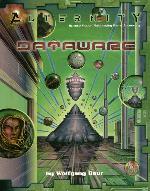
I should also mention that Dataware doesn't look as nice as the other Alternity products I've reviewed. The pages are not glossy and there's minimal color –– mostly a dull grey-green that is mildly depressing to look at for great lengths of time. The black and white line art used throughout is decent, but I miss the color. I guess I've spoiled by the supplements produced thus far.
When all is said and done, Dataware is a good, but hardly comprehensive, treatment of computers and robots in Alternity. I recommend it for those enamored of cyberspace or who want to play robotic or AI heroes in their games. My hope is that one day we'll see another book that includes more options and bases itself on a different model of how computers might operate in the future.
Style: 3 (Average)
Substance: 3 (Average)

