

 Search
Review of After The Bomb
 Goto [ Index ] |
About fifteen years ago, Palladium Books (PB for short from here on out) came out with an 'adventure supplement' called After The Bomb. Described alternately as what originally was a chapter left out of the first edition Teenage Mutant Ninja Turtles game, and what was going to be PB's next standalone before they acquired the TMNT license (Mr. Wujcik was a bit hard to understand on this point), this 48-page typewritten booklet became a sort of Palladium cult classic, going on to sell over 175,000 copies. Most roleplaying books don't even sell half that number, much less a cheaply-produced poorly-formatted supplement for a game that itself was a supplement (After The Bomb then required TMNT, and TMNT did not require, but strongly suggested, the use of Heroes Unlimited).
About four years ago, PB was working on a new edition of Teenage Mutant Ninja Turtles. They finished the product, created a huge media hype (well, huge for such a small company) over it, and listed TMNT2 in their catalog. However, they cancelled the product due to low pre-orders, and with a failure to release a new edition, they lost the license. However, someone at Palladium must have remembered how much of a success After The Bomb was, and so decided to recycle the effort that had gone into TMNT2. So, about three years later, the new standalone After The Bomb shipped, with not a pizza-muncher in sight.
Alas, Palladium still doesn't believe in chapters, so I will be reviewing this book by topic rather than chapter.
Background
The end of the world started with a high school prank and ended with the ultimate hack.
Before the Death (also called the Crash, the Bomb, the Big Death, or many other names depending on who you ask; they all know what you are talking about), the world was a paradise thanks to genetic technology. New foods (including the 'meat potato', which grew with normal vegitables but had the cell structure and taste of a pound of pot roast, and the EverFruit, a small fruiting evergreen with a kudzu-like root system that grows food year-long but starves out other plants for meters) had brought most of humanity out of starvation. Gengineered plants with petrolium sap gave the farmers who were put out of work by these gengineered foods a job and more respect, while solving the problem of dwindling oil supplies just as neat as you could please. Most diseases had been conquered, and even the real baddies like cancer and AIDS were put into remission with the same precision and regularity that tonsils are removed. Genetic tools were commonplace, and people could purchase EGGs (Embryonic Genome Generators) that allowed people to create transgenic mice, dogs, cats, rats, and all sorts of other combinations. (PETA must've blown every vein simultaneously.) Some combined human and animal DNA illegally, but once the result was alive and healthy, what could the government do? Life was about as close to utopia as we'll ever get.
However, people are still people, and people do stupid things. One day, a high school student snuck a test tube home, and using these common genetic tools, created a disease that was able to get around all the safeguards and immunity shots. And he got sick. Violently sick. He basked in the fifteen minutes of fame he received for pulling such an insane stunt, but got no worse than a slap on the wrist, because he had put no-one else in danger.
Soon, creating 'prankster diseases' was an underground extreme sport; people would push theirselves closer and closer to death in pursuit of the ultimate rush. Self-proclaimed experts and posers alike were cranking out new diseases, contagious and no, in an escalating biological arms race. While the media whined loudly and the government tried to stop it, no progress was made fast enough to stop the ultimate hack.
A group of genetic hackers started to gather on the Internet, posting their theories and discussing them. No normal bacteria or virus would do, they said -- they needed a disease that was identical to a human cell. Millions of hours of proccessing time, using an enormous shared-processing-power network, created this transgenic monster in a few weeks. It was so lethal and quick to spread that seventy four percent of the human race died, as well as a tenth of all mammals and two percent of all other animal life.
What would you do in such a situation? Seeing their race was dying, the remainder of humanity struck at itself, as if a hard enough blow had not been dealt already, hoping they could find a cure, an answer, with their bombs. The wars they fought were entirely remote, with missles and nuclear bombs. The human race was decimated.
However, the gengineered animals still had a chance. Imbued with the new intelligence, humanity, and other abilities from their human benefactors, and being (for the most part) immune to the prankster diseases, the animals have inherited the Earth.
Setting
Most of the setting section of the book is dedicated to the eastern cost of North America (or so it says; read my second caveat for this section). However, there's also a listing of two a dozen or so important countries (old and new) from around the world. The information includes (deep breath): Current political situation, official and unofficial languages, population and dominant species in that population, capital, government type, military power, level of technology, level of education, level of economy, and the currency. (panting) How's that for detailed?
The MacGuffin for adventures in this game is the Empire of Humanity, a loose combination-slash-stereotype of seditionist survivalist groups, corrupt government suits, and white supremacy coalitions. Although their numbers are dwindling due to rising infertility and gradual introduction of animal DNA into the gene pool (no crossbreeds allowed), they still retain control of one of the highest levels of technology in the world. Don't want your flying mutants using their ability to derail your adventure? Have an Empire helicopter circle around and fire a few warning shots. Need something to keep your players from advancing any further towards Point X? Have an Empire wargame take place between there and here, or show off the Empire's new prototype power armor. Need to spice up a slow part of the game? Send a two-ton Empire mecha through town. Can't explain why Group Z has such high technology? The Empire's been supplying them in secret as part of their agenda.
Postapopcalyptic games and stories fall pretty cleanly into one of two categories; survival (Alas Babylon, Fallout, Rifts) or the reconstruction of society (Gamma World, The Postman). After The Bomb, although presented with threats such as the Empire, falls into the second category. The fallout of the Death (both literal and figurative) is a generation behind the characters, and society run by animals is just starting to come into order.
I'm not sure what to call the book in terms of realism. On one hand, you have flying pigs, psychic two-fisted duck gunfighters, and nations with names like The Rodent Cartel Of Filly and Gatorland. On the other hand, you have only moderate supertech (Death-era powered armor and energy weapons, the former of which does not make its wearer invincible, and the latter of which packing a bit more punch than modern gunpowder weapons but also with recharging and overheating problems), attempts (failing and succeeding) to rebuild civilization, and rational discussions of the effects of unrational things (such as psionics and the predator-prey relationship as it applies to mutant animals). It's a sort of 'wierd hard science', to coin a phrase; the reasoning behind how it got into the world may not be scientifically sound, but once it gets into the world, it plays by the rules.
Caveat one: In the nation section, there are numerous references to the supplement bundle, because PB didn't want to compete with theirselves. It would have been nice if they'd included a paragraph or two in overview of the nations from the supplements, however.
Caveat two: No map. It's hard to tell which nations have the potential to be in direct conflict and which have only diplomatic relations without a map. Then again, it also means you can drop the nations into the part of the world that's familiar to your gaming group. For me the pro is smaller than the con, but your mileage may vary.
Character Creation
Character creation is, as per normal PB modus operandi, the lion's share of the book. Let's go through it, step by step, and see how the system has changed (and how it hasn't).
Step one is Attributes. The eight attributes of Palladium are still the same, and they're still randomly rolled (3d6, plus 1d6 if you rolled high, plus another d6 if you rolled high again). High stats give bonuses, but low stats don't give penalties. With the possible exception of Mental Endurance (your sanity, stability, and coolness under fire), new players will have no problem with the stats.
Step two is Species. You may either roll a random species or choose. The species list included in the core rule book is huge (over 100 species, with the racial info and background data spanning 64 pages), and concentrates on animals native to North America. However, there are also chimeras -- mostly stable genetic creations from before The Crash, such as flying pigs and spider-goats (the former were raised for an amusement park, the latter was based on a real-world attempt to have goats excrete spider silk in their milk). Throwbacks are extinct animals brought back to life accidentally or purposefully, such as passenger pidgeons and allosauroids (an accidental recreation of velociraptors when attempting to breed the ultimate chicken -- yes, you read that right).
Step three is the Background, and once again, you may roll or choose. Your background determines how much you know, and gives attribute bonuses -- a farm boy will have more mechanical skills than a member of the literati, but neither will have the fighting strength of a feral animal which accidentally became sentinent later in life. Your background may lead into an apprenticeship, which is the only form of 'higher education' available to most in the post-Death era; immediately after the wars and the disease, anti-technology sentiment was so strong that universities and other places of learning were starved for cash and closed down, if not destroyed by angry Luddesque mobs. This is also the step where you choose your skills, but this topic deserves a bit more explanation, so it's in its own section below.
Step four is Build Species. At this time, you turn to the appropriate page in the book to create your character's physical form, using Bio-Energy (a device to balance out the species: a mouse is not as powerful as a bear) to purchase psionic abilities, human traits, and animal powers. The psionic abilities include such as Sense Tectonics, useful in California, and Cell Reading, which is used to determine if two animals can have children -- an important ability what with the messed-up gene pool. Human features include thumbs, upright walking, vocal cords, and other useful traits that we take for granted. Animal powers include heightened senses, flight, and the 'predator burst'. Special abilities which are unique to one species, such as a skunk's spray or a camel's ability to go without water, are also purchased with Bio-E. If you need a few extra Bio-E, you can take disadvantages (such as Herbivore, Nocturnal, or Prey Mentality), or if you're large enough, sell off your intelligence and grace (there's one reason why the big brutes aren't as quick, in both senses of the term, than the rest of us).
Step five covers a few attendae, such as hit points (same as always; PE 1d6) and SDC (stun points, which is based on your Size Level; bigger critters take more to slow down). There are also notes for creating Chi (basically your soul's 'hit points'), ISP (Inner Strength Points -- used for psionics), and PPE (Potential Psychic Energy -- used for magic, not psionics as the name suggests) stats if you plan a cross-over with a game that uses the power-points in question. They're not used in the book, but the short explanation for conversion with Palladium's other game systems is a nice touch. In After The Bomb, all psionics are without ISP cost, so there's no more bookkeeping of how many more times you can send a telepathic message or rolling dice every night you sleep to see how many points you got back.
Step six is to choose an alignment. This section was written by Kevin Siembieda, and it says that we have to use it, and that the alignment has to fall into one of seven pre-made categories. I'd be much more pleased if it had given us a character defintion section instead ("How does your character feel about taking dirty money?" instead of "Principled and Scrupulous characters won't take dirty money, Anarchist, Diabolic, Miscreant, and Unprincipled characters definately will, and the Aberrant character might"), but Erick Wujick has rocked PB's boat enough for one book.
Caveat one: There are two random-roll mutants tables in the book; one if you have only the After The Bomb core rulebook, and one if you also have the various supplements (which are all available bundled together for $20); kudos for including both are due. However, I do have one nagging problem: These books together cover hundreds of species of animals, but if you want to create a tiger character, you are referred to Heroes Unlimited. No other non-ATB book is referenced anywhere else in the entire book, and the tiger is the only species in which you need to have Heroes Unlimited. WTY?
Caveat two: Although most of the book was entirely re-written, the Speed Chart was copied and pasted directly from some other Palladium book. This was obvious because the font of the rest of the book is a computer's, but the Speed Chart was noticably typewritten.
Caveat three: Kevin Siembieda wrote the experience and aligment section, as well as a column of the gamemaster section. In the experience section, I can appreciate his philosophy (experience points should be earnt for roleplaying and doing great deeds, not blasting monsters), but I can't deal with his attitude about it. (Tell me any other serious RPG in which the phrase "Hell Yes!!!" is uttered.) Also, KS thought it was important to write an entire paragraph for each alignment describing how they feel about cannibalism. I'll go over here, now, Kevin, if that's alright by you...
Caveat four: There's still a Physical Beauty stat. Although it has some game effect -- your beauty determines how human you look, and whether or not Empire soldiers will fire on you or put you in custody on sight -- it's still going to be a point sump.
Caveat five: I saw this phrase in the description of the rodent: "The teeth of rats and mice constantly grow and must be worn down by chewing or they will grow through the animal's lower jaw! It also makes them a powerful tool for chewing through a large range of hard materials including paper, cardboard, plastic, tree roots, wood, clay, brittle stone and even concrete (but not solid rock, brick, glass or metal) at the rate of about an inch per hour." Read that again: 'A powerful tool for chewing through a large range of hard materials including paper'?
Skills
The Palladium skill system is percentile, with combat skills instead based on d20 for quicker combat. Base skill percentiles vary based on the genre, while how quickly they improve depends on how difficult the skill is to learn. Compared to other Palladium games, the base skill percentiles are higher, but this is because the majority of the strength of ATB characters comes from their ability, not their 'kewl powerz'. (That, and the fact that there's no OCC bonuses in this game.) There's a quick skill chart in which all the skills, all their starting percentages, and all their levelup rates are listed in two facing pages, for quicker character creation -- no more flipping back and forth between different pages and squinting through dense paragraphs to find out what a skill's starting percentage is.
How many and what kind of skills you have depends on your background; each background has its own set of skill choices. Primary skills are things you understand well and which get all the nifty-keen bonuses (for high IQ, for going up a level, for having an appropriate background, and so on). Secondary skills are things you know how to do but not at a professional level (IQ bonus only). Some skills can only be learned as primary skills; no-one can learn how to build boats or use heavy artillary in their spare time.
Some of the skills have been copied and pasted from other Palladium RPGs, but the problem is far, far from the levels it used to be (for example, Ninjas & Superspies included a line about how the Piloting skill was used with Veritech Fighters). Small skill classes have been absorbed into larger ones (for example, the Wilderness and Pilot Related classes are no more; their skills have been split amongst broader skill classes). There are fewer one-sentence descriptions and more explanations on how a skill is useful in the post-Death era. Characters can easily end up with thirty or forty skills, but with the evocative descriptions, no skill seems useless, and you'll always find a skill you later you wish you knew (kind of like real life, ne?).
One of the problems that people have had with past versions of the Palladium skill system, one skill having multiple percentages for different tasks, has been mitigated. Although some old skills still have multiple percentages to stay backwards-compatable (such as Use And Recognize Poison, with a 24% chance to use and 16% chance to recognize base), all new skills instead have a base percentile, with penalties for difficult tasks. For example, the normal surgery skill level (before any bonuses) is 60%; treating cancer is done at at -25%. It's a system that's been seen everywhere else, and now it's finally part of Palladium.
A few cues have been taken from d20; some skills give bonuses to other skills, much like synergy bonuses, and sometimes a bonus is referred to by name (a 'background' bonus, an 'apprenticeship' bonus, et cetera).
Caveat one: In the beginning of the skill section, when it is answering some of the questions that have arisen over the years, it says that there are no automatic skills. However, in the skills section, it says that the Sign Langauge skill is given free to all characters without the ability to speak a human language.
Caveat two: Physical skills are still abusable by munchkinesque players, and some of the backwards-compatible physical skills are downright migrane-inducing (the Acrobatics skill in particular having six different percentiles, each with its own base ability and improvement rate).
Caveat three: I couldn't find out how and when characters gain new skills (I -think- it's one secondary skill every level, one primary skill every other level, in addition to GM-approved training, but I could be wrong). It's easy to work around, but its lack is annoying.
Combat
Combat is still the good old multiple-action, two-guns-a-blazing, quick-resolving system that's been used in all of Palladium's games. This system is a notch above Palladium's games for two reasons: dumping excess baggage and adding clean descriptions. Compared to most combat systems around (including those of games I love), I think it's fair to say that After The Bomb has got it right.
For those unfamiliar with Palladium's combat system, here's a runthrough. You get so many actions a round; characters get bonus actions for combat training or taking certain special abilities. Roll initiative at the beginning of combat to set the sequence for that combat, but any people who are surprised have to act after their attackers. Going in initiative order, you do the first actions, then second, then third and forth and so on. Attackers roll d20 and add their strike bonus; defenders can spend defense actions to try to avoid getting hit. Characters automatically have as many dodges as they have actions; training with certain weapons can give you parry actions, but only if you have that weapon at hand; armor acts as an automatic defense roll, and if the armor is the only defense that worked, the armor takes the blow instead of you. There's a few bells and whistles for certain special abilities, and one or two special rules (ties go to the defender, natural 20s beat all other numbers unless it's also a natural 20), but those are the important points; it's one of the quicker combat systems around.
Normally, Palladium games try to include all the various special conditions in the core rulebook -- car chases, fighter combat, mecha combat, metaphysical combat, and so forth. However, combat in After The Bomb is of the least-common-denominator type; it works pretty well with characters, and simply explains the basic combat rules, upon which you can add more complex rules. If you want to run, say, vehicle combat, you buy the appropriate ATB supplement dedicated to the topic. Other Palladium system games have tried to fit more in less space, and failed miserably; the extra space devoted to explaining basic combat is refreshing, and useful for new players to the game.
Caveat one: Characters get more attacks now -- the 'two attacks for living' rule of Heroes Unlimited is now a standard rule. This is going to chafe old-school Palladium lovers.
Caveat two: You still have to look up a table to find the SDC of objects (said table, by the way, was copied and pasted from another book), and the numbers are still clearly set down in a 'it looks good' basis. A motorcycle, a sword, a car windshield, and a deadbolt lock all take 100 points of damage to destroy, for example. A standard rule for creating the SDC of objects (1 point per pound if wood, two points per pound if metal, three points per pound of supertech, or something along those lines) would have been appreciated.
Equipment
As can be expected for the genre, a lot of the equipment is weaponry. Instead of just copying and pasting some modern weapon list from another game, the list is composed of weapons made using post-Death technology, including descriptions on how the weapon is used and where it comes from. The weapons list also includes weapons specially designed for animals of different sizes; the Tobermay .14 pistol from the weaponsmiths of North Carolina is just the thing for mutant mice, while a rhinocerous may want to stock up on 4 gauge shotgun shells.
One of the problems with other Palladium games -- just how many shots are fired when you shoot a burst, and how much damage it does -- has been solved. Included in the weapon listing is all the modes of fire the weapon can do, how many shots each takes, and how much damage is done by each shot. Nice work.
One rule which I hold near and dear to my heart is the 'Giant Weapon' rule; if you have a high Strength, you can order an oversized version of any melee weapon. I'm sorry, but the idea of bipedal horses wading throuch combat swinging giant axes just makes me tingle all over.
Most of PB is still in Early 80's mode -- for example, in Ninjas & Superspies you can equip your superspy's car with a 'state of the art stereo cassete deck' (not a verbatim quote) for $500. After The Bomb includes references to such things as MP3 players, Tivos, modern attempts at gengineering, the Internet, and DVDs. About time, don't you think?
Caveat: All the armor is medieval in design. Where's the bulletproof vests, explosive ordinance disposal suits, sports gear, and stolen Empire technology?
Miscellany
The book is perfect bound, as is normal with Palladium products, and as such is a bit fragile -- I accidentally left my copy in the bathroom while I showered, and the steam curled the covers of my book so that it does not close unless a paperweight is applied. You Have Been Warned.
The new After The Bomb is not 100% compatible with the old sourcebooks -- unlike what the ad copy in the back of the book claims -- as some of the rules are different. Characters can now take racial disadvantages, and background is not the sole source of a character's ability. Also, the sourcebooks assumed TMNT was going to be used, and so created characters based on the rules and skills from that game, not all of which are in After The Bomb. Combat in the standalone ATB is much more lethal than the old TMNT-based books (for example, a 'Jakartan heavy crossbow' from the sourcebook designed specially for huge creatures does 1d10 damage, but even a lowly lever-action crossbow from the standalone meant for you and I to use does 2d6 damage). Ergo, it'll take a little bit of work to make the old game's suppliments compatible with the new. Perhaps an 'After The Bomb Companion' could be in the works?
A lot of the problematic bits of the Palladium system were chucked by Wujick for his version of the game. No OCCs. No MDC. Physical Strength has been fixed -- 'brute', 'beastly', and 'crushing' strength are animal powers that increase the power of hand-to-hand strikes and lifting power while keeping bonuses to Strength to scale, instead of the automatic cutoffs that made other Palladium games confusing (in Rifts, you can lift 160 pounds with PS 16, but 340 pounds with PS 17). There are a number of areas with a phrase like 'There has been some confusion over the years, but the answer to this question is...'.
When it comes to art, it's a Palladium game. What do you expect? Someone once described Palladium Books as releasing art books with a RPG scribbled in the margins, and although the game listed here is a bit more than scribbling, the art didn't suffer for it. 98% of the art is new -- it seems someone's maxed out their Art Direction skill over at Palladium. A few pieces of work of Eastman and Laird have been retained from Teenage Mutant Ninja Turtles, and I swear I've seen one of the pictures before in Ninjas & Superspies, but that's about it. However, there's too many pictures of bipedal, physically anthropomorphic critters -- what do the critters without opposable thumbs do in this world?
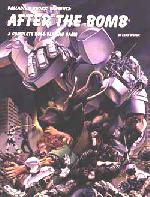
The cover art for the book is hands down the best I've ever seen. Most RPG books either have a simple design -- the landscape of the GURPS book, the claw-slash of the Werewolf core book -- or, worse, characters from the game standing around and trying to look cool. D20 Modern's cover: "Hey! I have a sword, she has a gun, and he has some blue mystic energy stuff coming out of his hand! Isn't that cool?" Rifts's cover: "I'm a cybernetic dragon posing all scary-like for no real reason while surrounded by psionic mage chicks. That's so cool!" Cyberpunk 2020's cover: "Hey, I've got a gun, and a car, and a chick, and wires sticking out of my head, so I must be cool." Instead of this, the cover of After The Bomb shows characters in action. Background center, a huge bipedal elephant has lifted an Empire of Humanity main battle robot over its head; the elephant is reeling from both the weight of the robot and from the two Empire soldiers far background left (one powered infantry, one normal infantry) opening fire on his back. The robot has in its left hand an eagle, which is slashing at vital wires and heat pumps with a sword; its right hand is outstretched for the two characters bottom center foreground. One of these characters, a lion, has just felled an Empire powered infantry grunt with a knockout blow; the other character, a mustang, is opening fire with a submachinegun at some character offscreen, unaware of the powered infantry unit sneaking up behind him from background bottom right.
The first 10% of the book, although called the 'character creation' section, could be termed the quick-reference area, because it also contains at various points information that will be looked up often: random animal tables, glossary, the Palladium system's rather esoteric optional healing and injury tables, definitions of skills and mutant animal powers, alignment and experience tables, and so on. It would be a bit more forgivable if this non-character-creation information had some sort of organization, but let's face it, this is Palladium. They've done this for years. A point was taken off of style for this.
A note for the fellow furries in the audience (if you're not a fur, just skip this paragraph, you're not missing anything): If you've ever wanted a simple RPG that could do your 'personal furre', this is it. With only rare exceptions, the alter-ego of every fur I know can be built with this book. Studious or sloppy, average or amazing, miniscule or huge, anthropomorphic or quadrapedal, barely sentinent feral beasts or kawaii airhead catgirls, ATB it can cover it. Knowing how much of a spread-out bunch that furs are, that's saying a lot.
A large impression of the book was that it's really made for the beginner to Palladium. Tables are cleaner, the font size is larger, and there are more lucid explanations of basic gaming concepts. Due to one or two gratuitous pictures in the book, and a reference to one of the chimera races having an 'active sex life', I cannot reccomend this book to children. However, parents wanting a game to play with their children may want to give After The Bomb a readthrough -- the concepts of Vampire and Dungeons & Dragons and the like may be a bit beyond them, but giant beasts, wolves with guns, and mutant powers are things every child who watches saturday morning cartoons can understand with ease.
There is a Quick Find reference of important sections (and, for some reason, chimera species) in the beginning of the book. It may not be an index, but for PB, it's a start.
The book can be converted to other systems with a minimum of difficulty. With races being point-built, powers being point-bought, and skills learnt via apprenticeship and study in one's free time instead of taking it from an arbitrary class, it seems like any reasonably described point-based system (such as GURPS or HERO) can take this book and run with it. As I noted before, there are also guidelines in various sections for combining After The Bomb with Palladium's other books.
Finally, a point from Substance was taken off for its multiple little quirks. Individually they'd be understandable, but taken together, I couldn't forgive it.
The Final Verdict
Although it may not be RIFTS Jadeclaw, this book has shown that Palladium is listening to its players. If you're a RIFTS player looking for a lower-powered version of the setting, a Palladium fan wishing for a revised and updated edition of the system, or a person who can't wait for Gamma World d20M, After The Bomb will please you well.

