

 Search
Review of The Traveller's Handbook
 Goto [ Index ] |
I'm a big Traveller fan. It was one of the first RPGs I ever played and the first I GMed. I own products from every incarnation of it, even the dreaded Gurps Traveller, and own almost all original (or Classic as it's now called these days) Traveller products.
Physically, this is an impressive book. It's heavy, and it's huge. That's the first thing you notice. The next thing you notice is the price tag, $44.95. Though after a quick mental "D'oh!", you realize it's priced reasonably, given it's size. Still, I couldn't afford full price, so I ended up buying it on Ebay for $29 total (I am not one of those who feel that RPG books are 'under' priced).
Traveller 20, or T20, takes the tack that Fading Suns d20 took - ditching all the regular d20 classes and introducing several new ones. Herein lies much of the problems I have with T20. Although realistic, several of the classes are simply terrible at combat. They have a Base Attack Bonus progression which ends up at 5 when they are 20th level. Again, this is somewhat realistic, especially for classes like the "Academic". But I think it's bad game design. You're going to end up with many characters simply worthless in combat. No one likes playing the far future version of Richard Simmons. By using the weakest normal Base Attack Bonus progression (where it ends up at 10 at 20th level), you're giving the character a much better chance of being useful, yet aren't stretching reality too much.
I also found it odd that the Army class has a fairly weak base attack bonus progression - the average one in d20 terms, that ends up at 15 at 20th level. The Navy is even worse. Not quite as bad as the Academic, but weak (the weakest normal progression, like that of a wizard). Should military classes be worse at combat than a Mercenary? Maybe the Navy, but not the Army. And should Mercenaries be on par with Marines? Marines are considered to be the toughest regular fighting forces around (and this is especially true in the Traveller universe). So I'd definitely say no.
While presumably not everyone will run a combat heavy game, Traveller always had a strong criminal and mercenary slant since the begining (early on, it was more or less "Thugs in Space", where the PCs were criminals or toughs.) So this great imbalance between the classes is perhaps a bigger problem in a game like Traveller than other SF games.
I also have problems with the concepts of some of the core classes. The "Traveller" class for instance. Does that really need a class? No. And why is "Mercenary" a core class? I don't really get how you can become a mercenary from the get go, once you're 18. It seems like it's something that you can't start out in, but can become on after a tour in the military or somesuch. I.e., essentially a prestige class. In fact, this is likely why in the original Traveller, which didn't have classes but had careers, there was no mercenary or "Traveller" career. Though they did follow the classic Traveller careers fairly closely (which is good, as early reports about the game had them doing something complete different and very wacky), I think they should have followed them much closer.
In a way, all core classes are somewhat similar in that all their special abilities are bonus feats. Some of the feats are exclusive to that class, but they all get the same number of bonus feats (about one every other level).
There are 3 prestige classes - the Big Game Hunter, the TAS reporter, and the "Ace Pilot". By contrast, these do have some special class abilities which aren't feats. But the Ace Pilot is a really dorky name. I can't help but think of Red Dwarf - Ace Rimmer. I think the first two should have been regular, core classes (well, maybe a generic reporter or media class). I also think some more prestige classes were needed. Special Forces, for army characters. Assassin. Lots more.
I also think Psionics should have been handled as a prestige class. Not only does it makes sense (that's one thing prestige classes are for - secret societies and such), there are balance reasons for it. As it is, Psionics are largely handled by feats and by random luck. If you have psionics, you might have powers in one of 5 different areas, or spheres. Each different power requires a feat to be taken, and each sphere is also a skill which needs to be built up. Okay, except that all spheres are not equal. Telepathy has 7 different powers or feats. Telekinesis has one. Teleportation has one. The latter two are potentially very powerful, depending on the character's PSI ability. So, not exactly balanced.
So, while I think most new classes are okay, some are flawed pretty badly, either in execution or concept. Even as NPCs classes, they wouldn't work. And as there are no NPC classes, the workload on the DM or Referee is going to be increased a lot. For some reason, many don't realize that part of the reason for the NPC class was to make things easy on the DM - the original ones are all very simple, with no special abilities or powers (other than the adept and it's spells). This is somewhat mitigated by the large appendix of stats for NPCs. But still annoying, IMHO.
Another interesting idea, but flawed (or so I think) is how characters gain past experience, called Prior History. This is similar to past versions of Traveller, and is almost a game of it's own. But in essence, the problem is it ends up producing characters that have a wide variety of character levels (each year of prior history, they get 1000 xp, plus possible bonuses). One PC might have a 3rd level character. Another might have a 10th. While this is perhaps realistic (though honestly, older is not always better), it largely defeats the whole purpose of having character levels (which is to make combat ability easier to gauge, as well as general competence).
While Prior History has balance problems, it also is quite confusing. I can't quite figure out how college works. Characters in it get XP, but what class are they? Academic? Any class they want? It doesn't say. And multiclassing is confusing. On the one hand, it says anyone can apply to a service class until they are 33, but in the multiclass rules, it says those classes can't be multiclassed into unless you have prior experience in that class. So how do you multiclass into it? And the Mercenary career - the text mentions an Academic might want to multiclass into that, but Mercenary is restricted to those who were in the Army, Navy or Marines. And why can't Scouts be a Mercenary? They were in a military service, and are as good in combat (in T20 terms) as the Army and better than the Navy. Or Rogues? While not in the military, they are good at combat as well.
It doesn't help that the only example of prior history is as simple as you can get: a character that starts off a rogue and stays a rogue his entire career (he's also immensely fat, perhaps this was meant to be a Marlon Brando/Godfather reference). Gee, thanks for the help. So in making up characters, we just ignored the multiclass restrictions in the prior career, and no one took university.
Speaking of combat, T20 introduces several new combat rules, most pretty major. For one, there are no more hit points. Instead, there are stamina points, which are more or less identical to hit points (and go up every level). There is also "Lifeblood" points, which are based on a characters constitution and are fixed. The explanation of this is actually hard to find in the book. It's in the combat chapter, but rather being the first thing explained, it's buried after a long section on starship sensors. WTF?
Anyway, since there are two types of hit points,armor is handled a bit differently. Armor increases armor class, but also has a damage reduction value. This reduces the number of dice a weapon does, to a mininum of one. The remaining value is then subtracted from that remaining die (which was the high roll). It's confusing to explain, but is actually fairly clever.
Example:
Alec is wearing cloth armor, which has a rating of 6. Homer comes along and shoots him with a Laser Rifle, which does 3d10 damage. Homer rolls for damage and gets a 7, 10, and 4. Alec thus takes 21 stamina poinst of damage, which is easy enough to figure, but the lifeblood damage would be 6. The cloth armor has a rating of 6, so that means 6 dice would be removed from the total. But there's only 3. So 2 of the 3 are removed, leaving the roll of 10 (the highest). From that roll of 10, 4 is subracted, leaving 6. (4 because the armor rating of cloth armor is 6, but 2 of that was used to remove dice).
I find this pretty clever, and it seems to work well enough, though it has some quirks. They've also managed to keep weapon damages and armor value consistent with other d20 stuff. Another change is that strength no longer helps in melee combat, it's dexterity, like in missile.
About 110 pages of the book is on design sequences for vehicles and examples of vehicles. While many Traveller fans are in fact people who love to design stuff, I think this really would have been better suited for another book. It's also really only suited for Traveller games, as Traveller tends to make certain assumptions about it's starships that don't really apply to other universes. (For one, their expense. Ships in Traveller are insanely expensive. Contrast that to say, Star Wars, where starships are priced like cars. Or most SF games where they are more like ocean ships. This is one of those things I never liked about Traveller. There's no real reason for starships to be that expensive, given the technology levels - robot construction, contra grav, computer design, all would drastically reduce the cost of starships. But they still cost 200 million credits , even for a small ship. I also don't understand how it can take years to build relatively small ships either. But I digress).
Basically, by comparison, in 35 pages or so, the Imperial Encyclopedia from MegaTraveller contains far more gear and vehicles and ships and such than in the 60 pages here, and all the ships were illustrated. Far more than in here. Several types of each firearm, too (different Tech Levels), not just the single example here. The premade designs in T20 simply take up too much space - one whole page, and while they are rare, when illustrated, the illustration of an item takes up a whole page (and the illustrations generally aren't very good, either). Lots and lots of white space here, and seem to be in the book just to pad it. No deck plans, either. Even Gurps Traveller had deckplans.
I also think this is going to confuse a lot of people not familiar with Traveller. It's also in the wrong place - it should have been put in the back as an appendix or something, not in the middle of the book. Maybe the equipment should be in the middle, like many games, but not the design sequences.
There are rules for trade and running a starship. And how to create star systems (both largely from previous versions of Traveller). But very little background material. While it's true that the original Traveller little black books didn't have any, the Traveller Book, which was an compilation of those, did have background material and a couple of adventures to get players started. This has none of that.
Ultimately, I would have liked the design stuff to be in another book (along with more design stuff, like for guns/weapons), and have a simple starship design system here (like in the original Traveller), and a condensed list of equipment, instead of 1 item, 1 page. As it is, this takes up a lot of room to give you very little equipment. Especially weapons. If you have 15 different tech levels, surely that higher level ones will produce better weapons. (This was the case in most previous editions of Traveller, except Classic Traveller). This is presumably to sell their PDF on weapons (though I'm just speculating, as I don't have that PDF).
It also would have been nice to have the weapon and armor tables reprinted in the back of the book, rather than 6 pages of ads (including one for my least favorite RPG company, Steve Jackson Games. Boo! ). Even if they got some money from those @#@%#!s, most of the ads are from themselves, and could have been condensed or something.
Also, it would have been nice if it had included stats for typical Traveller aliens. While you do get stats for the Aslan and the Vargr, you get several aliens that I had never heard of before. But what about Traveller mainstays like the Droyne, Hivers, Bwaps, Darrians, etc?
So, ultimately, should you buy this product? If you're a Traveller fan, it's maybe worth buying. I say maybe, because you'll have to do a lot of work yourself to truly run a Traveller game, as there are no stats for half the major alien races, and most of the minor races. Probably not that hard, but...it's annoying that you should have to all that work to convert an existing Traveller game to T20.
I also suspect that if you're not also a d20 fan, just a Traveller fan, you'll have trouble understanding this book. Part of this can't be helped, because under the d20 System Trademark License (d20 STL), you can't explain character generation. But it's made worse by poor layout of the book. I mean, "Lifeblood", a key concept in T20, is first explained on page 150.
If you're not a Traveller fan, then I'm not sure why you'd want this. It's not exactly like a toolkit, since it makes several assumptions, from physics to society (hippies really won't like this setting), that are really only applicable to the Traveller universe. Yes, you can change them. But again, you'll have to do a lot of work to make it into a generic sci-fi universe (IMHO, anyway). The classes are also out of whack/balance compared to other sci-fi games, (though I'm tempted to borrow the Noble class from Fading Suns d20).
This is really only great if you're a Traveller fan, a d20 fan, and you want to play Traveller 20, in the upcoming T20 setting. And plan on buying several future products from the company.
As I'm only a Traveller fan, and a d20 fan, who doesn't like their setting, nor do I want to buy more products from them (setting products, anyway - I'd buy technical sourcebooks, like a d20 verison of Fire, Fusion and Steel), this is somewhat of a disappointment. Somewhat better than just okay, almost good, but not great. It's definitely playable, I started running the old Sky Raiders trilogy from FASA with these rules. Now the scientific characters from that actually have skills other than just Admin-1. But it's far more confusing than it should be.
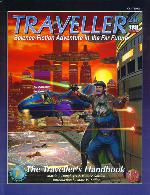
C is about right. On the RPG.net scale, I'd say 4 for substance, as there is a lot (and lot of it is also funny), but the layout, execution, and design of the book is horrible (and it's downright ugly - even the much ballyhooed cover is nothing special.) to give it a 1 for style.

