

 Search
Review of Aria Roleplaying
 Goto [ Index ] |
Want To Build A World?
Aria: Canticle of the Monomyth
Every once and a while, something new in role-playing games is brought to
light. A twist on game mechanics, a new type of character generation, or
perhaps a wondrous and rich setting. Aria: Canticle of the Monomyth is that
type of game. It is the trumpet for a new kind of role-playing...
Designed to be a cap system, Aria presents us with a detailed and rich
template used to define and create worlds, nations, and cultures. Inside we
find a system that takes an in depth look at the fantasy world -- any fantasy
world -- and gives it a logical, consistent structure that will enrich and
solidify it.
But Aria does not just define worlds, it inspires their creation. Never
before has building a complete game setting from scratch been so fun and so
simple. Aria: Canticle of the Monomyth has a companion volume, Aria: Worlds,
which delves deeply into the world building mechanic, but enough of the
system is presented in the basic rule book as to set the reader's imagination
on fire. Simply reading those chapters will draw your creative self out of
the pre-packaged darkness that enshrouds it as the ideas -- rich and
wonderful ideas -- begin to flow...
When you have ideas that demand to be fleshed and a system that will do that
with grace, why not?
Appearance:
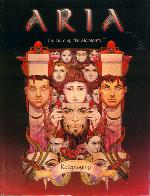
The most striking and immediate feature of the Aria RPG is it's cover. It is
a beautiful piece by Michael Kaluta depicting a woman choosing among a number
of masks which one she will wear next. The art on the interior ranges from
below average in a few spots to above average. Particularly nice is the
colophon, also done by Kaluta. Contributing artists include, in no particular
order, Janet Aulisilo, Craig Gilmour, Liz Danforth, Marc Ryberg, and many
more.
The typeface and layout of the book is clear and very readable. However, Aria
does fall prey to the grim spectre that seems to haunt the sensibilities of
RPG production teams of late. The book's Preface begins on page IV and
continues to page V, and is nearly unreadable due to dark type on a dark and
busy background design. Fortunately, it is repeated on the back cover in it's
entirety.
Writing and Narrative Style:
The writing of Aria bears note. Unfortunately, this is because it is the
game's greatest flaw. While technically precise, the style used to convey the
game's mechanics is impenetrable. Instead of using a common and familiar
vernacular, the authors have decided to coin numerous terms and they thrust
them upon the reader with great enthusiasm. One may no more skim Aria for
comprehension than peer through masonry.
The creators of the game explain their choice of the dedicated use of
neologisms thusly: "Experienced roleplayers will notice that several unique
terms are employed in Aria. These are meant to convey a sense of internal
cohesion and contribute to the general atmosphere of the mythic creation
fostered by the game... The game's language gives Aria a sense of tightness
and individuality."
While they are certain correct to a degree, their use of "unique terms" is at
times overwhelming. The text is dense and the ideas carried by the words are
sometimes difficult to ferret out. The actual rule or guideline of which the
narrative is addressing is often buried in a mire of verbosity. Aria is a
wonderful game that could be better served with a less heavy narrative style
and diction...
Setting:
Aria: Canticle of the Monomyth has no setting. It is a cap system. That is,
it is designed to work along with or replace the rules present in other
fantasy role-playing games. It does it's job very well. Any setting will
benefit from a touch of Aria...
Game Mechanics:
Conflicts and acts where the outcome is questionable are handled in Aria by
what is termed a Trial. First one needs to determine the Trial's Base. The
Trial Base is either three or, if the Trial utilizes Expertises (skills),
then find the Attributes that govern the Expertise in question, total their
values, then divide that result by six. That will be the Base.
Examples: Your character, Haradan of Uligran, is attempting to use his
personal influence with certain members of the Court of Uligrandess in order
to urge them to declare war upon the neighboring nation of Iyllwylen. You
must use your Charisma to draw upon the favors those member of the Court owe
you (this is known as making a Withdrawal Trial from your Influence Pool...).
Since you will not be using a skill in this case, your Trial Base will be
three.
If your character, Kerlissa the Bold, is engaged in a tavern "conflict" and
wishes to use her Brawl skill to make short work of those who would dare to
oppose her, you will first need to determine which Attributes govern this
Expertise (or skill). We can see that there is a small list and you know that
you must use your Rank (or rating) in Strength because it is the Expertise's
Primary Element. You may choose two Attributes from the rest of the list,
which is Agility, Endurance, Quickness, and Intuition. Kerlissa has a Rank of
five in Strength, a six in Quickness, and a seven in Intuition. So, 5+6+7=18.
And 18 divided by 6 is 3. You explain to the Mythguide (the gamemaster) that
Kerlissa is sizing up her opponents, using their bulk against them, and your
Trial Base for this Trial is a three.
Once you have a Trial Base, you check to find your Rank for the Attribute or
Expertise being tested. A Rank is a number between one and ten which is a
kind of benchmark used to determine exactly how well your character is able
to perform the Expertise it belongs to or how your character fares when
compared to others.
And lastly, you will need a Difficulty. A Difficulty is a penalty assigned by
the Mythguide to your actions dependent upon the situation, and is usually
rated from zero to ten. The scale for Difficulties is, however, open ended
and monumental tasks may bring about monumental Difficulties...
Once you have all these number in the fore, you will use them to determine
the number on which the player must roll under on a ten-sided die. Take the
Trial Base and add in the relevant Rank of the Attribute or Expertise
involved. Then, subtract the Difficulty for the task from that result. What
you have left is what the player must then roll then than using a d10. That
number is called the Adjusted Trial Chance.
The amount of difference between the Adjusted Trial Chance and the actual
roll will determine how successful the character was in performing that task.
By checking that difference on a chart, one can see the Degree of Success or
Degree of Failure for that Trial. These range from Mythic Success, through
Complete Success and Complete Failure, to Catastrophic Failure, with a number
of other values in between. These Degrees have no affect to the Trial
mechanics-wise, but are instead used by the Mythguide to help translate the
numbers into description.
An example: You decide your character will attempt to forge the necessary
documents for her and her friends to enter the Bey'rn City-State since you
don't have real ones handy. You gather the materials needed and sit down to
work. Forgery is the Expertise you will be using. It has Manual Dexterity as
it's Primary Element and you choose to use Perception and Intelligence as the
other two Attributes for your Trial. You have a Rank of seven in all of
those, so your Trial Base will be four. Your Rank in Forgery is six, having
decided during creation your character is a type of smuggler. The Mythguide
decides Bey'rn has a middle of the road passport system, assigning a
Difficulty of two. Your Adjusted Trial Chance is an eight. No other modifiers
are levied against you and you proceed to roll a two. Checking the chart, you
see you have rolled a Superior Success. When the guards check at the gate,
they will have a difficult time spotting your handiwork.
Interactive Histories:
Aria, if it accumulates the consumer base it deserves, will re-forge
role-playing as we know it, casting it in it's own image. Already the game
conforms to the single die mechanics that are showcased in it's newly created
cousins and focuses heavily upon characterization and character development
as is prevalent today. However, Aria utilizes game concepts that will
revolutionize the FRPG industry...
One of those concepts is that of the Interactive History. Simply put, an
Interactive History is role-playing the nations, societies, and/or cultures
that make up a game's setting (or Narrative Environment in Aria terms). Each
player will choose or be assigned some political entity to guide through a
set period of time. He or she will make decisions such as whether to declare
war when the time arises, institute a rebellion, or attempt to invent a new
kind of plow.
All of this is handled with what is named a Historic Interval. Historic
Intervals are a way to organize what happens to the player's nation and when
it occurs. The Historic Interval consist of a number of Phases that break the
actions, basically, into internal and external ones.
The Historic Interval begins with the Events Phase. This one is wholly
optional and all parties should agree upon it's use. Natural Disasters may
occur here. There is a base ten percent chance that one will befall a
player's society, and this list includes such things as tornados, drought,
and epidemics. If one of these Events does occur, a Trial roll is made to see
how well the nation deals with the crises. A failure indicates that it will
under go a Regression.
Next is the Internal Development Phase. During this Phase, players choose a
number of events from a list of possible actions which ones they would like
to have occur in their society in this Historic Interval. For each action,
there is an associated Trial and success indicates an Improvement in that
area, while a failure indicates a Regression...
The External Development Phases follows and is much like it's sister, the
Internal Development Phase. However, the number of actions any one society
can make during this Phase is determined by it's size (called Scope in Aria).
Again, a Trial is made for each action and success is rewarded and failure
punished.
Lastly is the Resolution Phase. It is here that the effects of all the Trials
made during the Historic Interval are applied. The details of this of
discussed and the specific effects of Regressions and Improvements are
discuss. All of these will be reflected in regular play (where the players
role-play characters) and during the next Historic Interval.
Important to understanding how the Interactive History works is understanding
exactly how nations, cultures, and societies might be role-played. First it
is determined what the players will be using as "characters" during the
Interactive History. Basically, any large social or political group is fair
game, although playing nations is certainly easiest. Possibilities include a
race as a whole, a large priesthood, or even a tribe of nomads.
Once it is know who will be playing what, it is necessary to assign the
entities being played attributes of a sort. These are called Determinants and
fall into three basic categories. They are: Social, Political, and
Economical. These categories are further sub-divided into areas such as
Power, Scope, Philosophical Orientation, Resources, and Suppression. The
sub-categories are each rated with a number, most from one to ten, and during
the Resolution Phase of the Historic Interval, these numbers may rise or fall
because of Regressions or Improvements.
An Interactive History in Action:
An example: Robert is playing the nation of Uligran and Susan that of
Iyllwylen. For a number of weeks, each player has been role-playing a
character from their respective countries, but now, a great war is upon them
and the Mythguide decides he would like to use this opportunity to introduce
his players to the concept of an Interactive History.
The Mythguide, Howard, decides that this Historic Interval will represent a
decade of game time. First comes the Events Phase and Susan is disappointed
when Iyllwylen is unlucky enough suffers a small earthquake. Howard decides
it occurs in the southern mountains, the base of Iyllwylen's mining
operations, and a Trial using the Resources Determinant is rolled. A Superior
Success comes up and Howard and Susan agree that two out of twelve mine
shafts have collapsed, putting a small dent in the metals Iyllwylen will have
available during the war.
Next up is the Internal Developments Phase. Robert chooses two actions:
Intrigue and Taxation. Both of his Trial rolls are successes. Susan decides
that her now slightly disadvantaged nation. She thumbs through the list and,
with a smile, chooses to apply the Develop/Invest and Research actions. As
Robert grumbles, they move on to the External Development Phase.
Here, Susan has the advantage. Her nation has a Scope of eight and has a base
number of External Actions set a four. Robert's Uligran was a colony of
Iyllwylen at one point and is still rather small. Uligran has a Scope of only
five, permitting Robert to take three actions. Howard tells both they must
both spend an Action on War. Susan picks Blockade, Espionage, and
Intimidation as her remaining three. Robert takes the books and reads through
his choices, his brow furrowed. After a moment, he announces Alliance, Raid,
and War as his choices. Both Robert and Susan are successful when rolling
their Trials.
Both players and the Mythguide draw their chairs closer to the table as they
enter the Resolution Phase. Howard asks Susan to begin. She pulls out a few
sheets of blank paper, writing as she speaks. "In 3345, Year of the Goddess,
a small earthquake struck the province of Ceryiden, collapsing two mines
shafts and damaging a third. Twelve people were killed. Although the miners
are shaken and the area is in an uproar over what they consider to be unsafe
working conditions, ore production still continues, albeit at a slowed rate.
"That same year, the Minster of War decided to make the King's Smith's
recommendations a reality. He spoke in chambers with the Boy Monarch and the
capital city has become the testing site for a new and improved kind of steel
forging process. In addition, the King's Smith himself has recently begun
testing a new kind of long distance weapon, possibly involving gunpowder.
"Because of the infantile war the Uligrandian people have thrust upon us, we
have had no choice but to set patrols at all roads leading to and from their
nation. Because they are nestled between the Herikan Mountains and E'erydan
Wastes, we are certain our measure will ensure this war will have a timely
conclusion.
"Our spies have recently returned from Uligran will tales of a people ready
to commit acts of sacrilege against our church. Iyllwylen has sent
representatives to the ragged collection of dust farmers who fancy themselves
a government, warning that any act taken against our religious centers will
not only be met with the severest mortal resistance, but by the wrath of the
Goddess herself".
Howard indicates it is time for Robert to describe narratively his nation's
Actions. "Well..." he begins, "Uligran did begin raiding the Iyllwylen
country-side early this Historic Interval. As an oppressed people, we have
little choice but to steal back what is rightfully ours from the tyrannical
nations that took it. Let's see, what else...Haradan himself once again stood
before the Court of Uligrandess, asking that spies be sent into our
neighboring nation's lands in an effort to stay one step ahead of them.
Permission was granted and a small number patriots crossed the borders...".
Howard speaks up. "There's still Taxation and Alliance..."
"Oh yes," says Robert. "The Court of Uligrandess decided that a political
alliance with the E'erydan Raiders would be helpful at this time. We are
hoping that they will soon join our fight for true independence. As for
taxation, in order to raise an army, it was necessary to raise the taxes
against an already poor people. But, the blame for that too rests on
Iyllwylen shoulders...".
The session ends and the next week Howard decides to involve the player
characters in the story again. Using what happened in the last Historic
Interval as a guide, he creates an adventure. Upon their next visit, Susan
and Robert learn that the earthquake uncovered a ruin said to hold the Horn
of Ker, an artifact that could turn the tide of the war. The characters are
drawn into a Uligrandian plot to wrest the Horn from it's burial spot and
they must dodge raiding parties, border patrols, and angry Iyllwylen miners
as the struggle to gain the item for the Court of Uligrandess...
Character Creation:
In Aria: Canticle of the Monomyth, characters are truly children of their
environment. Personas, as characters are called in the game, are not
cardboard cut outs that a player might spend fifteen or twenty minutes
detailing. Instead, what has already been created for the game, the setting,
histories, and more, is reflected strongly in them.
Character creation begins in earnest when the player chooses a Heritage
Template for his or her character. This will determine a number of things
about said character; where he or she is from, his or her race and physical
attributes, special abilities, and more. The Mythguide, possibly with help
from the players, will set up a number of Heritage Templates for the game's
setting (or Narrative Environment) before play begins.
Once the Template is chosen, the player and Mythguide will need to make a
number of decisions about the character's family. Since Interactive Histories
may be used in the game, a Persona's immediate relations can become very
important to game play. Much like Pendragon, Aria allows for players to
role-play a character, then that character's son, then the son's son, and so
forth. This is called a Perpetual Genealogy, and so issues such as
inheritance and other family members are important.
The next consideration is Status, both personal and that of the family.
Status is broken down into six categories and is roughly equivalent to a
character's social class. Those categories are Ruling, Privileged,
Professional, Labor, and Marginal. Character's Status will determine how is
treated by other and what Vocations are available to him or her.
Assigning the Persona's Characteristics is the next phase in character
creation. Aria uses a point based system and this is a limiting factor in
decisions made about the character. While the term Characteristics is used in
the rule book to apply to both the physical aspects of a character, such as
his or her height, and the familiar statistics, such as Strength, only what
is called Attributes will be discuss with any length in this work.
Attributes are the benchmark by which a character is judged against his or
her peers. Six of these are used and each is rated with a number from one to
ten. These numbers are called Ranks. The Attributes for each Persona are
chosen from a list of sixteen, according to the player's desires and
character concept. The list includes Agility, Communication, Hardiness,
Intelligence, Presence, and Willpower.
After the Attributes are decided and paid for, the player next chooses a
Vocation for his player. During the setup for the game, the Mythguide will
decide what Vocations are available for players and what will be necessary
for a character to be involved in said Vocation. Location, Status, the
technological level of the character's starting society, inherent abilities,
and the like are all requirements that the Mythguide might impose upon the
player wishing to choose a specific Vocation.
When the Mythguide details each Vocation, he or she will also decide which
skills (called Expertises in Aria) are common to and/or required for that
Vocation. However, Expertise outside a character's profession may be chosen
during Persona creation. All skills, whether accompanying a Vocation or
chosen by the player, are rated from one to ten and points must be spent to
acquire and advance in them.
That finishes out the core of character creation in Aria. But by no means is
the small sample here all there is to that process. It is detailed and
time-consuming. The final product, however, is worth all the book-keeping,
page-flipping, and decision making that each Persona requires. In the end,
you will have a character that will truly step off the page when the
role-playing begins...
Why Aria is Revolutionary:
Aria is a spark of Life.
A FRPG can offer you a rich setting, dripping with detailed cities and
unexplored coasts. A FRPG can serve up thousands of pages of background
materials and come with a cardboard castle in the box. A FRPG can have
shelves full of books based on it's setting. A FRPG can do all that and still
be flat.
There is a certain je ne sais pas that thrums through a truly wonderful game
setting. There is something that draws the players and gamemaster in and
keeps them interested. A something that harkens to what role-playing is all
about: throwing open the gates to otherness.
Aria offers you all that, perfectly bound.
That certain something is a sense of cohesion and realism. It doesn't ask to
suspend your disbelief, it just does. None of the details jar the sleepers
and break the dream. A FRPG whose setting is a seamless whole, whose peoples
belong to the world they inhabit and who vibrate with a sense of realism and
history, whose storyline is honest and relevant will wake in us what draws us
to fantasy role-playing: a sense of wonderment.
Aria: Canticle of the Monomyth offers you that spark. It will help you create
worlds, races, and stories whose sense of cohesion is intrinsic. The game
mechanics that allows you to build these detailed settings also bind the
elements therein into a coherent cloth. Your finished product will seem real
and alive because the creation process sets up patterns that mimic those
found in our reality.
But that realism does not stop with the setting. Aria Personas also sing with
it. Robert Smith is not playing Haradan from Uligran. Robert is playing
Haradan of Uligran. Uligran, the country under seige, where the Courts of
Uligrandess plot and the mountain valley is green and teaming with life.
Robert is playing Haradan, whose father lead the rebellion against Iyllwylen
and whose grandfather played the Crystal Harp...Characters are very much a
part of an Aria world. They are not cut from the cloth, but part of it's
whole.
Aria does as Tolkien did. The game's intent is to help us explore our
collective mythologies and it succeeds. With it's Interactive Histories,
living Personas, and detailed worlds, there is only one word that can
describe a fully realized Aria campaign: epic. Adventure ideas spring forth
as the game is played and they are part of the cohesion that is present in
the rest of the setting. Like the myths they emulate, these experiences are
ones that are created by a group and then shared...
Lastly, there is the Interactive History. While not unique to Aria, it is
therein that the concept is finally brought to fruit. Interactive Histories
bring a whole new and exciting perspective to the realm of FRPGs. It's
application allows the players not only to experience the Narrative
Environment, but to shape it. It is an exciting ride.
Role-playing the nebulous giants that the character's interact with has
numerous rewards. Not only does it allow the game to blossom as the history
of the setting comes alive under the player's gaze, but the simple
participation is such events illicits a personal interest in what is
unfolding and ultimately rewards the players and Mythguide with a personal
sense of satisfaction. Interactive Histories can be the catalyst that causes
the players to begin to care about what happens in the game. To care not just
about what happens with their own characters, but with happen is happening
around their characters. The Personas and people behind them begin to become
swept up in the currents of events that are washing over the campaign
setting...
With Interactive Histories, the Cycle begins to become clear. The world
shapes the setting, which shapes the nations it holds. The nation's state of
affairs affect the characters, who, stirred, strike out. The character's
actions sway the nation, which causes it's neighbors to act. The neighboring
countries light the campaign setting on fire and soon, the mythic world
begins to burn...In Aria, a farmer becomes a hero who becomes in turn a
legend...
Simply, if you are going to buy one fantasy role-playing game this year, buy
Aria.
Ratings (Out of Five):
Overall: Four and a half Tombstones
Setting: n/a
Mechanics: Four Tombstones
Art and Graphics: Three and a half Tombstones
Writing: Two and a half Tombstones
Product Support: Three Tombstones
(c) John "Seanchai" Grose 1995
Style: 3 (Average)
Substance: 5 (Excellent!)
Every once and a while, something new in role-playing games is brought to light. A twist on game mechanics, a new type of character generation, or perhaps a wondrous and rich setting. Aria: Canticle of the Monomyth is that type of game. It is the trumpet for a new kind of role-playing...
Designed to be a cap system, Aria presents us with a detailed and rich template used to define and create worlds, nations, and cultures. Inside we find a system that takes an in depth look at the fantasy world -- any fantasy world -- and gives it a logical, consistent structure that will enrich and solidify it.
But Aria does not just define worlds, it inspires their creation. Never before has building a complete game setting from scratch been so fun and so simple. Aria: Canticle of the Monomyth has a companion volume, Aria: Worlds, which delves deeply into the world building mechanic, but enough of the system is presented in the basic rule book as to set the reader's imagination on fire. Simply reading those chapters will draw your creative self out of the pre-packaged darkness that enshrouds it as the ideas -- rich and wonderful ideas -- begin to flow...
When you have ideas that demand to be fleshed and a system that will do that with grace, why not?
Appearance:
The most striking and immediate feature of the Aria RPG is it's cover. It is a beautiful piece by Michael Kaluta depicting a woman choosing among a number of masks which one she will wear next. The art on the interior ranges from below average in a few spots to above average. Particularly nice is the colophon, also done by Kaluta. Contributing artists include, in no particular order, Janet Aulisilo, Craig Gilmour, Liz Danforth, Marc Ryberg, and many more.
The typeface and layout of the book is clear and very readable. However, Aria does fall prey to the grim spectre that seems to haunt the sensibilities of RPG production teams of late. The book's Preface begins on page IV and continues to page V, and is nearly unreadable due to dark type on a dark and busy background design. Fortunately, it is repeated on the back cover in it's entirety.
Writing and Narrative Style:
The writing of Aria bears note. Unfortunately, this is because it is the game's greatest flaw. While technically precise, the style used to convey the game's mechanics is impenetrable. Instead of using a common and familiar vernacular, the authors have decided to coin numerous terms and they thrust them upon the reader with great enthusiasm. One may no more skim Aria for comprehension than peer through masonry.
The creators of the game explain their choice of the dedicated use of neologisms thusly: "Experienced roleplayers will notice that several unique terms are employed in Aria. These are meant to convey a sense of internal cohesion and contribute to the general atmosphere of the mythic creation fostered by the game... The game's language gives Aria a sense of tightness and individuality."
While they are certain correct to a degree, their use of "unique terms" is at times overwhelming. The text is dense and the ideas carried by the words are sometimes difficult to ferret out. The actual rule or guideline of which the narrative is addressing is often buried in a mire of verbosity. Aria is a wonderful game that could be better served with a less heavy narrative style and diction...
Setting:
Aria: Canticle of the Monomyth has no setting. It is a cap system. That is, it is designed to work along with or replace the rules present in other fantasy role-playing games. It does it's job very well. Any setting will benefit from a touch of Aria...
Game Mechanics:
Conflicts and acts where the outcome is questionable are handled in Aria by what is termed a Trial. First one needs to determine the Trial's Base. The Trial Base is either three or, if the Trial utilizes Expertises (skills), then find the Attributes that govern the Expertise in question, total their values, then divide that result by six. That will be the Base.
Examples: Your character, Haradan of Uligran, is attempting to use his personal influence with certain members of the Court of Uligrandess in order to urge them to declare war upon the neighboring nation of Iyllwylen. You must use your Charisma to draw upon the favors those member of the Court owe you (this is known as making a Withdrawal Trial from your Influence Pool...). Since you will not be using a skill in this case, your Trial Base will be three.
If your character, Kerlissa the Bold, is engaged in a tavern "conflict" and wishes to use her Brawl skill to make short work of those who would dare to oppose her, you will first need to determine which Attributes govern this Expertise (or skill). We can see that there is a small list and you know that you must use your Rank (or rating) in Strength because it is the Expertise's Primary Element. You may choose two Attributes from the rest of the list, which is Agility, Endurance, Quickness, and Intuition. Kerlissa has a Rank of five in Strength, a six in Quickness, and a seven in Intuition. So, 5+6+7=18. And 18 divided by 6 is 3. You explain to the Mythguide (the gamemaster) that Kerlissa is sizing up her opponents, using their bulk against them, and your Trial Base for this Trial is a three.
Once you have a Trial Base, you check to find your Rank for the Attribute or Expertise being tested. A Rank is a number between one and ten which is a kind of benchmark used to determine exactly how well your character is able to perform the Expertise it belongs to or how your character fares when compared to others.
And lastly, you will need a Difficulty. A Difficulty is a penalty assigned by the Mythguide to your actions dependent upon the situation, and is usually rated from zero to ten. The scale for Difficulties is, however, open ended and monumental tasks may bring about monumental Difficulties...
Once you have all these number in the fore, you will use them to determine the number on which the player must roll under on a ten-sided die. Take the Trial Base and add in the relevant Rank of the Attribute or Expertise involved. Then, subtract the Difficulty for the task from that result. What you have left is what the player must then roll then than using a d10. That number is called the Adjusted Trial Chance.
The amount of difference between the Adjusted Trial Chance and the actual roll will determine how successful the character was in performing that task. By checking that difference on a chart, one can see the Degree of Success or Degree of Failure for that Trial. These range from Mythic Success, through Complete Success and Complete Failure, to Catastrophic Failure, with a number of other values in between. These Degrees have no affect to the Trial mechanics-wise, but are instead used by the Mythguide to help translate the numbers into description.
An example: You decide your character will attempt to forge the necessary documents for her and her friends to enter the Bey'rn City-State since you don't have real ones handy. You gather the materials needed and sit down to work. Forgery is the Expertise you will be using. It has Manual Dexterity as it's Primary Element and you choose to use Perception and Intelligence as the other two Attributes for your Trial. You have a Rank of seven in all of those, so your Trial Base will be four. Your Rank in Forgery is six, having decided during creation your character is a type of smuggler. The Mythguide decides Bey'rn has a middle of the road passport system, assigning a Difficulty of two. Your Adjusted Trial Chance is an eight. No other modifiers are levied against you and you proceed to roll a two. Checking the chart, you see you have rolled a Superior Success. When the guards check at the gate, they will have a difficult time spotting your handiwork.
Interactive Histories:
Aria, if it accumulates the consumer base it deserves, will re-forge role-playing as we know it, casting it in it's own image. Already the game conforms to the single die mechanics that are showcased in it's newly created cousins and focuses heavily upon characterization and character development as is prevalent today. However, Aria utilizes game concepts that will revolutionize the FRPG industry...
One of those concepts is that of the Interactive History. Simply put, an Interactive History is role-playing the nations, societies, and/or cultures that make up a game's setting (or Narrative Environment in Aria terms). Each player will choose or be assigned some political entity to guide through a set period of time. He or she will make decisions such as whether to declare war when the time arises, institute a rebellion, or attempt to invent a new kind of plow.
All of this is handled with what is named a Historic Interval. Historic Intervals are a way to organize what happens to the player's nation and when it occurs. The Historic Interval consist of a number of Phases that break the actions, basically, into internal and external ones.
The Historic Interval begins with the Events Phase. This one is wholly optional and all parties should agree upon it's use. Natural Disasters may occur here. There is a base ten percent chance that one will befall a player's society, and this list includes such things as tornados, drought, and epidemics. If one of these Events does occur, a Trial roll is made to see how well the nation deals with the crises. A failure indicates that it will under go a Regression.
Next is the Internal Development Phase. During this Phase, players choose a number of events from a list of possible actions which ones they would like to have occur in their society in this Historic Interval. For each action, there is an associated Trial and success indicates an Improvement in that area, while a failure indicates a Regression...
The External Development Phases follows and is much like it's sister, the Internal Development Phase. However, the number of actions any one society can make during this Phase is determined by it's size (called Scope in Aria). Again, a Trial is made for each action and success is rewarded and failure punished.
Lastly is the Resolution Phase. It is here that the effects of all the Trials made during the Historic Interval are applied. The details of this of discussed and the specific effects of Regressions and Improvements are discuss. All of these will be reflected in regular play (where the players role-play characters) and during the next Historic Interval.
Important to understanding how the Interactive History works is understanding exactly how nations, cultures, and societies might be role-played. First it is determined what the players will be using as "characters" during the Interactive History. Basically, any large social or political group is fair game, although playing nations is certainly easiest. Possibilities include a race as a whole, a large priesthood, or even a tribe of nomads.
Once it is know who will be playing what, it is necessary to assign the entities being played attributes of a sort. These are called Determinants and fall into three basic categories. They are: Social, Political, and Economical. These categories are further sub-divided into areas such as Power, Scope, Philosophical Orientation, Resources, and Suppression. The sub-categories are each rated with a number, most from one to ten, and during the Resolution Phase of the Historic Interval, these numbers may rise or fall because of Regressions or Improvements.
An Interactive History in Action:
An example: Robert is playing the nation of Uligran and Susan that of Iyllwylen. For a number of weeks, each player has been role-playing a character from their respective countries, but now, a great war is upon them and the Mythguide decides he would like to use this opportunity to introduce his players to the concept of an Interactive History.
The Mythguide, Howard, decides that this Historic Interval will represent a decade of game time. First comes the Events Phase and Susan is disappointed when Iyllwylen is unlucky enough suffers a small earthquake. Howard decides it occurs in the southern mountains, the base of Iyllwylen's mining operations, and a Trial using the Resources Determinant is rolled. A Superior Success comes up and Howard and Susan agree that two out of twelve mine shafts have collapsed, putting a small dent in the metals Iyllwylen will have available during the war.
Next up is the Internal Developments Phase. Robert chooses two actions: Intrigue and Taxation. Both of his Trial rolls are successes. Susan decides that her now slightly disadvantaged nation. She thumbs through the list and, with a smile, chooses to apply the Develop/Invest and Research actions. As Robert grumbles, they move on to the External Development Phase.
Here, Susan has the advantage. Her nation has a Scope of eight and has a base number of External Actions set a four. Robert's Uligran was a colony of Iyllwylen at one point and is still rather small. Uligran has a Scope of only five, permitting Robert to take three actions. Howard tells both they must both spend an Action on War. Susan picks Blockade, Espionage, and Intimidation as her remaining three. Robert takes the books and reads through his choices, his brow furrowed. After a moment, he announces Alliance, Raid, and War as his choices. Both Robert and Susan are successful when rolling their Trials.
Both players and the Mythguide draw their chairs closer to the table as they enter the Resolution Phase. Howard asks Susan to begin. She pulls out a few sheets of blank paper, writing as she speaks. "In 3345, Year of the Goddess, a small earthquake struck the province of Ceryiden, collapsing two mines shafts and damaging a third. Twelve people were killed. Although the miners are shaken and the area is in an uproar over what they consider to be unsafe working conditions, ore production still continues, albeit at a slowed rate.
"That same year, the Minster of War decided to make the King's Smith's recommendations a reality. He spoke in chambers with the Boy Monarch and the capital city has become the testing site for a new and improved kind of steel forging process. In addition, the King's Smith himself has recently begun testing a new kind of long distance weapon, possibly involving gunpowder.
"Because of the infantile war the Uligrandian people have thrust upon us, we have had no choice but to set patrols at all roads leading to and from their nation. Because they are nestled between the Herikan Mountains and E'erydan Wastes, we are certain our measure will ensure this war will have a timely conclusion.
"Our spies have recently returned from Uligran will tales of a people ready to commit acts of sacrilege against our church. Iyllwylen has sent representatives to the ragged collection of dust farmers who fancy themselves a government, warning that any act taken against our religious centers will not only be met with the severest mortal resistance, but by the wrath of the Goddess herself".
Howard indicates it is time for Robert to describe narratively his nation's Actions. "Well..." he begins, "Uligran did begin raiding the Iyllwylen country-side early this Historic Interval. As an oppressed people, we have little choice but to steal back what is rightfully ours from the tyrannical nations that took it. Let's see, what else...Haradan himself once again stood before the Court of Uligrandess, asking that spies be sent into our neighboring nation's lands in an effort to stay one step ahead of them. Permission was granted and a small number patriots crossed the borders...".
Howard speaks up. "There's still Taxation and Alliance..."
"Oh yes," says Robert. "The Court of Uligrandess decided that a political alliance with the E'erydan Raiders would be helpful at this time. We are hoping that they will soon join our fight for true independence. As for taxation, in order to raise an army, it was necessary to raise the taxes against an already poor people. But, the blame for that too rests on Iyllwylen shoulders...".
The session ends and the next week Howard decides to involve the player characters in the story again. Using what happened in the last Historic Interval as a guide, he creates an adventure. Upon their next visit, Susan and Robert learn that the earthquake uncovered a ruin said to hold the Horn of Ker, an artifact that could turn the tide of the war. The characters are drawn into a Uligrandian plot to wrest the Horn from it's burial spot and they must dodge raiding parties, border patrols, and angry Iyllwylen miners as the struggle to gain the item for the Court of Uligrandess...
Character Creation:
In Aria: Canticle of the Monomyth, characters are truly children of their environment. Personas, as characters are called in the game, are not cardboard cut outs that a player might spend fifteen or twenty minutes detailing. Instead, what has already been created for the game, the setting, histories, and more, is reflected strongly in them.
Character creation begins in earnest when the player chooses a Heritage Template for his or her character. This will determine a number of things about said character; where he or she is from, his or her race and physical attributes, special abilities, and more. The Mythguide, possibly with help from the players, will set up a number of Heritage Templates for the game's setting (or Narrative Environment) before play begins.
Once the Template is chosen, the player and Mythguide will need to make a number of decisions about the character's family. Since Interactive Histories may be used in the game, a Persona's immediate relations can become very important to game play. Much like Pendragon, Aria allows for players to role-play a character, then that character's son, then the son's son, and so forth. This is called a Perpetual Genealogy, and so issues such as inheritance and other family members are important.
The next consideration is Status, both personal and that of the family. Status is broken down into six categories and is roughly equivalent to a character's social class. Those categories are Ruling, Privileged, Professional, Labor, and Marginal. Character's Status will determine how is treated by other and what Vocations are available to him or her.
Assigning the Persona's Characteristics is the next phase in character creation. Aria uses a point based system and this is a limiting factor in decisions made about the character. While the term Characteristics is used in the rule book to apply to both the physical aspects of a character, such as his or her height, and the familiar statistics, such as Strength, only what is called Attributes will be discuss with any length in this work.
Attributes are the benchmark by which a character is judged against his or her peers. Six of these are used and each is rated with a number from one to ten. These numbers are called Ranks. The Attributes for each Persona are chosen from a list of sixteen, according to the player's desires and character concept. The list includes Agility, Communication, Hardiness, Intelligence, Presence, and Willpower.
After the Attributes are decided and paid for, the player next chooses a Vocation for his player. During the setup for the game, the Mythguide will decide what Vocations are available for players and what will be necessary for a character to be involved in said Vocation. Location, Status, the technological level of the character's starting society, inherent abilities, and the like are all requirements that the Mythguide might impose upon the player wishing to choose a specific Vocation.
When the Mythguide details each Vocation, he or she will also decide which skills (called Expertises in Aria) are common to and/or required for that Vocation. However, Expertise outside a character's profession may be chosen during Persona creation. All skills, whether accompanying a Vocation or chosen by the player, are rated from one to ten and points must be spent to acquire and advance in them.
That finishes out the core of character creation in Aria. But by no means is the small sample here all there is to that process. It is detailed and time-consuming. The final product, however, is worth all the book-keeping, page-flipping, and decision making that each Persona requires. In the end, you will have a character that will truly step off the page when the role-playing begins...
Why Aria is Revolutionary:
Aria is a spark of Life.
A FRPG can offer you a rich setting, dripping with detailed cities and unexplored coasts. A FRPG can serve up thousands of pages of background materials and come with a cardboard castle in the box. A FRPG can have shelves full of books based on it's setting. A FRPG can do all that and still be flat.
There is a certain je ne sais pas that thrums through a truly wonderful game setting. There is something that draws the players and gamemaster in and keeps them interested. A something that harkens to what role-playing is all about: throwing open the gates to otherness.
Aria offers you all that, perfectly bound.
That certain something is a sense of cohesion and realism. It doesn't ask to suspend your disbelief, it just does. None of the details jar the sleepers and break the dream. A FRPG whose setting is a seamless whole, whose peoples belong to the world they inhabit and who vibrate with a sense of realism and history, whose storyline is honest and relevant will wake in us what draws us to fantasy role-playing: a sense of wonderment.
Aria: Canticle of the Monomyth offers you that spark. It will help you create worlds, races, and stories whose sense of cohesion is intrinsic. The game mechanics that allows you to build these detailed settings also bind the elements therein into a coherent cloth. Your finished product will seem real and alive because the creation process sets up patterns that mimic those found in our reality.
But that realism does not stop with the setting. Aria Personas also sing with it. Robert Smith is not playing Haradan from Uligran. Robert is playing Haradan of Uligran. Uligran, the country under seige, where the Courts of Uligrandess plot and the mountain valley is green and teaming with life. Robert is playing Haradan, whose father lead the rebellion against Iyllwylen and whose grandfather played the Crystal Harp...Characters are very much a part of an Aria world. They are not cut from the cloth, but part of it's whole.
Aria does as Tolkien did. The game's intent is to help us explore our collective mythologies and it succeeds. With it's Interactive Histories, living Personas, and detailed worlds, there is only one word that can describe a fully realized Aria campaign: epic. Adventure ideas spring forth as the game is played and they are part of the cohesion that is present in the rest of the setting. Like the myths they emulate, these experiences are ones that are created by a group and then shared...
Lastly, there is the Interactive History. While not unique to Aria, it is therein that the concept is finally brought to fruit. Interactive Histories bring a whole new and exciting perspective to the realm of FRPGs. It's application allows the players not only to experience the Narrative Environment, but to shape it. It is an exciting ride.
Role-playing the nebulous giants that the character's interact with has numerous rewards. Not only does it allow the game to blossom as the history of the setting comes alive under the player's gaze, but the simple participation is such events illicits a personal interest in what is unfolding and ultimately rewards the players and Mythguide with a personal sense of satisfaction. Interactive Histories can be the catalyst that causes the players to begin to care about what happens in the game. To care not just about what happens with their own characters, but with happen is happening around their characters. The Personas and people behind them begin to become swept up in the currents of events that are washing over the campaign setting...
With Interactive Histories, the Cycle begins to become clear. The world shapes the setting, which shapes the nations it holds. The nation's state of affairs affect the characters, who, stirred, strike out. The character's actions sway the nation, which causes it's neighbors to act. The neighboring countries light the campaign setting on fire and soon, the mythic world begins to burn...In Aria, a farmer becomes a hero who becomes in turn a legend...
Simply, if you are going to buy one fantasy role-playing game this year, buy Aria.
Ratings (Out of Five):
Overall: Four and a half Tombstones
Setting: n/a
Mechanics: Four Tombstones
Art and Graphics: Three and a half Tombstones
Writing: Two and a half Tombstones
Product Support: Three Tombstones
(c) John "Seanchai" Grose 1995
Overall: Four and a half Tombstones
Setting: n/a
Mechanics: Four Tombstones
Art and Graphics: Three and a half Tombstones
Writing: Two and a half Tombstones
Product Support: Three Tombstones
(c) John "Seanchai" Grose 1995
Style: 3 (Average) Substance: 5 (Excellent!)

