

 Search
Review Editing
Review of Corrupting Influence
 Goto [ Index ] |
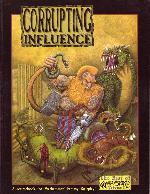
The book is 128 pages, perfect bound. It sports a full color painted cover of a Dwarven Troll Fighter engaged in battle with chaos beasts. Interior art is black and white. All art within and without is well done and depicts the dark, grim and gritty nature of the game the book is dedicated to. The font size is too small. No doubt this is so more material can be stuffed into the book, but it makes for a sometimes difficult read. There are several typos throughout, but nothing too jaring.
The book is divided into five sections:"The Game", "Background", "Fiction", "Scenarios" and "Miscellany".
"Fighting Chaos: Why Bother?" is the first article in "Chapter One: Playing the Game". It is by Timothy Eccles who has a reoccuring column in Warpstone called "The Correspondent". In this article, Mr. Eccles illustrates the ugly power of chaos. He discusses the fact that chaos dominates the game to the extreme that if it is portrayed as written in the "official" Warhammer world the average group of PCs won't have a snottlings chance in a game of Snot ball of winning; however, he doesn't offer any solutions instead saying, "I am not sure there is one". The article is an interesting opening for the book, but perhaps is not as strong as it could have been. It serves to open an interesting topic but does not offer any real solutions.
The next article "To Fight, or Not to Fight" by John Keane is a fun read and should be read by all players. Combat in WFRP is nasty business. Limbs are lost, fate points burn and people go insane. The smart player learns to avoid combat if possible. All GM's should make their new players sit down and read this gem.
I found "Volatile Magick" by Paul Slevin & Paul White the strongest article in this section. It explores the age old argument of magical weapons in the Old World. In my personal campaign, there are few. Players in my group learn to treasure any items they find. If I were to add a few more, then I would make use of this article. It gives some ideas on controlling magic by making it a "double-edged sword". Fun stuff.
"The Secrets of the Warhammer Artists" by Graeme Davis is an exploration of all the in-jokes by the Warhammer artists. It is a fun read, but I'm not sure it needed to be placed here as "the best of Warpstone".
"Chapter Two: The Old World" is the strongest part of the book. "Holy Knights, Pagan Days: Knights Templar in the Old World" kicks off this section and is brought to life by a host of people (Peter Huntington with additional material by John Foody, Anthony Ragan and Tim Eccles). This article is 27 pages long and worth every word. Templar orders of Sigmar, Ulric, Myrmidian and Manann are explored in depth. Background is here in detail and profiles are given to replace the Templar profile in the Warhammer rulebook. The article also touches on Templars from other orders and non-human templars. These are not given as much depth as the first five.
Reading "Low-Life on the Highway" by John Foody will give GM's a wealth of ideas to spring upon their players. "Disease in Warhammer" by Michael Anderson takes a look at medical history in the Old World and gives a list of diseases and their effects that adventures could come across. "A Gentleman's Guide to Marienburg" is meant as a handout that newcomers to Marienburg will find helpful. It serves as a colorful introduction to the city; although, I've found this article for free on the net. "Prosthetics" by John Foody offers an interesting answer to the famous Warhammer Critical Hits tables. With this article limbless characters can obtain everything from crutches to mechanical limbs. It also includes an NPC that would make for an interesting encounter. The chapter closes with "Mankind's Last Best Chance?" by Tim Eccles. It is a defense of the often abused Witch-Hunter, and gave me a new image of them.
"Chapter Three: Fiction" has one story by Francis Plunder titled "The Final Adventrue of Ursula Urjingraad". The sentence "fiction based upon the popular roleplaying game" sends shivers down my spine. Too often "roleplaying fiction" is so trite that I can hear dice tumbling in the background whilst reading it; however, this story is enjoyable. It has a surprise ending that I won't give away.
Interestingly enough, Chapter 4 is misslabled as "Chapter Five: The Scenarios". hmmmmm. A forgivable mistake, but a glaring one. This is the largest section of the book. Warpstone likes to concentrate on adventures which do not have cults as a focus and can easily be adapted to any city. These adventures hold to that standard except "One Hour (to) Morr" does have a chaos cult as its focus. All of them could easily be slipped into any city. I must admit that I have not had the opportunity to play-test any of these.
"A Hundred Years of Trade: The Hofbauer-Bodelstein Trading Company" by John Foody isn't so much a scenario as it is an excellent piece of background material with a worthy adversary for an intrepid group of PC's. "The Greys: A Secret Society" by Martin Oliver offers the same. In two pages I gleamed four plot hooks for my own campaign.
"Camoes" offers five adventure seeds. The theme of them seems to be placing players in the midst of a moral dilema "Rough Justice" and "AWOL" being the two finest of the five.
"The Eternal Guard" and "One Hour (to) Morr" both by John Foody are the first fully developed scenarios offered in the book. The first is a murder mystery set in the city of Marienburg with a Hammer Horror film feel. The adventure has good pacing and should make for an interesting night of play. "One Hour (to) Morr" is inferior, but it does offer an interesting new cult "The Third Eye".
"The Cannon Ball Run" is a short scenario also by John Foody. It involves setting up the players to foil a perfect crime, but it might be more fun to have them be a part of the crime.
"The Missing Children of Regensdorf" by Paul Williams is one of the most interesting of the scenarios. The children of the sleepy village of Regensdorf are being abducted and brutally murdered. The adventure has a couple of false endings, and should intrigue the players.
The last feature in this chapter "A Buried Past" by John Foody is interesting, but in my opinion needs some work on the GM to get the players to bite at the plot hook.
The book ends with player handouts with permission to copy for personal use given. There are also reproductions of the covers of the first nine issues of Warpstone and index listing articles from Warpstone issues one to nine. The best part of the index is many of the features from issues one to nine can be found on Warpstone's web sight. If that is the case, it is listed here (an example is an expanded disease list as a companion to the Disease article).

