

 Search
Review of Dwarfs: Stone and Steel
 Goto [ Index ] |
With the publishing of the much anticipated Realm of Sorcery (RoS) for Warhammer Fantasy Roleplay, Hogshead has begun its printing of books dedicated to the various races of the Old World in Warhammer Fantasy Roleplay (WFRP) with its first book: Dwarfs: Stone and Steel by Alfred Nunez Jr.
Keep in mind it is difficult to judge WFRP products, since Hogshead (hereafter referred to as “HH”) requires approval from Games Workshop for any of its products and must follow closely any precedent set by Warhammer Fantasy Battle (WFB) by Game Workshop (GW). Thus the finished and approved product may not be what the author or HH set out to produce.
In WFRP and WFB, dwarfs have been your typical gruff and dour dwarfs, with a splash of steampunk tossed in to sell minis. It was my hope that the product would expand beyond the typical genre conventions typified by Tolkien and a generation of gamers.
The Cover
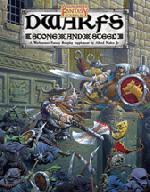
By Ralph Horsley while technically appealing has a generic battle scene of heavily armored dwarfs defending the gate to their city. The cover seems fitting for a WFB product, and while not that different from the cover of the WFRP rule book, I was hoping for something a little bit more subdued and setting a tone different from that of the WFB line, but the covers suffices. If the cover of the WFRP rule book suggest anything, gore sells books.
The Interior Art
Unlike Marienburg: Sold Down the River, this book has far less art and much of it seems to have been drawn from earlier WFB products, such as the full page art on page 6 which served as the cover for the WFB Armies Dwarfs book (for WFB 4/5 edition). Overall the quality of the art is good, but many of the images are too dark to even make out what is in the illustration while others are simply murky. My other complaint is that there are at least twelve pictures of a Dwarf standing around holding an axe, pick or hammer and looking menacing.
The Chapters
The book has nine chapters and three appendices.
Chapter 1: History of the Dwarf Race
This chapter does a decent job of succinctly updating the history of the Dwarfs, as detailed in the various WFB material to the rather sketchy WFRP history. While many WFRP fans might wince at the introduction of WFB background into WFRP, the author does it almost seamlessly.
Chapter 2: Dwarf Society
A chapter detailing Dwarfen society that presents a very stereotypical view of dwarfs: Age, Wealth, Skill, and Reputation are the main social values of Dwarfen society, with a nod to Tradition as well. Their social structure is predictable as well featuring Clans and Families. Notable here is the attention paid to female dwarfs and the author makes a point to present female dwarfs as central and important figures in Dwarfen society. Strangely, “Dwarfen Anatomy” is in the “Society” chapter. This is followed by Guilds and Craft Guilds, details on other social groups, expatriate Dwarfs who now live among human society, Dwarfen Law, the Calendar, and Dwarf-Friends and Grudges. Oh, I should mention that it is here that the old age question is answered: “Do female Dwarfs have beards?” (The answer, by the way, is “no”)
Chapter 3: Dwarfholds
This chapter covers the Dwarfen holds both in Dwarfen possession and lost to their enemies. It is here that the few adventure seeds are planted. Of use are the two maps detailing Dwarfen lands and surprisingly some information on Dwarfen holds in the “Scandinavia” of the Old World: Norsca, a welcome addition. The chapter concludes with an excerpt from Inferno Magazine, which while entertaining seems to be lacking in detail compared to some of the comparable work in Inferno by that author and artist.
Chapter 4: Dwarf Technology
A chapter that introduces some WFB material into WFRP. Gromril for example is a metal common to WFB but absent in the earlier produced WFRP and its addition here is welcome as well. A list of weapons then follow, although they are missing some useful information such as their weight (encumbrance), cost, and rarity which is commonly listed with equipment. Various Heavy Weapons, beyond the means of players are introduced as well although if these weapon'’ shells have a blast radius these are absent and alternative forms of ammunition are not listed, such as chain shot or shrapnel shot. Present as well are rules for the Gyrocopter that may upset those WFRP fans who dislike anything that smacks of WFB but I happen to like the whimsical inclusion of them in the world and appreciate their presence in the book. Another inclusion that might offend the sensibilities of WFRP purists are the details on Dwarfen ships, giant cannon armed metal clad ships and submersibles which I think add a nice “steampunk” touch to the world without going “overboard” (Pun not intended). For those who miss the groan-worthy WFRP and WFB jokes, worry not, there is a giant Earth Borer Mining Drill that uses a “Bhlak and Dekkur drill bit”, the name of the foremost tool company in the US.
Chapter 5: Magic
This chapter develops the earlier material on Dwarfen Runes in Realm of Sorcery. It reiterates some of the rules, details three famous “Rune Weapons of Renown”, and a whole new set of Runes as well as a reprint of the Runes listed in RoS. At the conclusion of the chapter there is a section detailing Dwarf Wizards and Alchemists which goes some distance in reuniting the Magic rules for Dwarfs in WFRP with those of WFB and the WFRP supplement RoS, a transition well executed without stepping on any toes.
Chapter 6: Dwarf Religion
This chapter proves useful in finally developing the threadbare Dwarf pantheon by giving us the descriptions for the Ancestor Gods “Grungni”, “Valaya”, “Grimnir”, “Gazul”, “Smednir”, “Thungni”, “Morgrim”, and the “Ancestor Cults”, the latter which I found to be one of the few innovating additions that this book has to offer. Overall this chapter proves quite useful in providing some of the details on Dwarfen religion and spiritual life.
Chapter 7: Dwarf Characteristics
This chapter is directly applicable to the generation of Dwarf PCs and NPCs. Thankfully it offers an extensive “Dwarf Names” chart for Male and Female names, so hopefully there will be far fewer “Gottri”s, “Gotrek”s, and “Snorri”s in the Warhammer World. The Place of Birth and Basic Career tables should help the development of characters. The chapter includes 18 new careers. These careers are “Farmer”, “Miner”, “Runescribe”, “Alchemist” (Dwarfen variation, four levels), “Lodefinder”, “Loremaster”, “Master Artisan”, “Master Engineer”, “Mountaineer”, “Pilot”, “Shipmaster”, “Dragon Slayer”, “Daemon Slayer”, “Stoneshaper”, and “Veteran Warrior. The “Warrior” career is actually just a list of additional Specialist Weapon skills to apply to the Marine, Mercenary, or Soldier careers from the WFRP rule book. The Templar and Witch Hunters are also simply variations on previously printed careers.
There is also a list of about ten or so new or reprinted skills that might add a bit of depth to characters, although a few are skills that would be possessed by only the odd Dwarf. There are also some details on adapting the rules from Apocrypha 2 to generate a PC’s or NPC’s background.
Lastly, there are a mere page or so on notes on “Role-playing Dwarfs” which I consider the worst part of the book and a severe disappointment.
Chapter 8: Dwarfs of Renown
This chapter feels like filler for the most part, detailing the characteristics, details, and skills of some of the famous Dwarfs of the world. It gives extensive history on each Dwarf but very little detail on their personalities. Eight are detailed here, and I felt this chapter was fairly useless although I was heartened by the fact that the author chose to include an old personality from WFB 2 “Sven Hasslefriesan” and his “Voltsvagn” (pronounced “Volkswagen”). This proved a nice continuity tie in with earlier WFB products.
Chapter 9: Khazalid & Runic Script
An extended treatment of previous Dwarf glossaries that gives quite a few runes and their translation into English. I personally would have liked a bit more detail on the grammar of Dwarfs to make convincing looking handouts, but this should suffice.
Appendix A: Timeline
An extensive and detailed timeline of the Dwarfs.
Appendix B: A Dwarf Glossary
A useful listing of Dwarfen terms. Might have been of use up front when the terms were first introduced, but would make a great handout for Dwarf players.
Appendix C: Gazetteer of the Dwarf Realms
A very useful listing of the Dwarfen strongholds. The author cunningly avoids the previous problems with earlier gazetteers by mentioning who is included in the population.
The Good
This book has a lot of content, and would be particularly useful for Dwarfen players. However much of this information is focused more on the role of “Imperial Dwarfs” who live among the ancient Dwarfen realms rather than the more common “Expatriate” Dwarfs who live among the humans and others, who incidentally are the ones most likely to be played.
For those unfamiliar with the WFB history, the history chapter will be quite useful, as well as the new careers (a handful of them badly needed careers, not just for Dwarfs but for the Old World in general), the new skills, the gazetteer, and the maps of the Dwarfen Realms. The Glossography could be quite useful as well for GM’s making handouts and the like.
The author does an excellent job of drawing in material from not only the current WFB material, but older material as well that predates even WFRP. A number of discrepancies between WFRP and even the various WFB versions are dealt with or cunningly evaded and thus proving that the differing backgrounds of the two games (WFB and WFRP) can be joined despite their differences.
This product is particularly useful for those GM’s who use Dwarfs in their campaigns and who are missing much of the WFB information to their game, and there is a sizable amount of content in this product.
However...
The Bad
There are a number of shortcomings with the product. First the presentation issues. All the copies I saw at the store seemed poorly bound, and upon opening the book that I purchased the back sheets to the appendices looked a bit loose, like frequent consultation might cause them to fall out easily as the glue seems to be separating.
Some of the art has been used previously before, at least one piece in a previous WFRP product while other pieces of art are rendered so dark as to make the illustration worthless. They look like black squares with white smudges in them. Also I was disappointed that only a few of the careers in the book had accompanying illustrations.
Overall the book has only a couple of typos that I found, so that proved not much of an issue. There is one place where the same information is reiterated
Other issues. The editor of the book had posted onto the WFRP mailing list that the book would include 32 pages of material on Chaos Dwarfs yet this material is absent from the book. I was a little startled since there was no mention of this omission on either the WFRP mailing list nor the Critical Hit Forum where that post was reposted and the author of the Dwarfs book participated. Seeing as how I bought the book to primarily read the Chaos Dwarf material, I can’t help but feel a bit disappointed that a huge portion of the material mentioned that would be present is absent instead without any notification. Furthermore there were very few references in the text proper to Chaos Dwarfs at all.
Compounding my disappointment is the actual writing of the book. To say this book was inspired by the earlier and original article on Dwarfs in the White Dwarf 152 article or the WFB Dwarfs book that followed would be generous. At various points in the text the author goes through and paraphrases these earlier works in an obvious manner. When I purchase a WFRP product, I expect a product for WFRP, not a veiled conversion from WFB to WFRP with some embellishment. Yet when I read the Dwarfs book and then consulted the earlier two sources, I found that the author had pretty much simply paraphrased portions of the book from these earlier sources.
For example:
“Appropriately this name means Torrent Gate”, because it stands in the deep chasm down the mountainside form Lake Varn, barely a day’s trek from Karak Varn. High above the city, a huge waterfall cascades from the lake and rush fiercely down the chasm. Here the ingenious Dwarfs have constructed thousands of water wheels to power their drop hammers, ore crushers and washing pans. The chasm resounds to the noise of mining operations, creaking wheels, and the rushing waters. At night the chasm glows with a thousand furnace fires.” (White Dwarf 152 page 56)
“A day’s trek from the fallen Karak Varn, Zhufbar (“Torrent Gate”) is situated in a deep, steep sided canyon formed by a thunderous waterfall cascading from Black Water (Drazh Varn) into the river below. Here, thousands of water wheels power huge drop hammers, crushers, washing pans, drills, bellows, forges, and other machinery. The sounds of rushing water and Dwarf machinery fill the entire canyon, reverberating from its walls. At night, the entire area glows from the fires of hundred of furnaces.” (Dwarfs: Stone and Steel, p 28).
It’s not just at this one point in the text either, but there are various locations where the text simply paraphrases earlier writings by Nigel Stillman, that I couldn’t help but wonder why that author wasn’t credited in some manner at the start of the book.
There seem to be a few oversights, as I mentioned earlier the encumbrance of weapons, their cost, their rarity, or the area of effect for various weapons. Most of the careers are fine, although the Ship’s Master who helps in the building of ships seems to be lacking “Boat Building”, “Carpentry”, and “Metallurgy”. I’m not crazy about the Slayer careers, but they’re pretty popular and I’m sure they’ll slake the thirst of many gamers.
The Chapter on NPCs was worthless to me and seemed needless, although I suspect that someone will be grateful that it is there. So setting aside my own personal objections, I wish that the author had noted where some of the skills and spells originated from so that GM’s and Player’s alike would know where to consult for that information.
My greatest disappointment is at an absence in this product: Roleplay worth material on Dwarfs. Everyone knows that Dwarfs grumble, like gold and ale, and at least in the Warhammer world seem to speak with a Cockney or Scottish accent. In other words, they’re stereotypes. The book states that all Dwarfs are individuals yet then saddles them down with the generic rules for Dwarfs: by loyal, keep your word, build a reputation, acquire gold, bargain, and honor your clan. In a 112-page book, the book offers a mere 9 paragraphs on role-playing Dwarfs. What I was hoping was that the book was going to expand upon the Dwarfen personality, not reinforce what existing stereotypes there are. Its scandalous when the “The Complete Book of Dwarfs” in AD&D 2nd Edition provides more advice on role playing Dwarfen personalities.
This could be remedied, but the chapter on Dwarfen society falls shockingly short on any detail. The material is superficial: we learn that they have low birth rates, that they are matrilocal and sometimes polyandrous but that’s about it. Yet there are no real details about Dwarfen society that brings their daily life into vivid focus. What’s a Dwarfen home like? Do they sleep on beds or stone? Do they eat meals together? What is sacred and what is profane? What is taboo in their society? We know about their burials, but how long are they mourned? What exactly are the ceremonies performed? Are they accepted as Ancestor Gods? Is it common to build a memorial to them? What does food mean to them? What do the consider art? Do they have theater? How important are the performing arts? What are their religious ceremonies like? Do they have shrines in their homes to their ancestors? What happens to the crippled or the mentally insane? What currency do they use? How does the internal economy work? How is their military organized? Are common folks allowed to be officers or only nobility? What are the kind of wages a Dwarf makes? What is life like for the Expatriate Dwarfs who make up the majority of PC Dwarfs? The treatment of Dwarfen culture was so superficial and hewed so closely to the WFB material that there wasn’t any real development beyond the standard Dwarfs with a dash of “Tinker Gnome” steampunk thrown in for fun and flavor.
The book presents a very homogenous society where everyone seems to follow the rules, which suggests to me simplistic world view. Where is the conflict and divisions inherent in any society? What about feuds over the wills of the dying? What about conflicts between the nobility and other segments of society or between other noble families? What about angry, aggressive males who are rejected at marriage or feel cheated? What about trade wars? Ancient grudges between clans over sleights, real or imagined? What about old age and disability? What about adultery? What if a woman can’t bear children? Is there Dwarfen homosexuality, after all, half the population is unmarried? Is divorce possible? What about child abuse? What about human racism against Expatriate Dwarfs? What about animosity between Expatriate and Imperial Dwarfs? Dwarfs keep everything in, what if they just snap? Are there Dwarfen serial killers and murderers? What about Dwarfs simply snapping under the oppressive pressure of their culture and traditions? Are there alternative to dealing with shame other than joining the Cult of Slayers? How do Dwarfs with the traditional society cope with the ever increasing technological innovations?
What about relations with humans? Prices too high – trade wars. What about human resentment to all the psychotic Dwarfen Troll Slayers entering human communities? What about cultural misunderstandings? What about human resentment towards Dwarfen miserliness? Or human envy about Dwarfen skills and craftsmanship? What about anti-Dwarf union pressure? These are things that should have been discussed in greater detail, these are the things that will make for an interesting game and be relevant to play in an area where humans predominate! It’s important to stress that the books applicability to most campaigns is very limited due to the book’s myopic focus on the Imperial Dwarfs of the mountains as opposed to the Expatriate Dwarfs that make up the vast bulk of PC and NPC dwarfs in any campaign.
The fact is that the image of Dwarfs in the “Dwarf: Stone and Steel” book is a far cry from the way Dwarfs are depicted in WFRP to date. Shadows Over Bogenhafen had its wretched drunken Dwarf in stocks, only to be later found dead as well as human racism against Dwarfs. Death on the Reik had less than honorable Dwarfs bailing from their work assignment and frightened of a bogeyman, as well as a Dwarfen slum where the Dwarfs had fallen on hard times and even sold their Clan Chieftain’s magic weapon for drink and food. Something Rotten in Kislev had a mad necromantic Dwarf with a fancy for necrophilia, and one of the PCs for that adventure was a grave robbing agitator. Power Behind the Throne presented a reviled Dwarfen class that few bothered to stand up for. Yet there was barely a hint of this dark and dirty side to Dwarfen existence. For a role play supplement, there’s very little “role play” there.
The picture painted of Dwarfs in this book has far more to do with the heroic image presented in Warhammer Fantasy Battle rather than the Grim World of Perilous Adventure in WFRP. Essentially, this book dropped the ball by turning its back on the very atmosphere that made Dwarfs different from other games. Rather than developing the complex and ambiguous image of Dwarfs presented already in WFRP products, we get a whitewashed sanitized version without a hint of conflict, complexity, or character. Creatively, this is far below the standard of most WFRP products.
Conclusion
This product deserves an “Average” rating at best. A Three “Average” for Style due to the adherence to WFB imagery, Dwarfs standing about waving things suggestive of over-compensation, and the too dark images. Content-wise this product delivers the same old material with little new spin on it, mainly in part because at some places it just reiterates what has already been said in other books – literally! Still, there is relevant information here, particularly in generating Dwarfen characters, some magic, new careers, great maps, and the gazetteer. GM’s with little knowledge of the WFB version of Dwarfs will find this content exceedingly useful. But its critical use, at developing and redefining our concept of what Dwarfs are in the game, their limits and potential has been greatly neglected. As I stated, this is essentially a product going through the motions, an uninspired conversion of previously published material for WFB with considerable embellishment, but with nothing substantial. As a role playing supplement, it is sorely lacking in providing any of the rich inner life that Dwarfs and their society should have. Thus a “Three” or “Average” for Substance, although personally I feel that a company should try and aim higher than just merely putting out an “Average” product.

