

 Search
Review Editing
Review of Trollbabe
 Goto [ Index ] |
Introduction
Trollbabe is a new roleplaying system by Ron Edwards and published by Adept Press, currently in PDF format. It is available from the Adept Press website http://www.adept-press.com/trollbabe for $10.00 and is delivered to the customer via a password protected download. This allows you to access the document anytime, and download it again if it is lost.
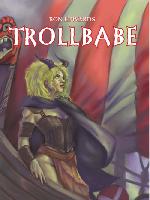
It is 47 pages, black and white interior, color cover, and includes an index. The artwork varies in quality, but is all suitably evocative of the setting. The cover is astounding.
Setting
The game takes place in a vaguely defined fantasy world largely populated by humans and trolls. The humans are (roughly speaking) of Germanic/Norse cultural types. The trolls are, well, big and hairy. Three maps of the setting are included, but very little detail is given. The expectation is that each gaming group will flesh out the setting around the needs and exploits of each trollbabe's saga, starting small and growing the scale slowly over time. More on this below.
There is only one characer type available: the trollbabe. What is a trollbabe? Trollbabes are tall (7' or so) female half-human/half-troll hybrids. They are inhumanly strong, deeply magical, and a fulcrum of conflic between the races. And they have horns.
Yes, horns -- comming out of their heads.
This will, perhaps, be off-putting to some players used to a broader selection of character types, but in the tradition of Prince Valiant, and early versions of Pendragon, Trollbabe focuses not on widely divergent character powers, but on divergent actions in play to distinguish characters.
Structure of Game
The Trollbabe mechanics have a single goal, and that is to promote the construction of a cool, dramatic story surrounding the trollbabe. There is no effort to accurately model some fictional world, nor to provide play balance. For example, the level of magic a trollbabe can use is determined by the scale of the adventure, not on any intrinsic abilities of the character. In an epic scale adventure, epic scale magic is available. In a narrowly focused adventure concerning a few individuals, lesser magic must be used. There is no attempt to "make sense" of such differences, only that the logic of the story hangs together properly.
Corespondingly, there is a focus on player empowerment, as it is the player who will make key decisions regarding how his trollbabe's story unfolds. The GM's power, on the other hand, is limited in specific ways. For instance, the player decides where an adventure will take place by stating (in between adventures) where his trollbabe will be travelling next. The player also decides (to a limited degree -- see below) the scale of the adventure. The GM then decides the "stakes", which is simply the ongoing situation confronting the trollbabe. This division of power is found through the rules: the GM "frames" scenes, either the GM or player can call for a conflict resolution (see below). The GM narrates the exact effect of a successful outcome. The player, on the other hand, narrates the outcome of failed conflics.
This division of power will seem odd, of course, to gamers used to the traditional "GM is god" approach, but it is a very deliberate design choice meant to avoid certain common pitfalls in other "storytelling" type games. Namely, situations where the GM generates a complex story with his NPC's as the protagonists, and the player characters merely the supporting cast. In Trollbabe this situation is impossible. The players have great power in driving the narrative.
System Overview
The trollbabe has merely one stat, called her "number", which may be chosen arbitrarily by the player. To win fights she must roll less than her number. To succeed with magical effects, she must roll higher. There is also a scale for social conflicts, also based on the number.
If a roll is a failure, it can often be re-rolled, like many systems with "fate points" or "luck points". There are a couple of twists, however, which make re-rolls a central element of play.
The first is that re-rolls must be accompanied by an event or description, provided by the player. On the character sheet, there is a list of re-roll events, and the player must check one off for each re-roll. That even cannot then be reused until the next session (usually). A couple of examples are "a sudden ally" or "a remembered spell". If the player wishes to re-roll, he must make up an event or description matching the checked item. For instance, if the player checks "a remembered spell", he must describe the spell that his trollbabe has suddenly remembered and how it helps her. It is OK, in fact expected, for the player to make this up spontaneously.
The second aspect of re-rolls is they raise the stakes of failure. If you fail a conflict, and don't re-roll, then the effects of failure are guaranteed to be mild -- and the player gets to narrate the exact circumstances of failure anyhow. However, with each re-roll attempted, the cost of failure rises, through injury ultimately to possible death. This means that only in situations where many re-rolls are made, and thus presumably the situations is of high narrative tension, will great loss be possible. This is the logic of storytelling, not reality.
And regarding character death, a trollbabe can only die if the players wants her to. Otherwise, she is merely incapacitated and thrust deeper into the conflict. In fact, this is the point of all failed die rolls, not to punish the character, but to introduce complications and deepen the suspense.
Relationships
Along with the re-roll items mentioned above, a trollbabe can qualify for re-rolls based on the relationships she has with other people, or even groups. For instance, if she makes friends with a fellow traveller, and they get into a scrap with someone, she can qualify for a re-roll by virtue of having her friend helping her. However, relationship based re-rolls can also be had for more vague connections. Is she fighting for the honor of someone she loves? Certainly a re-roll is allowed then. Did her mentor teach her a trick for fighting giant rats? Why not. All the player must do is check off the mentor relationship and describe the trick. Player creativity is rewarded here. Even adversaries can be used to gain re-rolls if the player is creative enough.
There is a deeper point to relationships, though. Relationships form the only method of character advancement in Trollbabe. The trollbabe herself is considered to already be a profoundly competent person. It is through her relationships with others that her power grows. This idea has obvious roots in games such as Pendragon and Hero Wars, but Trollbabe is the first system that I'm aware of that it forms the exclusive advancement path.
Campaign Structure
I've saved what I think is the most innovative aspect of the game to last, and that is the notion of scale in Trollbabe. Put simply, each adventure has a scale, which measures the number of NPC's whose fates are in the balance. For instance, an adventure may present the trollbabe with a young troll being hunted by a band of humans. The stakes then, would be the life or death of this single troll. On the other hand, the stakes could involve the fate of a kingdom.
The stakes of the first adventure starts low, a single (or a few) persons. The stakes can only be raised at the request of a player (between adventures), and they can never be lowered. This forces a structure on the campaign starting with small, personal conflicts, and gradually rising (at the player's pace) to a more epic scope. This is, as far as I know, the first time this has been used.
This makes campaign construction very easy. It is simple to invent a conflict about a few people. And by the time a campaign reaches more global scope, the characters should have settled into the setting, and have formed a network of relationships to work from. This avoids the, "This premise is so huge, where do I start?" problem found in games such as Nobilis. I believe this same technique could benifit such games, even if not formally part of their rules.
Conclusion
Well, it should be obvious that Trollbabe isn't everyone's cup of tea. Folks who don't tend to like storytelling focused games, or games on the rules-light side, won't find anything here. However, for those who do, Trollbabe is a very tight, focused, and truly innovated system. It almost perfectly targets its goals. It is most similar, in this regard, to the (sadly out of print) Prince Valiant system by Greg Stafford. Folks who liked Prince Valiant will love Trollbabe.

