

 Search
Review of In The Labyrinth
 Goto [ Index ] |
Melee and Wizard were both released in 1977, but In the Labyrinth didn't come out until 1980. In the roughly tree years in between, a lot of things had changed in the fantasy RPG landscape. In '77, Dungeons & Dragons and Tunnels & Trolls had been the only major fantasy RPGs; by 1980, they'd been joined by AD&D, RuneQuest, Chivalry & Sorcery, High Fantasy, and others. TFT was no longer the only fantasy RPG with an emphasis on detailed, "realistic" rules.
Nevertheless, TFT managed to make a splash -- enough of one that, for a time, it was the second-best-selling RPG, with only AD&D ahead of it. So let's take a look at this game that did so well...
Presentation
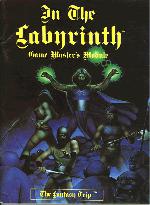
In the Labyrinth was a single, staple-bound book, with the "letter sized" pages that are still common for RPG books today. The cover artwork was a reasonably good quality painting of a party of adventurers battling some generic humanoid monster-thingies around a campfire.
Inside, the rules follow a two-column layout. Artwork is sporadic throughout the rules, and generally of good quality for the time. These days it'd be considered very plain, but in the days pre-Pagemaker, it was about as good as you were going to get in an RPG. As with the other books, the text is easy to read, things are explained clearly, and there are good examples given.
The System
TFT could be considered one of the first "universal mechanic" systems, with everything rooted around the TFT saving throw. Since TFT was attribute-based, saving throws were made against an attribute, and had a difficulty expressed as a number of dice -- e.g., 4/DX would be a saving throw on four dice against Dexterity. A character succeeded with a saving throw if he/she rolled equal to or under his/her current value in the attribute listed.
This mechanic was also the basic mechanic that was used for combat and magic -- a combat "to hit" roll could be considered a 3/DX saving throw. However, for historical reasons, the term "saving throw" wasn't used to describe it in that context.
Complicating things a bit were automatic successes and failures -- an extension of the critical hits and fumbles that combat and magic had. A table listed automatic success and failure thresholds for different saving throw difficulties. A few items specified that automatic successes were not possible for them -- you simply couldn't "luck into" doing them right.
The central task for the GM in task resolution, then, was to set saving throw difficulties. The rules helped out here with plenty of specific examples throughout.
Character Creation
In the Labyrinth took the character creation system that Melee and Wizard had used and built upon it, creating a fully point-based character creation system.
Players started out with base minimum scores in the three attributes of Strength, Dexterity, and Intelligence, and some "extra" points to allocate among those attributes -- just as in Wizard. Players then had the choice of whether to create a Hero or a Wizard.
Wizards could know spells, just as in Wizard -- the spells they could choose from were determined by Intelligence, and Intelligence also gave the number of spells they could know.
Heroes could also know spells -- however, they could only learn one spell for every three points of Intelligence, and Heroes could only use spells they'd bought that way; where a Wizard could pick up a spellbook and read a spell out of it, Heroes could not do that.
What Heroes got in return was greater access to Talents -- the skills of TFT. Like the spells of Wizards, Talents required a minimum Intelligence to learn, and had an effective "cost" in Intelligence to know. Unlike spells, however, Talents cost varying amounts of Intelligence. Heroes could buy them at the listed cost, but Wizards had to pay double (except for a couple of special Talents that were considered to be "semi-magical" in nature, such as Alchemy). Among the various Talents were weapon proficiencies, which meant that while Wizards could in theory fight as well as Heroes, in practice, they rarely would.
It should be noted that some of the "talents" in TFT overlap into would be considered "advantages" in other games -- for example, the Charisma talent, the Sex Appeal talent, and the Warrior talent (which reduces damage taken in combat).
The system also had a wealth of character races to choose from -- the standard humans, orcs, elves, dwarves, and halflings were there, but also goblins, hobgoblins, centaurs, giants, gargoyles, reptile men, mermen, and TFT's own original race, prootwaddles (which were primarily a "comic relief" race, but you could play one if you were insane enough). There was also a short section devoted to the topic of half-breed characters, for those lovers of half-orcs and half-elves.
Combat & Magic
Both combat and magic were covered in TFT in their respective books -- Melee or Advanced Melee, and Wizard or Advanced Wizard, depending on the level of detail and options you wanted. IMHO, Melee worked fine as an RPG combat system, but Wizard is a bit limited; I'd strongly recommend Advanced Wizard instead. (See my prior review of Wizard for reasons why.)
One interesting thing is that the rules on secrecy which apply to player-vs.-player games with Melee and Wizard also apply in games with a GM, if the GM is also running the monsters. Thus, under the TFT rules, a player whose wizard's casting a spell doesn't always have to tell the GM what spell his/her character is casting! Just as in GM-less play, though, a player doing that must write down what spell is being cast and set the paper with it aside, so it can be revealed when necessary.
In some cases, the players may have to tell the GM an effect, but not how the effect's being produced -- for example, the player might tell the GM "my wizard casts a spell, and a wolf appears in this spot", but doesn't have to reveal whether the spell cast was an image spell (making the appearance of a wolf with no reality), an illusion (making a semi-real wolf), or a summon spell (producing a real wolf).
This also applies to invisibility -- the player of an invisible character in combat can choose to use plotted movement, noting down on paper where his/her character is moving, and only reveal the character's location when the character does something to reveal it. Combined with the other rules, this means that the player of a mage character could cast a shadow spell (creating darkness in an area), have the character move into it, cast invisibility, create an illusion of him/herself, send the illusion out, and then move out invisibly... without the GM knowing that the illusion is just an illusion!
I note all this because it's a very different paradigm than players usually operate under today -- a very Gamist paradigm, to lapse into threefold-speak for a moment.
The Rest of the System
With combat and magic, which took up the majority of most fantasy RPG's rules, put in supplements, what did ITL have to fill its pages with? Quite a bit, actually.
There's a fairly extensive section on jobs that characters can hold between adventures. Most of the time I didn't use that, since most player aren't interested in their characters holding down "ordinary" jobs, but it was useful for times when the party had some downtime and one or more of them wanted to make money. It's also nice to have info on such things as how much money a mercenary captain makes, how much town wizards make, etc.
A brief system is presented for handling getting caught by city guards and trials. There are notes on duels and their status in the setting, overviews of the guilds that are common in the setting and what their dues and pricing for various services are, rules for hirelings (including slaves, since slavery is legal in parts of the setting), and rules to use if the PCs are out looking for a job.
There's the typical equipment table, along with notes on adjusting weight of armor for larger and smaller than human characters. There are also notes on how much creatures of different sizes typically weigh.
For adventuring, there's notes on movement speeds, how long different actions take, rules for lighting, noticing things, recognizing what something is, doors (opening, breaking down, etc.), tunneling (bring your pick!), traps (including not only detecting and removing, but advice to the GM on designing them, and rules for PCs setting them), and noise and hearing it.
And, of course, there are rules for advancement. Characters earn experience points for combat, casting spells in pressure situations, successfully making saving throws (either against danger or to use a talent), time spent in play, and the catch-all category of "GM's discretion" (which seems to be mostly for roleplaying awards). There's also a note that players can and will try to abuse the XP system by doing things like killing small helpless animals, opening the same lock all day, etc., and admonishing the GM not to let them get away with it.
Monsters
They're not really "system", but the game does have a fairly extensive list of "monsters". The PC races mentioned above can all be used, and the common fantasy bits (dragons, ogres, trolls, giant spiders, etc.) all get their spots. Animals receive pretty good coverage, especially riding animals.
There are also some unique ones, some of which are quite silly (in name, at least) -- brown and silver slime, piranhakeets (piranha/parakeet), scuttles (bloodsucking crustaceans), goo (giant amoeba), bloodtrees (bloodsucking trees), am bush (bushes that fire poison gas pods), hymenopterans (intelligent insects that come in several types, commonly called "bugs"), slinkers (monkey-like things that like to steal stuff), intelligent, magic-using octopuses, and shadowights (creatures of solid shadow).
The Setting
TFT is nominally set on the world of Cidri. Cidri is an artificial world, constructed by a group of dimension-travelling humans called the Mnoren. It's a huge world, with a surface many times as large as that of Earth -- the idea being that even though gamemasters may create whole continents of their own, they can all fit somewhere on Cidri.
The Mnoren are now vanished, but there are gates littered around the place that lead to other parts of Cidri, or to other worlds entirely. And the dimension-travelling past allows for the presence of high-tech artifacts, characters drawn from other worlds, and excursions to other worlds/universes.
Cidri itself isn't specified much, though -- outside of the mentions that duels and slavery are legal in some places, the various guilds, and the unique monsters listed above, we don't learn much of anything about Cidri.
There's four pages near the back with a sort of mini-setting -- two one-page maps (a village and an area of about 250 x 300 miles around it), a page of notes on the village, and a half-page of notes on the area map. It's enough to get a group started, but it's hardly a full setting.
Thus, for practical purposes, TFT is simply a generic fantasy game, with a few rules that allow for mixing in high tech with your fantasy.
Odd Stuff
There are a few odd things about the rules. The major one is the insistence on using hexmaps for everything -- thus all the "dungeons" presented have corridors going off in the six directions of the hexmap. This does work fairly well for natural caverns, but in buildings, it can be a bit of a pain. There's also a set of suggestions about how to map labyrinths (the TFT word for dungeons), with the suggestion that you use different colors for different levels of the dungeon, mapping them all together. A neat idea, but in my experience, it just produces unreadable maps.
Conclusions
In the Labyrinth expanded Melee and Wizard into a true roleplaying system through the addition of talents to character creation, and the addition for rules for things other than fighting with weapons or magic. It continued the tradition established in the previous games of clear, logical rules that just seemed to make sense.
The major problem I encountered with TFT in the two years that I ran it was that once players advanced past a certain point, everything became too easy. Since there were only three attributes, and all rolls were made against attributes, it didn't take a lot of advancement for things to get very easy. The fact that most of the saving throws in the system were against 3d6 -- including all rolls to hit or to cast spells -- didn't help a lot. A character with a 14 or 15 effective Dexterity would almost always successfully hit in combat, and could almost always successfully cast spells.
But with that problem laid aside, TFT was a clear, easy-to-understand, well-packaged system. The system appealed both to those looking for more realistic rules, and to those looking for a simpler, more "gamey" system -- not an easy task to accomplish.
Overall, I'd have to say that TFT was one of the best systems of its era. The simplicity and quality of the rules is why it continues to have active users, even after being out of print for over 15 years. In some ways, GURPS can be considered to be "TFT Version 2", but I personally find TFT to have a much simpler feel to it than GURPS.
In its own time, I'd consider ITL to be tops in both Style and Substance. Today, I'd consider it a bit below average in Style, and above average on substance.

