

 Search
Review of Torg Starter Set
 Goto [ Index ] |
I. Contents
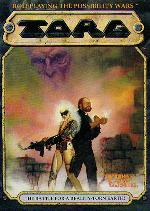
Torg originally came in a boxed set, containing the Rulebook, an Adventure Book, and a World book, plus one Drama Deck and a special Torg die (a red-and-blue mottled D20, highly prized by Torg enthusiasts). The art varies in quality, from mediocre to striking. The Rulebook cover is a passable glossy of a bionic future punk and a Catholic priest, with an evil face lurking the clouds. The back cover has the memorable phrase, "The storm has a name..." These books are all of sturdy construction. The books have a nice, dark, attractive font.
II. Capsule in Brief
The Rulebook is divided into two sections. In the Player's Section, Chapter One is Creating a Character. Torg's default is a template-based system; assign some skill points, and go. This section is brief. Chapter Two is The Basics. While it does go into much detail, it does a good job of explaining some of the Torg mechanics, a language all their own. Chapter Three is the Drama Deck. Since card play is a unique feature of Torg, this beats some explanation as well. Chapter Four is an introductory solo, the Lizard and the Lightning.
The Gamemaster Section is divided into thirteen chapters, beginning with On Being a Gamemaster, a thorough treatment of the Torg rules, some background on the world of Torg, and a section on creating new character templates.
The Worldbook is an indispensable companion. It's a combination gazeteer of Core Earth and the Realms, and rules supplement for the Realms.
The Adventure Book has two sections. The first is a primer on running Torg. The second part contains a sample adventure (Before the Dawn) that introduces the metaplot, as well as various adventure seeds.
Torg suffers from some organization problems. Some rules appear only in the Player's Section or only in the Gamemaster's Section. The first part of the Adventure Book should probably have been integrated into the rulebook. There is no index. Several Realms in the Worldbook introduce new skills. The sample adventure is abysmal; besides being highly linear, it features a silly German damsel in distress popping up in dinosaur-occupied Los Angeles, and doesn't capture the flavor of the Realms very well. It's also quite difficult for beginning characters.
III. Torg Mechanics
Characters have the Attributes of Dexterity, Strength, Toughness, Perception, Mind, Charisma, and Spirit. Human average if 8, with an upper bound of 12. This may see flat, but Torg uses an exponential scale, such that every 5 points marks a tenfold increase. PC's have an average Attribute of 9 and 3/7. Each template has a Tag Skill, rated at 3 adds, and may distribute 13 adds among other skills (up to 3). A Skill has a related Attribute, to which it is simply added when generating a result total.
To perform an action, the player generates a dice total, by rolling D20. A natural 10 or 20 entitles the player to another roll. The total is compared to a chart that generates a Bonus Number; the Bonus Number is added to the Attribute or Skill. If the result total equals or exceeds the Difficulty Number, the action succeeded. In cases where a degree of success is needed, the margin of success can be read on a chart that will give a result of Minimal, Average, Good, Superior, or Spectacular. Combat and other situations use the margin of success in other ways.
There are two kinds of characters. The first are Ords, normal characters. The second are Possibility-rated characters, which includes the player characters, important NPC's, and the villains. Possiblity-rated characters are defined by the Reality skill and Possibility Points. PC's begin with 10 Possibility Point. By spending a Possibility Point, the character is entitled to add another open-ended die to an action total. A Possibility can also cancel some damage. Finally, they are used to fuel some abilities. Characters earn Possibilities throughout the adventure, and receive an additional award at the ened. Possibilities are also used as experience points; they may be spent between adventures to learn or improve skills.
Besides Possibility Points, characters also have the Drama Deck on their side. It is used in two ways. First, there is the initiative line. Each round, a card is drawn. It determines which side goes first, as well as describing special conditions. For instance, "V: Up H: Flurry" means the bad guys go first AND get a free roll-again, but the good goes get to make two actions apiece. The Deck is also used as a tool for the players to influence the game. Each player keeps a hand of cards. These cards may be Hero Cards (may be used as an additional, free Possibility Points), Adrenaline cards ( 3 DEX, STR, or TOU for one roll or event), or Subplot cards (which may introduce relationships with NPC's, provide helpful clues, or allow special actions like Martyr). Players use their cards in conjunction with Possibilities to create humongous action totals, allowing the kind of super-action found in Hollywood blockbusters. For instance, a character shooting at a jeep might, by spending a Possibility, using a Hero card, and Adrenaline, eagle-eye the engine and disable the jeep in one lucky shot. Cards are regenerated between Acts. Additional cards may also be gained by taking Approved Actions.
While most games treat sand-throwing, intimidation, or fake-outs as matters for GM judgment, Torg takes an exhaustive, innovative approach. Besides the standard attacks, Torg allows you to Maneuver, Trick, Intimidate, or engage in a Test of Wills. These can have the result of making an opponent lose a roll again, act as Unskilled, or on a supreme roll, suffer a Player's Call, suffering the worst possible outcome of the character's intent. These Interaction rolls are sort of a bridge between the Charm and Persuasion rules and Combat. In Torg, it is not only possible, but desirable, to attempt to tire out or trick your opponent, just like the movies. Besides the immediate benefits, which can be significant, the Interaction rolls appear as Approved Actions on the Drama Deck. If a character succesfully performs the Approved Action, the player draws an additional card.
Combat is basically a skill contest. If you hit, your same roll as used as an Effect Total, and the result points are read against their Toughness as damage. Ords take more damage than Possbility-rated characters; the in-game explanation is that an infusion of Possibility energy makes someone more able to escape death, while the basic effect is another version of the Mook Rule. One quirk of combat is known to Torg afficianos as the "Glass Ninja Effect." In short, because it is so hard to hit a high DEX character (such as a ninja), when you do hit, your roll must very high, translating into a large damage total. Splat. Some gamers regard this as a fatal flaw, others as not a problem, and many come up with their own House Rules and fixes.
The core book cover a variety of weapons and equipment from various technology levels with admirable ease. It also includes the house Magic and Miracle systems.
Some players may find the mechanics overly complicated. However, Torg's unique blend of narrativism and number-crunching can be very satisfying.
IV. Torg: The Possibility Wars
The setting is this: sometime in the Near Now, on an Earth basically like ours, alien invaders strike. The United States experiences huge areas of blackout and technology "dead zones" as bipedal dinosaurs attack. Indonesia falls off the map, Egypt gets invaded by shocktroopers and tanks, and France turns back the dial to the Middle Ages and the era of Papal supremacy. Earth has been invaded by the High Lords.
Each High Lord is a supervillain of supervillains, armed with a Darkness Device. The Darkness Device is actually an evil entity that takes the form of a powerful artifact appropriate to its home reality. The High Lords receive great power. The goal of a High Lord is ultimately to become Torg, a demi-god with full command of his Darkness Device. To accomplish this, he must drain the Possibilities, the lifeblood of Reality. What High Lords do is to open interdimensional gates to other realities. They then invade, bringing their reality with them. The invaded reality fights back. Stelae, special devices designed to absorb and store Possibilities, connect the invaded Realm to the invader's reality. As Possibilities run low, and belief shifts from the original reality to the invader's, the area is transformed. The transformation is physical, as trees spring up in industrialized areas or castles turn into modern offices, but it is also metaphysical. Reality is defined by belief. In some realities, magic is possible. In others, technology we consider "impossible" is commonplace.
But such an invasion requires careful planning. A surge of Possibilities can destroy poorly placed stelae, while the invaded reality has millions of souls ready to oppose the invader. Furthermore, the clash of realities causes the forces of Reality to create champions. People Transcend, becoming Possibility-rated, able to alter destiny to their will. Many of these become heroes, a threat disproportionate to their numbers. Torg is a game of legends; these Storm Knights serve as a focus of the resistance, while also inspiring ordinary people to believe and fight back.
While the invading realms blanket Earth with a new reality, it is possible to defy the new reality. People can create "contradictions." The Possibility-rated can even create personal bubbles of their home reality. But over time, the world transforms to the new way of being.
Each invader brings their own version of reality with them. Most of these are recognizable variations or fusions of cinematic genres. They are:
The Living Land - Blanketing much of the former United States and Canada, this is a land of primitive reality and spiritual omnipresence. The invaders are the Edeinos, bipedal reptiles who revere Lanala, Lover of Life, through their panentheistic, ecstatic faith. Technology doesn't work here; neither does magic. But the edeinos are capable of a wide variety of miracles, including prayers that turn pain into joy, or create weapons out of living things. The edeinos loathe "dead things." Their leader is Baruk Kaah, High Priest of Lanala. Like many High Lords, his ambition lead to corruption, making him an easy tool for the Darkness Device. Besides encouraging Baruk Kaah to use and handle "dead thing" (like Earthly tools or stelae), this Darkness Device has also perverted Lanala's ecstatic faith into a religion of war and arrogance. The Living Land is sort of a cross between "Land of the Lost," "The Herculoids," "Jurassic Park," and "The Gods Must Be Crazy."
The Nile Empire - A colorful fusion of pulp adventure and Egyptian myth, the Nile Empire is a near-Earth reality, Terra, similar to our 1930's. The Pharaoh Moebius was a costumed arch-villain. A resurrected Pharaoh of a legendary time, he acquired a Darkness Device in his quest for mystical artifacts. Rather than conquering his home world, like most High Lords, he simply disappeared, and turned his attentions to other realities. His twisted realms feature Tommy guns, masked vigilantes, weird science, Egyptian magic, and the miracles of Egyptian myth. Think of the Pharaoh as a supervillain who won. However, some of Terra's heroes discovered what had happened, and found a way to follow him to Earth. These Mystery Men are reminiscent of early Golden Age superheroes. The Nile Empire is Flash Gordon meets Indiana Jones, with echoes of "The Shadow," "The Rocketeer," Weird Tales, "The Dark Knight Returns," and the Golden Age Green Lantern. Fans of Adventure! should feel right at home.
The Cyberpapacy - With reality at his fingertips, Jean Malreux, the Pope of Avignon, set about putting the world under the rule of his Church, and perverting the stern Catholic faith of his world into something that better suited his purposes. Another Earth-like reality, Malreux's invasion plunged France and her neighbors into a new Dark Age, complete with an enthusiastic Inquisition. But in the early days of the Possibility Wars, some heroic Storm Knights confronted Malreux. In the process, Malreaux was connected with Earth's mythic Dreamtime as well as a cybertech reality. He transformed, and his Darkness Device propogated the change. Embracing cyberware as the Lord's gift, he rules over the Cyberpapacy, a realm of Middle Age theocracy and cyberpunk technology, peppered with sorcery and demons. Malreux is a wicked Antichrist, a deluded would-be-messiah who is actually a pawn of evil.
Aysle - Fantasy reality. Not a D&D knockoff, this realm nonetheless supplies the requisite elves and dragons. Aysle is a disc-shaped world ruled by humans, populated with oppressed, jaded dwarves, violent, chaotic giants, and aloof elves. Aysle features such unique touches as Secular Dwarvenists, Renaissance-era technology, and a strong Scandanavian flavor. The High Lord is a special case. Once, the evil Uthorian invaded Aysle, wearing his Crown of Darkness. Light and Dark battled. In one decisive battle, Uthorion killed Queen Ardinary's champion, then confronted the Queen herself. Rather than simply kill her, Uthorian sunderered his spirit and took over her body. Impersonated the Queen, he claimed victory, and set about placing all of Aysle under his rule. But during the Possibility Wars, he was drive from Ardinary's body. Ardinary, a good-hearted and honorable ruler, is now technically the High Lord. She won't use the Darkness Device, but is reluctant to call back her forces until things are set right. Meanwhile, Uhtorion has taken a new body, a Viking warchief, and is still scheming to reclaim his place as High Lord. Think "Willow" meets "Braveheart" meets "Excalibur," with touches of "Beowulf," "Lord of the Rings," and "The Three Musketeers."
Nippon Tech - Most invasions on Earth began with spectacular bridges decending from the Heavens. Not so in Japan. There, a secret army of businessman, gangsters, and spies arrived well in advance. When the invasion hit, no one noticed a thing except some odd weather. But something had happened. Nippon Tech is a megacorporation, one that ultimately controls most of Japan, and a disturbing amount elsewhere. In a short amount of time, Japan's technology skyrocketed, along with pollution and crime. Meanwhile, the Yakuza are on the move, allied with mysterious ninja. Nippon Tech is a non-magical, non-spiritual realm of intrigue and technology. But in the corners lurk the discontent and the secrets of the Martial Arts. Think "Rising Sun" meets "Robocop," with dashes of Akira and the ninja movies of the 80's.
Finally, there is Orrorsh- the realm of Victorian Horror. Another Earth-like world, in Orrorsh's history, there arose an Empire that ruled the world. Redcoats brought order and civilization to the darkest corners of Gaea. But then something happened, something horrible, and the world become plunged into a living nightmare. Behind it all was the Gaunt Man, a name synonymous with evil. Gradually, the Empire crumbled, leaving only a fortress-like enclave of civilization on an island called Victoria. The rest of the world was lost to murder, terrors of the night, and diabolism. Worse, one of the Victorian's own unleashed evil onto our Earth. The Victorian marched, hoping to undo what they had wrought. But they had been duped. The Gaunt Man was behind it all. Orrorsh is a realm of Victorian colonialism. Most of Indonesia and surrounding have been pacified by the Victorians or lost to unspeakable horrors. The Gaunt Man is the High Lord's High Lord. It is he who provided the others with their monstrous Gospog shamblers and the dread Ravagons. It was he who orchestrated the unprecedented joint invasion of Earth. Think "Dracula," "Frankenstein," "The Stand," and "Heart of Darkness."
Ultimately, each realm must be defeated. To do so, the heroes must find a way of defeating and removing the stelae, while avoiding destruction by the High Lords and their minions.
V. Playing Torg
Character creation is pretty straightforward. The most difficult part is acclimating players to a game system that is moderately complex and frequently idiocyncratic. Also, as an out-of-print game, many mechanical problems remain unfixed. Some players may not know what to do with Possibilities and cards at first, but they are vital to survival.
Thanks to the Internent, Torg is still fan-supported and even occasionally (I have heard) played.
The best parts are the odd genre collisions, like ninjas versus Cyberpriests, or a gang of Ayslish dwarves trying to thwart an Egyptian crime boss. Torg aspires to a heroic scope, and largely succeeds, despite some mechanical shortcomings and occasional inconsistencies. Torg Gm's have the task, and the privilege, of writing house rules and updating source material. Torg is more than ten years old. It's quirky and orphaned, but still interesting.
West Eng Games continues to sell Torg rulebooks and the remaining sourcebooks at bargain prices. Other items can be harder to find, but nearly all the Torg merchandise can be found somewhere on the Internet.
Torg game fiction includes the original trilogy (palatable game fiction), Out of Nippon (great, great Nippon/Orrorsh crossover, City of Pain (awful, awful book about Berlin, a clumsily introduced mixed zone), Strange Tales of the Nile Empire (great stuff), and more.
Torg begs to be converted, but the complexities of the setting are such to make it a monumental undertaking. And you'd have to figure out something to do with the Drama Deck, it's just too cool.

