

 Search
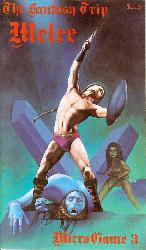
Review of Melee
 Goto [ Index ] |
Introduction
1977. There were two big fantasy games: D&D and T&T. Such "oldies" as Runequest and C&S were still in the future. This is the time that The Fantasy Trip: Melee came out.
Melee was a small, simple game: a dueling game for two or more players, where the players make up warriors in a few minutes, then have them duel in a hex-map arena. As a dueling game, it wasn't much -- but it was also intended to be the basic combat system for an RPG, The Fantasy Trip.
As an RPG combat system, Melee broke sharply from D&D and T&T. Where both of those used semi-abstract combat systems, Melee attempted to be a detailed, blow-by-blow system. One of the sharpest examples of this difference was in the length of combat rounds: D&D's were one minute, T&T's two minutes -- Melee's were five seconds.
The combat system was simple -- simple enough to fit in twenty-four 4-inch by 7-inch pages, with room left for title page, table of contents, character sheet, monster stats, character creation, experience rules, introductory story, example of play, summary tables, and a few illustrations. But it was complete as well, covering melee, missile fire, "rolling to miss" someone in the way of a missile target, readying weapons, dodging, and parrying.
Presentation
While this was Steve Jackson's first RPG, he'd written quite a few professionally-published games before Melee, and was able to explain the game system so that it was easy to understand and play, even with a level of detail far beyond the other RPGs then on the market. The writing is still a model of clarity in explanations, and having the introductory mini-story at the start be the example of game play in the back was an inspiration to GMs and players about how combat could be described beyond the "he hits, you hit" level. The layout was also a model of clarity, compared to other RPGs of the time. Important information about combat modifiers was repeated in a set of summary tables at the back of the book. An example character sheet was given on the back page, with permission to photocopy it. Examples and illustrations of map setups accompanied the more complicated rules, to help explain them. And the rules on turn order and possible actions were "highlighted" with a grey background to make them very easy to find and reference during play.
Illustrations besides those used as examples were a few pieces of line art and reproductions of the counters for the game. By today's standards, they weren't much, but compared to, say, the illustrations in the original D&D books, they were of very high quality. Further, they were inserted into the book very well, with text actually being flowed around illustrations smoothly, instead of the illustrations being blocked off.
The System
Melee brought a number of innovations relative to D&D/T&T to the table, almost all of which also showed up in later games (note, though, that I'm not saying they were copied from Melee -- independent invention happens often!). Characters were generated on a point system, with points to split between the two attributes of Strength and Dexterity. The system was level-less, with combat rolls being made against attributes, and advancement allowing characters to increase those attributes. Armor absorbed damage instead of making you harder to hit. Critical hits (for double and triple damage) and fumbles (drop weapon or break weapon) were in the rules. Characters who took a hard hit could take penalties or be stunned for a round.
Summary
Twenty-five years later, much of Melee still survives in GURPS -- adapted to add a skill system and a Health attribute, but the line of descent is clear (for obvious reasons, since Steve Jackson designed both). Melee was -- and is -- enjoyable as a simple standalone game, but it also pointed to a new direction in RPG combat system design, heading towards more detailed, blow-by-blow systems. The Arduin Grimoire tried to do the same thing around that time, but through a different approach of modifying and adding to the D&D combat system, rather than starting from scratch. By starting from scratch, Melee managed to be both simpler and more detailed than the D&D Arduin combination.
Remembering that this is a historical review, and thus is rating the game on its historical merits, I give TFT: Melee a 5 out of 5 on both Style and Substance, as one of the best games of its time.

