

 Search
Review of Cartoon Action Hour
 Goto [ Index ] |
I mean, if there was ever a genre custom-made for roleplaying, this is it. Hell, it's a genre which most RPGs resemble already. Retro-toons are full of larger-than-life characters with a variety of kewl (but illogical) powers, and said characters are thrown together for no real reason in a strange and poorly designed fantasy universe, each week fighting a new evil with the same plan, or the same evil with a different plan, complete with lame-ass plotting, cheesy drama and clichés out the wazoo. Even better, they featured the kind of one-dimensional characterisation most roleplayers are very familiar with: "well, Rogue is from the South, so every five minutes, make sure she says "y'all" so we don't forget, okay?". They're also often either featuring our favourite comic book or fantasy fiction characters, or have the very same design principles (I heard a rumour once that He-Man was going to be Conan the cartoon but the censors balked at the last minute so they gave him a blonde dye job and He-Man was born!). And finally, they're so ingrained in our psyche that pretty much everyone loves them, and knows how they work.
And yet strangely, we so far have only seen games about modern cartoons, where the heroes use their fricking pets to fight their battles, or are panty-flashing school girls. It's only a matter of time before somebody makes a H.R. Puffnstuff RPG and then it'll all be over. So thank the Lord that CAH has come along to take us back to the world of Saturday morning, a world where men were He-Men, women wore jumpsuits, and villains had extra-powered ninja death clutch action buttons in their belts. Damn!
Of course, there are problems with this idea. Do you play it straight? CAN you play it straight in a genre we all know is pretty stupid, or will it just fall into parody and thus meaninglessness? Also, any time you try and simulate a highly stylised universe, you have to decide how far to go with the mechanics. Do you try and model the actual rules of the universe, with stats like "Wear Annoying Cravat" or "Solve Mystery" and use narrative-convention mechanics that are more down the collaborative storytelling path of the roleplaying rainbow? Or do you just make a simple, mostly simulationist rules-set, which allows you to make the right SORT of characters, and leave the rest up to players knowing the genre conventions? CAH takes the second approach, and it works because, as I mentioned, the genre is so ingrained and so appealing to most of us that we don't need much forcing from mechanics to get into the mindset. Indeed, all that is really needed are simple, decent mechanics that don't get in the way of this.
Which of course begs the question: since we know the genre anyway, why download this game when we could probably do the whole thing ourselves with RISUS?
A good question. The answer comes down to a few factors: does the core system itself work as well as RISUS? Are the cartoon specific mechanics well done? And are the resources provided for generating characters and constructing a series useful and inspiring? Well, let's find out…
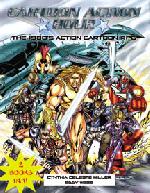
CAH is a 108 page RPG by Cynthia Celeste Miller. At the moment it only comes in PDF form (hard copy soon to be available), and is available on the net here. I was told that I only received a review copy, less flashy but easier to download, but the production values exceed pretty much ANY PDF product I've seen so far, so the ones the public are getting must be very shiny indeed. A few times the pictures were a little scratchy because of the low-res of the review copy, but otherwise the small amount of art is excellent and the lay-out is first class. Plus a full colour cover, no less, depicting a typical morning TV schedule from our youth (with fictional shows, of course - no licensing deals here).
The writing is simple, light and very easy to read, and you can expect to burn through the book in a few hours or so. Indeed, many may find the style too light as the target audience seems to be new gamers and younger gamers, and some of the more spoon-fed moments may grate on old hands. But Cynthia's up-beat stylings make these easy to swallow.
Kargorr is the best example of this. Throughout the book, commentary, expansion and explanation of the purpose and implementation of the rules, along with GM tips, are all provided in character from Kargorr, a classically cheesy retro-toon villain. Yes, as you might imagine, he says "bah!" a lot. At first, Kargorr's simplistic advice and obvious jokes annoyed me…but eventually he won me over. Kargorr and Cynthia make a natural double-act, and the conflict between them is good fun. Those who can't stomach cute won't like him but they can also pretty much ignore him since his inclusions are just asides in the margins. And the rest of us can love him in all his scowling glory.
Also potentially annoying is the insistence on calling chapters "channels" but it's no big deal. After a detailed contents (no index is provided, but there is no need for one since everything is incredibly easily to find), Channel 1 provides just a two-page spread on how to roleplay and what's in the book. Short and sweet.
Channel 2 is the biggest section in the book, and deals with chargen. Strangely, the first step isn't concept, but the second step, tagline, assumes you have a concept, and concept guidelines are listed in the sidebars. There is perhaps a paragraph missing. Whatever the case, we go through taglines, name, description, personality and background before we even get to any stats. I think this is somewhat backwards and overplayed, particularly in a setting where marketing power-claw action figures is ten times more important than personality (and when have you ever seen a cartoon hero with a background?), but then again, a good visual hook is important. Characters also provide Story Hooks which they get XP for dealing with, much like flaws in 7th Sea.
Chargen then is a point-based process with two basic things to buy: Traits and Special Abilities (or SAs). Traits are FUDGEian in style in that there is no set list for every character - you pick and choose what makes you exceptional and everything else is assumed to be average, which is 0 in this case. The scale is -4 to 4; you can get points back by dropping Traits below zero if you want. The skill list seems to cover everything it should, and I had no problem building Scooby on about 50 points, and Batman on a few more. The 4 point range means the system is rather grainy, particularly for non-super heroes, but since all rolls are D12 trait, the numbers fit the system properly and that's what matters.
Super heroes can have ranks above 4, written 4 (2) to 4 (5). For these, you roll the d12 the number of times in brackets and then add the 4. This means superheroes can't exceed the limits of normals, which is strange, but that's what SAs are for. It also means that the jump between normal and super level attributes is quite significant, statistically, nicely reinforcing the setting jump.
With your remaining points, you purchase Special Abilities. The Special Ability section I really have no business reviewing because I just cannot use these things. It's like handing a starving man a menu. But I'll do my best to describe it.
Actually, perhaps the simplest option is for you all to go to the Godlike mailing list on Yahoo Groups, go to the files section and download the free playtest rules for Wild Talents. Done it? Right. Well, imagine those rules, but much, much simpler. It's the modular approach of Wild Talents with the simplicity of BESM.
Like Wild Talents, powers aren't listed to pick and choose. Rather, you first pay a cost for how much you will use it per session, on average, simplified to three levels (rarely, once per session, all the time). Then, you add on attributes to your powers like duration, damage, range of effect etc to describe how your power works. Then there are modifiers which make these attributes cost more or less. For example you can buy a power like say, a Force Field, which has the attribute of preventing damage. The amount of points you spend on damage prevention would indicate how much you could prevent. Then you might take say the Item modification to make it cost less (cos as an Item, you can lose it) and maybe the Hardened modification to make the prevention also cover armour piercing attacks. And so on.
The process seems to work as far as I can tell, and is easy to understand, but I had a few problems with it. Firstly, the attributes are optional. That is, if your power doesn't seem to be the kind that runs out, you don't have to pay a huge amount of points for it to have a Permanent duration- it's automatically permanent. The text simply says its up to the GM and common sense to judge what has a duration and what doesn't but durned if I could figure it out. A gas cloud has a duration, but does invisibility?
My second problem was bigger, and it comes from the fact that a lot of powers in cartoons are flexible or ever-changing. The first character I decided to create was Schmoo, and he can turn into anything he wants, a power not covered by the two-forms-only Alternate Form power. Then there's the inventor or wizard character who each episode invents a completely new solution to the problem at hand (a solution which mysteriously vanishes by the next episode). Villains tend to use these a lot, too (or their sidekick evil scientist does).
The games solution to this is a power called a "Spell Cluster" since it is mostly designed for wizards. Players spend a much larger amount of points, again depending on frequency of use, and are thus allowed to do anything within a certain category (eg any attacking Special Ability, any defensive, movement, transformation etc). The problem is that this rule is a small aside, dwarfed by all the rules for armour piercing hardbody exploding nunchuks, and seems far less balanced and carefully designed. And yet almost all the character concepts I came up with seemed to have Cluster-type powers. This should have been given more space and more treatment, because it's a common thing and also wide open for rules abuse.
Besides this, though, it seems to work and those of you who like the build-it-from-scratch approach should get a lot of fun from the colourful and detailed list of options to purchase. There's also special rules for spending your points on Animals and Vehicles, who in turn can have their own special abilities. I was able to build KITT fairly easily with the car rules, but I ran into a common problem I have with most such points based systems: a lack of any concrete idea what the trait levels MEANT.
And this was true throughout the game. Yes, there is a table explaining that a trait level of 3 is Great and 4 is Excellent (whatever THAT means) but no examples are given, and no discussion of context is provided. In the universe of Scooby Doo, is Scooby a Great detective or just a Good one? Do all of the Scooby gang have Detective as a skill? Is Frank better than Daphne? Since Scooby and Shaggy run at the same speed, do they both have the same level of Dodge? Do I put Scooby at 1 for disguise because in the greater scheme of things he isn't that great - or do I use the universe rules of Scooby which says that Scooby on Shaggy's shoulders wearing a large overcoat and a ten-gallon hat is going to fool 90% of people, and thus he is a master of disguise? Guidelines! We need guidelines!
As you can imagine, this is twice as bad with superpowers because of all the subtle questions about their usage. And again, no examples at all. In fact, the biggest flaw in this whole game is simply this: not one single pregenerated character or NPC, apart from the simplistic example they use to show you how to use the rules at each step. What is needed is about twenty fully fleshed out and ready to run PCs, and it would be particularly helpful if some of them fit recognisable heroes. If we could see how the system built He-Man, Scooby and Optimus Prime it would be so much easier. And also, it'd be a lot easier to play it on spec - which, for a light-hearted game like this, should be an important design consideration.
This is made even more unforgivable by the fact that the last chapter contains some 4 fully fleshed out campaign ideas, with full descriptions of possible PCs and NPCs - but not a statistic in sight. Nor are there any guidelines for making a balanced party - or for dealing with the fact that most toon hero groups weren't balanced, with either one character being tougher than all the rest, or one, two, or more annoying children, pets or robots who did nothing but just PISS EVERYONE OFF CONSTANTLY. Actually, comic relief characters do get a very brief mention, but there are no guidelines for playing Scrappy Doo. (My suggestion would be: expect every player to pummel you to death if you take this character).
Of course, plenty of people have no problem with these kind of chargen systems in other games - and since the system is very simple, these problems aren't exactly difficult to examine from a mechanical perspective.
So what is the system? As mentioned above, it's simply rolling a D12, adding your trait and trying to beat a target number - fairly standard stuff. Roll a 1 and you always fail, roll a 12 and you can add your Oomph stat to your result for a more dramatic success. PCs also have a number of Stunt points which they can spend to automatically add their Oomph to a roll. The problem with these is that, from a game perspective, there's no reason why any player would not buy these at maximum levels, nor is there much reason why, from a simulation perspective, a character wouldn't have them maxed out either. After all, one of the whole points of the retro toons was that everyone can be a hero, even Scrappy fricking Doo.
My favourite rule in the game involves these stats though: a character can lose a Stunt point until the next season to "give his all" in a check, by quadrupling his Oomph bonus before adding it. Very toonish, very cool.
The combat rules are also full of toonish brilliance like this, such as death being impossible, and healing occurring "a short while later" or "a long while later". Best of all is the Mook rule, which allows groups of a dozen or so guys to have just one difficultly number associated with them, as a group. Beat that number and when the badly-drawn cloud of dust clears, they're all knocked out - you describe how. Finally, an RPG with a proper mook rule. It's these sort of combat rules are the heart of the game and were the things that most made me want to grab the people on the train and make them play a game with me right then and there.
If you happened to be on the 9.14 to Nottingham that day, I'm really sorry. But the Cobra Commander did roll a critical, dammit!
Otherwise, combat is simply opposed dice rolls of attacking Traits versus dodging or defending Traits, then repeat for the side that lost Initiative. There are then the usual suspects of modifiers and penalties for doing manoeuvres and tricky stuff like charging, called shots and so forth. These were done remarkably well, covering all the bases and giving plenty of options without forgetting (as too many games do at this point) that the game system is designed to be simple and light. A good balance is kept; think Cthulhu or BESM.
Channels 3 and 4 provided the above combat rules clearly and efficiently. The remaining two Channels are GM advice and campaign ideas, respectively. The majority of the game book make up these two chapters, and it's here that the game really shines.
The rules arbitration and basic GM skills stuff isn't anything we've never seen before, but beyond these is the genre-specific advice and it is good. Like a lot of such advice (like Nightmares of Mine, for example) a lot of it is pretty obvious stuff but that doesn't stop it from being useful to have it gathered together and listed off to get your brain in the right place. Little things that you forget are covered too, like the fact that putting a garbage can over a villains head instantly incapacitates him (and causes him to wander around asking "who turned the lights out?"). The after-show message is also covered, and I know a lot of gamers are going to have fun with that one.
Storytelling techniques are covered next, including cliffhangers and cuts to the villains planning their plans. This isn't in the text but it occurs to me that most retro-toons had as much screen time for villains as it did heroes, and said villains also often stole the show. It would therefore perhaps be very in keeping with the genre to let players play both heroes AND villains - after all, it's not like its hard for our heroes to figure out what the villain is doing each episode, so suspense isn't needed. There's also something wonderfully Jungian about having a player play both He-Man and Skeletor, especially in the fight scenes…
Unfortunately, although plot composition is looked at, specific adventure design and running issues like the lack of suspense are not covered. Nor is there a sample adventure, which could of course provide the same material through teaching by example. Again, I think CAH is a game very appropriate to pick-up-and-play gaming, and not having a ready-to-run adventure is shooting themselves in the foot somewhat. As well as making it damn hard on the GM because toons do have a very esoteric dramatic construction and I want some help with it, dammit!
However, when it comes to campaign design, there is plenty of info provided, along with an absolute shirtload of examples. 15 of these are just outlines over a few paragraphs, but four of these are fully-fleshed out ready to run campaigns.
Warriors of the Cosmos is a classic fantasy lasers all-out war for the last outpost against evil kinda thing. It doesn't really grease my nipples, but is wide open for any sort of character or story you'd care to run. Tommy K and the Star Kitties is next, basically doing Josie and the Pussycats in space. Eighties snytho-pop vs the Slaggorians who want to make rock and roll illegal, this one has buckets of style and would be great fun. Defenders of Aqua City has a bit too much backstory but would make a great anime series as a result. Aquatic inventions give Mayor Jonathon Seaport and his two wayward daughters the means to defeat off an endless variety of fish-themed evil.
My favourite though, is the sheet-soakingly cool Dark Brigade. Picture the guys from Predator, but they fight supernatural nasties like in the X-Files. Unfortunately, their ex-leader has become a vampire and has thus got the vampires, ghosts and werewolves working like an army, too. Not only is this a superb idea that I'll probably pinch for non-cartoon storytelling as well, both the PCs and NPCs here are amazingly cool and just scream for action figures. I had to stop myself from calling my mother and asking for a Lieutenant Thomas "Lightning Claw" Dobbs (with electric Lightning Claw Action!) toy for my birthday, these guys are that cool.
But I quickly came to my senses. I'm an adult now. I can by my own damn action figures!
The outlines are a mixed bunch; some awful but mostly the standard is high. Highlights include The Outlaws of Skull Gulch (very Bravestarr), Dekkledd (pulp action retro-toon! Woohoo!), The Transbots (Transformers with a twist) and the Super Battle Brothers (adventure and excitement on the Galactic Laser Boxing circuit!). There's a lot of cool stuff here and it'll certainly make you giggle, but they all still need a lot of work to make them playable.
We close with two appendices. Appendix one is a glossary of game terms, and a glossary of 1980's slang, which is like, so totally heinous, for sure. Appendix two is a toonography, covering a wide selection of classic retro-toons. I was pleased to see a few here which I thought I'd forgotten (Blackstar, for one) and the memories all came flooding back. For some reason, G-Force, one of the greatest of them all, is missing, but otherwise, the list is quite complete. And we finish with a character sheet and a series design sheet, which are both fairly well done.
So, let's return to the questions I posed up above. Does the system work? It's nothing special, but it's definitely the right level of detail and it gets the job done. Are the system-specific mechanics well done? Those that are in there are fun and appropriate, but there aren't too many, which is good - there's a nice balance between making a solid, playable game and wacky genre-obeying rules. And is the support material useful? Well, it's funny, well-written, well researched and definitely inspires you to run the game, and includes some of the kewlest ideas for cartoons ever. So, I think it passes.
Problems? Yes. Even if chargen didn't have the hiccups mentioned above, it's still going to require a lot of GM control and guidance if players are going to be able to make the characters they want, and characters that fit into a series - and there just isn't enough help provided for this. Nor is there enough on running adventures. Both of these could be greatly helped along by the inclusion of pregens and prewritten adventures - and which could easily be fixed by adding a few of just these such things to the download section on the website. Or making a GMs guide (hint hint, Cynthia!).
The problems can be remedied, and the product will need a bit of elbow-grease from a GM to get it up and running but that's true of a lot of games - and few of them have such excellent advice to help this, or have such a brilliant concept that most gamers adore. Nor are they as much fun. CAH is unlikely to win any Origins awards but it's dirt cheap, it's fun, it looks good, it's a quick and easy system and it does what it says on the box. A great idea, backed up by a good game.
In a gaming market where Nobilis is getting all the kudos for breaking new ground, Ms Miller is the quiet revolutionary, proving that there's a lot of directions we haven't tried yet, and a lot of new ground to cover. And some of these feature robots who can turn into dinosaurs.
I know where my money is going.
Substance: 3 (few hiccups, but gets the job done) Style: 5 (kewl and fun from start to finish)

