

 Search
Review of HERO System
 Goto [ Index ] |
The Hero System is the game engine behind one of the oldest and most hallowed RPGs in gaming, the superhero game Champions, first published in 1981. The game eventually branched into non-superpowered genres with other games in the line, such as Fantasy Hero, Danger International and the remarkable Justice, Inc.
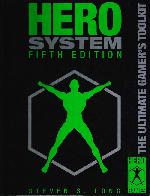
Physically, the book is very handsome, a fat 380-page hardcover with an iconic cover design and copious (and mostly excellent) illustrations running to $39.95. This high price tag is becoming more and more common for core rulebooks in the roleplaying hobby. Some games are worth that much - other games aren't. Fortunately, Hero Fifth Edition justifies the cost with a huge amount of text in a small but easy-to-read typeface.
For those fans of the 4th edition of the Hero System and its shoddy binding, have no fear - the Fifth Edition is very sturdily bound, and will stand up to years of play and abuse. A stout binding was one of the goals that Hero had when putting the book together, and it shows. As a test of the book's toughness, Hero put the book into a clothes dryer for a while to see how much damage it could take. Now that's what I call "testing to destruction."
The Fifth Edition is a thorough and exhaustive revision of the older game system, completely rewritten and reformatted. The actual changes to the mechanics are slight, and are mostly on the order of tweaks, with a fair number of additions and enhancements from other 4th Edition products, as well as some entirely new material. The real distinction between this volume and those which preceded it, however, is the approach taken by the text itself. For the first time, the Hero System is presented as a true generic system, capable of emulating and facilitating play in any genre, rather than a superhero game system into which other genres could be shoehorned.
This has for many years been the intent of the Hero system, but only how has this potential been fully realized. Not only are the powers and abilities more fully generic, but the examples (and there are literally hundreds of power examples) are spread across many genres, including fantasy, Sci-Fi and modern.
The book is organized into chapters. The first section covers character creation, which eats up a remarkable 225 pages, over half the total length of the book. This section is as large as it is because it, more than any other section, contains the meat of the game - the rules for describing characters, the sorts of abilities they have, and how they work. This means that the fundamental resolution system of the game (a very straightforward 3d6 roll under a rating) is covered in the skills section of the character creation chapter, rather than in its own section. This wouldn't make sense for most other game systems, but it works for Hero, since the entire game is built around defining characters, their capabilities and they ways they interact.
The second chapter covers combat, damage, endurance and healing, and is weighty as well at 63 pages. The combat rules are not so complex as this would seem to indicate, however - they're not all that much denser than D&D3's combat rules, and are more clearly explained. No fuzzy attacks of opposition; the rules here are clear as crystal.
The rest of the book covers equipment, environmental situations, and gamemastering. After the incredibly thorough coverage in the previous two chapters these sections seemed very abbreviated to me, but I suppose that the book couldn't possibly have been any bigger, and I wouldn't have wanted to give up the detail in the character creation and combat sections.
One thing I would have liked to have seen would have been a longer discussion of what Hero calls "Reasoning From Effects," which is the fundamental concept behind the system, and something that's vital to really getting the most out of it. The huge number of examples of the various ways to utilize the powers go a long way toward presenting this to the reader, and it's briefy touched upon toward the end of the book, but a lengthier discussion of it in the introduction would have helped novices get into the game more quickly.
And the Hero powers system, the core of the game and what differentiates it from any other game on the market, is truly a thing to behold. With it you can emulate any ability, device, spell, psionic technique, source of cosmic power... the possibilities are only limited by the user's imagination and knowledge of the system. It will take some elbow grease to become fully acclimated to these rules - but once you are, they are flexible to an unparalleled degree.
Inevitably, comparisons are made between GURPS and other "Universal" game systems. The distinction lies in the approach taken by the two games. GURPS presents a core game system and offers various subsystems for handling specifics like magic, psionics, vehicles, and so forth. Hero, in contrast, offers a substantially more detailed and comprehensive core engine which includes what are, essentially, the means to create your own special abilities, powers, magic and what-have-you.
This means that the Hero System is effectively complete in one volume - supplements will be gravy, though Hero has plans for a complete product line, including a GM's pack and The Ultimate Martial Artist, both of which should be available shortly.
Hero is not a rules-light game; the rules here are exhaustive. As such it will appeal more to those who want a firm mechanical foundation for their games, rather than those who want an ultra-simple, fast-flowing game engine. This is the only count on which the Hero System suffers in terms of flexibility - because it is a detailed and comprehensive game, it will be too much for those gamers who want low-density mechanics for certain genres. At the same time, the entire system is here in this book - there will be no "optional" sourcebooks later on that prove to be essential because they add elements which should have been in the core rules to begin with. As such, the complexity level is higher than the average nowadays, but it should remain constant, as opposed to games which add complexity in their supplements.
One of the nice little touches of the game is a brief section in the back of the book which recounts the origins of the Hero System (as Champions) and its evolution over the years.
This book is more than worth the price of admission if you're looking for a solid superhero game (which it remains) or an immensely flexible rules system for playing in any genre. I already have half a dozen totally unconventional campaign ideas that I'd be hard-pressed to fit into any other system. Plus Champions and the Hero System are classics in the roleplaying hobby, and with good reason. If you don't mind a bit of a learning curve, this game is a winner.

