

 Search
Review Editing
Review of In The Labyrinth
 Goto [ Index ] |
Wouldn't you know it? I've kept all my TFT books for years; every couple of months, I dig through boxes looking for something, and run across my game books. So now, when I want to do do a review, they are nowhere to be found.
Grrr.
Nevertheless, I promised a review for The Fantasy Trip, and I remember plenty about the game, so I will do my review; I may do a more thorough capsule review sometime in the future.
First, a disclaimer: in addition to The Fantasy Trip, I bought Man-to-Man (the proto-GURPS book) as well as about a hundred GURPS books; I'm listed as a playtester in a couple of them. I also played TOON and Munchkin. Perhaps this makes me biased, but I still claim I'm not a Steve Jackson fanboy.
the product line
In the '70s, the fashion in RPG systems was to write a game that required at least two books, maybe even three, as opposed to the current fashion of writing one stand-alone book with a crippled game system, then releasing suppliments. The TFT system likewise required three gamebooks, but decided not to go the usual "player book/DM book/monster book" route; instead, The Fantasy Trip required a combat book, a magic book, and a campaign book.
This actually made sense, because there were basic and advanced rules for both combat and magic. In theory, you could just get Melee and Wizard (the basic combat and magic rules, respectively,) or even skip Wizard and do a no-magic setting, or add one or both of the Advanced Melee/Advanced Wizard books. In practice, you pretty much had to get Advanced Wizard, since it had the rules for scrolls and healing potions, while Advanced Melee had exotic weapons you knew someone would demand ("I want a bullwhip! No, wait! An arquebus!")
Still, the price was right: Melee and Wizard cost $2.90 each, the advanced books cost $5 each, and In The Labyrinth cost about $7. Since In The Labyrinth came out about the same time as the DMG, you spent a lot less money for the "Advanced TFT" set than for "Advanced D&D". You even got a set of counters.
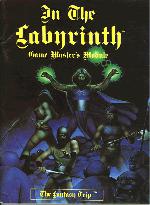
One of the problems with TFT was that you still didn't feel like you were getting enough. The books were thin. The cover illustrations for In The Labyrinth and the two advanced books were identical (an airbrushed stereotypical fantasy party surrounded by nameless hordes.) Internal illustrations were sparse. Visually, the TFT product line looked more professional than the original D&D but not as professional as AD&D.
There was also the infamous lack of an index. The books weren't big, so you could usually find the most-used pages quickly, but if you needed a particular obscure rule, gameplay stopped. Metagaming -- or perhaps someone else -- later released the "Gamemaster's Codex", which provided computer printouts of ordered lists (spells and talents sorted by IQ, by cost, alphabetically, etc.) as well as one line rules summaries with page references. The codex had its own problems, however; dotmatrix printing is pretty hard to read, especially when it hasn't been proofread for errors.
the system
The way I was griping about the production values, you would think that I didn't like the game much. You would be wrong. I played a lot of TFT because the system really worked.
First: the combat and magic systems had a good balance of simplicity versus complexity. The game uses a unified task resolution system: roll three (or more) dice to beat one of three ability scores -- Strength (ST), Dexterity (DX) or Intelligence (IQ). The more difficult the task, the more dice you roll. Having a Talent (such as Thief) reduces the number of dice you roll, or increases the number of dice your opponent rolls (when dodging in combat, for example.) The first TFT release, Melee, was designed as a quick but detailed medieval tactical game to be played in a short time period (lunchtime at highschool, for instance.) This gives the entire TFT system a good foundation.
Second: the spell list concentrates on simple effects that you might actually need in play. Spells in TFT cost ST points (fatigue) to cast and a specific IQ score to learn. Again, the magic system originated as a wizardly duel game, so playing TFT with basic Wizard tends to result in combat mages, healers, and illusionists. Advanced Wizard adds alchemy, enchantment, and a few auxillary spells to round out the fantasy wizard archetype.
TFT also introduced Talents, which are a combination of skills and advantages (in GURPS terms.) Weapon skills, spells and talents all cost IQ points to purchase. The three attributes are also purchased using a pool of points, called character points in this case; thus, TFT was the first point-based fantasy character system, as opposed to D&D and Runequest, where players rolled up their characters instead of paying for them.
Since TFT was an early character-point system, it still had character classes left over from the original FRPG concept. However, there are only two classes: Hero and Wizard. The classes only have two game effects:
- some spells, talents, and magic items are usable only by wizards; and,
- heroes and wizards pay different point costs for talents and spells: heroes pay 3 IQ points per spell (triple the cost for wizards,) while wizards pay double IQ cost for talents (other than Literacy and Alchemy.)
In addition, TFT introduced a job system, so your character could earn cash for equipment purchases; again, it was an obvious prototype for the GURPS job system and worked in a similar manner. TFT also had its own generic fantasy world background: Cidri.
the world of Cidri
In The Labyrinth described an unusual fantasy background, a world called Cidri. The backstory of Cidri: an ancient all-powerful race of dimension travellers called the Mnoren made an enormous planet containing everything they could ever want... then vanished. The backstory really wasn't that important; the gamebook recommended never using the Mnoren. The point of the Mnoren myth was to explain Cidri: it is a normal-Earth-gravity world with hundreds of continents. In practice, it tended to break down into small areas with a gate or two allowing travel to exotic places.
The Mnoren myth also explains why the many religions of Cidri included Christianity and other Earth religions; the Mnoren kidnapped a few people, or left an active gate on Earth. Because of this gimmick, highly-religious players who were uncomfortable with the polytheism of typical RPGs could play in an area of Cidri that duplicated medieval European religious distribution.
Cidri was also unusual in that it was slightly higher tech than, say, Greyhawk. Cidri chemists could manufacture gunpowder using dragon fewmets; gunpowder weapons were risky, but carrying a grenade or two to blow open a stubborn door was a typical TFT adventuring tactic. Molotov cocktails are also standard. The general tech was roughly late medieval, with a high degree of mechanical failure.
TFT next described the various professional guilds; pretty standard fare, except for the part about animosity between the Wizards' Guild and the Engineers' Guild. Churches are also described in the same section, since religion on Cidri is mainly social and political; there are no clerics on Cidri, although priest characters could learn a few wizard spells and believe their power comes from the gods. TFT discourages active appearances of gods, listing the same reasons as the ban on the Mnoren: they are just too powerful and take away some of the mystery and humanity of the game.
The fantasy races and monsters on Cidri are typical, but there are a few twists. Goblins, for example, are not necessarily evil. Gargoyles are also a possible character race; of course, since gargoyle organs are also valuable spell components, gargoyle PCs might want to watch their winged backs. TFT also introduced Prootwaddles, which are idiotic painted humanoids; allowing prootwaddle PCs definitely turned a game silly.
Monsters have their own twists. Dragons have a natural hypnosis ability and could make a wizard forget a spell permanently -- for a price. Vampires and lycanthropes are infected with communicable diseases and are considerably less powerful than their World of Darkness counterparts. Wraiths are an insubstantial humanoid race -- not necessarily evil at all. There's also an intelligent race of evil humanoid octopi. Oh, and also: children.
On the whole, the Cidri background gives a different feeling than Glorantha, Greyhawk, or the Forgotten Realms; it's less epic, more heroic, if that makes any sense. Characters can acquire considerable power, but it seems less extreme than the upper ends of AD&D (although it was about the same power level as original D&D.) The absence of distinct clerical powers "de-supernaturalizes" the game slightly, although it was still a fantasy game. It felt a lot like a roguelike game (like nethack): very pragmatic.
the bad points
So if it was such a great little game, why didn't people want to play it? For one, Metagaming collapsed almost immediately. Not enough game materials were released, nor was there a large network of third-party publishers producing adventures and add-ons, which is what was happening to D&D in the '70s. In other words, D&D was the equivalent of IBM-compatible, while TFT was more like an Amiga or Tandy Color Computer.
In particular, there was not enough info about the world of Cidri. Here we have a unique setting, a gigantic world criss-crossed by magical gates, and only the barest amount of information. The reason must be the same as why AD&D defined all the outer planes as infinite; so that there was plenty of room in the world for each GM to have their own area, so everyone could play in the same world! Of course, this reason was just plain silly. For a pseudomedieval fantasy setting, you want a small world, not a huge cosmopolitan one. My AD&D campaign was based on a flat earth a few hundred miles across, and it was all I needed; no one ever made it to the edge or even went across the sea to another landmass.
There were also the production value problems I mentioned before. Although not the worst rulebook ever, it wasn't organized well at all and didn't look as pretty as the Runequest boxed set or the D&D basic boxed set with the blue cover art of a dragon. And no index; I cannot mention enough that there was no index.
The lack of clerical magic distinct from wizardly magic also turned off some people. There are people out there who like to play clerics (Trust me! It's true!) You could play a cleric in TFT, but the rules sort of suggested that all religions were frauds. It could have been easily fixed: just give those with the Priest talent the ability to bless holy water and allow holy water to act like a one-shot power stone to charge spells.
There were also a few problems with the system itself. Both hits and fatigue are marked off from ST (GURPS wisely added a fourth ability, HT, to correct this problem.) Counting talents and spells against IQ makes jack-of-all-trades characters difficult and encourages players to put all their earned experience into IQ, raising it to ridiculously-high levels.
the good points
Still, there were some pretty good ideas in TFT that haven't been used in modern fantasy RPGs, not even in GURPS, which is why you hear people occasionally saying they'd like to see TFT 2nd Edition. For example: since the combat and magic systems were designed for dueling (no referee,) encounters in TFT felt a little more fair; there were tactical decisions players could make that would leave the GM guessing (for instance, if there was an area of magical darkness, a PC wizard could announce "I cast a create spell into the darkness" without needing to tell the GM what was being created.)
Another good point: despite having only two classes and three attributes, it worked. TFT did a convincing job of using its limited resources. Charisma in TFT was talent-based, not a seperate stat. Wisdom wasn't necessary. There were no levels, unless you counted attribute totals -- and you didn't need levels, because the attributes were what was important. And with such minimalist rules, it was hard for munchkins to create unbalanced characters.
And despite its minimalism, TFT allowed you great flexibility in character creation. Once in highschool, our fantasy roleplaying club (yes, this was before people believed Pat Robertson) came up with the somewhat silly fundraising idea of a TFT marathon: we would play TFT for 12 hours and would get people to pledge a per-hour donation. Characters in this game session included an Erol-Flynn-as-Robin-Hood clone, a knight, a wizard, and a dwarven brothel owner (Don't ask. He was skilled with the bullwhip, though. Again, don't ask.)
So yes, I do think back fondly to my days in the labyrinth and occasionally miss it. The Fantasy Trip was optimized for fantasy dungeon crawls and did it well.

