

 Search
Review of HERO System
 Goto [ Index ] |
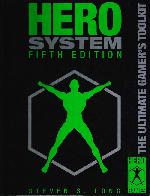
The Cover is a striking, if minimalist version of the spread-eagled hero logo that Hero System fans should know well. The interior art is spare, but professional. The layout is basically good. I do have a complaint: the interior font is uncomfortably small.
The Powers section is now sidebared throughout with Power examples.
2. Chapter Overview
Introduction - Provides a nice overview of the system before launching into character creation. The bit for returning players glosses over the changes, which are few, but significant.
Character Creation - This is the meat of the Hero System, whose claim to fame is to be able to create nearly anything. There are no radical departures from 4th edition. Basically, you begin with a number of points, which are spent on Characteristics, such as Strength or Intelligence; Perks, such as a Contacts or the Fringe Benefits of being a CIA agent; Skills, such as Combat Piloting or Stealth; Talents, such as Absolute Direction Sense or Perfect Pitch; and Powers, such as Energy Blast or Desolidification. You can acquire more points by taking Disadvantages, such as Psychological Limitations, being Hunted by a villain, or a Vulnerability to fire.
Skills are nearly 100 percent compatible with 4th edition. The main additions are some new gun bunny and wuxia skills such as Two Weapon Fighting and Autofire skills. Most skills work like in GURPS; roll 3d6 and try to get your skill level or less.
The Talents have added a few and lost a few. Luck is now a Power, for instance.
The biggest changes in 5th edition are countless tweaks to existing Powers. Summon has been greatly expanded, and thus improved, by defining your relationship with the thing you Summon. Multiform has been radically reduced in cost for characters with numerous forms. The biggest change, however, is to beneficial Adjustment Powers. Aid now costs double, and restored Characteristics are not permanent; restoring lowered Characteristics is now the domain of Healing. Healing is also 10 character points per die, and in this version, has an absolute ceiling of your maximum healing roll (let me try to explain). If you have 3d6 Healing, you must keep trying to beat your roll in order to heal someone a second time, and in any case, you can't heal more than 18 points on someone period. The rules do not state when you can Heal them again, although the available FAQ suggests one day, with suggestions for lowering that interval. In other words, healers under 5th edition are more expensive by a factor; using Steve Long's suggestions in the FAQ, Healing is effectively seven or eight times as expensive in 5th edition if you want to be able to Heal someone several times a Turn. Being a 4th edition player, I can live with the doubled cost but find the maximum Healing rule perplexing. However, for many games, this new rule will be very balanced, although I find the bookkeeping required obnoxious.
The Disadvantages have been further generified: Secret Identity is now a Social Limitation, for instance. All very good. There are other minor changes, mostly good. Enraged is now the assumption, and Berserk a worse version.
Power Frameworks have been clarified. Elemental Control has been clarified to the point where it is now difficult to comprehend; using Aid or Drain on one is now very complicated and possibly unbalanced. If someone Drains 2d6 of my Ice Blast from my Ice Powers Elemental Control, I lose 2d6 from Ice Blast, every other Power in the framework, and the EC pool. Ouch. I won't try to describe what happens with Aid.
Package Deals no longer offer a price break, and Racial Package Deals no longer affect Characteristics Maxima.
Combat and Adventuring - There is lots of new material in the 5th edition. Rapid Fire and Autofire have taken on a life of their own; under the new edition, it is possible to produce characters who can deliver a LOT of attacks in one Phase. Optional Rules are included to cover nearly every genre, from Silver Age superheroes to noir to the latest Schwarzenegger movie. Complete, almost to the point of being cluttered. New Hero players wanting to model ONE genre will find a lot of extraneous and distracting material. Some of the rules are rather complex; I'm still getting the hang of the new Autofire options.
The Environment - Stuff that can kill you, that isn't wearing tights. Electricity, falling, fire, radiation, and so forth.
Equipment - Apart from some tweaks, this is largely the same as 4th edition. Hero System covers Automatons (robots and zombies), Computers, Vehicles, Bases, and Weapons and Armor. The Focus limitation takes care of miscellaneous equipment. Defining new equipment in Hero System is pretty painless, although you will want to familiarize yourself with the relevant section.
Gamemastering - Full of desultory sage advice, some helpful prodding about genre modeling, character growth, and storytelling. This is a somewhat medicore section: probably the result of having been cribbed from Champions and Fantasy Hero, melted down, and generified, on a schedule. Traditionally, Hero System has depended on its sourcebooks to guide gamemasters, which is a solid book design concept, but not very helpful to neophytes.
Changing the System - The last full chapter. Basically, an essay of how to change everything you hate. It includes the mathematical rationale for the point costs (and why they don't always quite add up), how to create new abilities, and how to invent your own rules. Not exactly exhaustive, but it is there, and I appreciate that.
3. Overall and Conclusion
This is a complex, venerable game with years of solid fan and creator support. The 4th edition was seemingly intended to be the last major version. The 5th edition has revisted those rules. There are changes: some I like, some I don't.
For existing Hero System fans, I highly recommend this volume. It makes a nice companion to the 4th edition, offering suggestions, possible cost changes, and a number of other tasty bits. I will not say it is a wholly improved version. I don't like some of the changes to Powers (particularly how healing works), and many of the new rules are complex or open the gate to a different style of play. For instance, introducing Autofire Skills to your Champions campaign can open a whole can of worms in itself. Fortunately, much of the new material is Optional, and for everything else, there's 4th edition.
For new players, I'm not exactly sure what to tell you. Buy this book, unless you don't like it. It offers the depth of GURPS's character creation, in a somewhat different form, and with less attention to minutiae. It also offers a similar, but more "cinematic" game system and a much more exciting combat engine. It does involve a lot of fractions, so if you hate math, this game may require some patience.
As a fantasy or sci-fi game, Hero System is a lot more involved than taking DnD or Trinity off the shelf. You are largely on your own for world design, at least in this book, and the gamemaster will have to make many design decisions for himself (how much damage does a laser pistol do? is it visible? how many points should a character be?). Spells have to built from the Powers rules, offering a lot of flexibility, but also requiring more detail and thought in both game and character design.
As a super-hero game, this is THE toolkit. It will do anything. High-powered super-heroes is one thing GURPS does badly. If you like four-color heroes, and you don't mind math, this is a good game. However, it offers no Karma, Force Points, Hero Points, or other butt-saving measures. I've described Hero System/Champions as the ultimate simulationist super-hero RPG; you can build characters with abilities like the comics. To capture the feel of comics, I still favor DC Heroes/MEGS/Blood of Heroes, the exponential super-hero game put out by Mayfair many years ago. And for simplicity, White Wolf's Aberrant could be easily stripped down to a super-hero game. I will call the Hero System and MEGS the best two superhero roleplaying games of all time, with not much to dictate your preference except your own personal style.
If you run this game, plan on setting down for a couple of evenings to read it cover to cover, and keep it handy as a referebce until you get the hang of things. Read the online Rules FAQ, and be prepared to make some outlays for genre sourcebooks if you are not a very experienced gamemaster. If you are player, you'll at least want to read it through when you have the chance, to familiarize yourself with your options. This is not a game for diletanttes, although once mastered, it is easy, even pleasurable, to work with.
Hero System is sort of the standard transmission of the super-hero games. As a generic toolkit, it is no more complex than GURPS, but you may wish to consider other options. If you prefer simpler, looser games, you might still be happier with something like Big Eyes, Small Mouth (the generic anime rpg) or a more specific product tailored to the genre (like Feng Shui or Vampire).
Hero System, with the 5th edition, seems to have returned largely unchanged, although better educated, and is moving forward with all the support it enjoyed in previous versions. For experienced Heroes, I say, buy. For newcomers, look it over first, with an open mind.

