

 Search
Review of Call of Cthulhu Roleplaying Game
 Goto [ Index ] |
Unstoppable as a Shoggoth in heat, the Hasbro/WOTC machine continues undaunted in its quest to take over the gaming landscape. Its latest target is the much loved Call of Cthulhu. Long before this game even came out, I think it's safe to say that it was the topic of many a heated discussion.
Could d20 actually handle a gritty, non-heroic (heroic as in "ho ho! I am a mighty hero, watch me smite evil" kind of way) style of gaming as required by Lovecraft and company's tales of cosmic horror?
"Enthusiastic" fans on both sides of the debate went back and forth endlessly on whether it could (or even should) be done. So now, the game is here. Is it a good game? More importantly for some, is it worth the 40 bucks WOTC wants for it?
The short answers: Yes, and it depends.
For a lengthier answer, keep reading.
Partly because I think this game is worthy of a review, but also because I find the flame ridden "discussions" that seem to accompany such endeavors occassionally amusing, I have decided to submit my own review.
First off, my biases as a gamer: Yes, overall I like the d20 system. I like D&D 3rd edition (at least moreso than previous editions). I also like the original CoC game as well, although I have read only a handful of Lovecraft's stories. I am of the belief that ultimately the system isn't as important as the players and the GM. That said however, certain systems do make the GM's job easier or harder.
Now then, back to CofC (as the d20 version of the game is referred to). Upon seeing the book in my local game store, I immediately snatched it up. Being a fan of horror gaming in general and CoC in particular, there was never really a question of whether or not I would pick up the d20 version. Casually flipping through the book in the store left me with the following first impression: it certainly is a pretty book.
Delving a little deeper, my thoughts were as follows:
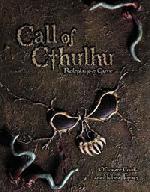
Hardcover - always a plus in my opinion. The cover is done up to look like old, cracked leather with a stylized "skull's eyes" and fangs as its central graphic element. It does a good job of evoking a mildly creepy feel without being too busy, although there are these fleshy tendril things in the corners that I think are a bit much.
Full color - again, another plus. I've always been a sucker for full color rulebooks. As for the artwork in CofC, it is generally of good quality and most of it does a good job of evoking a certain mood that seems consistent with the subject matter. Some of the artwork however does look like it belongs more in a D&D monster manual than one devoted to Lovecraftian horror, and some of it is just bad or "hokey" looking. But generally speaking, it is my opinion that the artwork is of a higher quality than found in previous versions of CoC (I can already hear the cries of "heretic!" ringing in my ears).
Layout - the text is laid out in a funky sort of slanted column. It's a little disorienting at first, but I found that I quickly got used to it and it didn't bother me much. It's a nice gimmick, and one that gives you a subtle reminder that there's just something "not right" about what you are reading.
Going deeper still:
Character Generation is handled by rolling 4d6 and dropping the lowest die. All the usual d20 system Abilities are present (Strength, Dexterity, Constitution, Intelligence, Wisdom, Charisma), although now you have Sanity points as well, which are based off your Wisdom score. Your Ability scores generally range from 3-18 (which is a similar range to that found in classic CoC). The rest of the usual items on the d20 character sheet are present as well: Saving throws, AC, Hit Points, etc.
There are levels, but no classes (sort of). There is only one class: the Investigator. In essence, this is the same as having no classes, only levels. Still, there is an important decision you have to make regarding your character. You must decide whether he or she is offense based or defense based. Choosing the former gives you a better base attack bonus progression, while the latter gives better saving throws. An optional rule gives offensive characters a free weapon proficiency Feat and a level based bonus to AC for defensive characters.
Everything else about your character is more or less standardized. Hit die (d6 in this case), skill points, Feats (similar to those special abilities/advantages/edges found in other game systems), etc.
I was surprised to see that CofC uses Hit points instead of the Wounds/Vitality system. I just assumed Wounds & Vitality would be used. Not a big deal to me either way. Another thing that surprised me is the inclusion of Psychic Feats. If you want to play in the "traditional" CoC style, I say leave them out of your campaign but if you want to mix things up a little or maybe use the rules for more "generic horror" gaming, then you may find some of them to your liking.
As for Feats, all the usual favorites from D&D 3rd Edition are here, along with a few new ones. Ditto for skills (many of the new ones will be familiar to players of the original CoC).
One thing to note however: a quick look through the Feats section clearly betrays CofC's D&D lineage. Many of them are combat related, and in fact players new to Mythos gaming may get the idea that CofC is meant to be played as an action-horror game. Of course that's a perfectly valid approach if you like it, although many veteran CoC players will no doubt balk at such heresy.
Following all the character creation material is a chapter devoted to Sanity and disorders. As previous reviews have mentioned, the Sanity system is lifted more or less intact from the Chaosium version. I consider this a good thing, as I've always been fond of CoC's Sanity rules. The material on psychological disorders was good and provides useful information for GMs and players, although I remember the sanity section in my Chaosium 5.5 rulebook being much more extensive.
Next up we have combat, which should be familiar to players of 3rd edition D&D, although it seems to be a little more streamlined (I don't recall seeing Attacks of Opportunity mentioned for example, and they don't push the use of miniatures). Love it or hate it, it's the D&D combat system. If you like one, you'll like the other. For those unfamiliar to d20 combat, you roll a d20, add your base attack bonus (based on your level), and either your Strength or Dexterity bonus (for melee, and ranged combat respectively). You need to roll equal or better than your target's Armor Class in order to hit.
Yes, you do gain hit points as you gain levels. However this is offest by the fact that anytime you take 10 or more points of damage you must make a Fortitude saving throw or die. I would have instead preferred to have no hit point gain as you go up in levels instead of the massive damage rule, but when you take into consideration the fact that most "traditional style" campaigns will be very low level, it isn't too bad.
If you have never played D&D 3rd edition, then suffice it to say that the combat system offers you quite a few options when the bullets start flying. Cover, surprise, initiative, and everything else you expect from any decent combat system are all included. It has been said that if you're resorting to combat in Call of Cthulhu, you're already in trouble. For the most part, that does hold true in the d20 version as well, as many mythos entities are frighteningly powerful.
The section on equipment is serviceable but no very much a no frills sort of deal. Weapons are covered in fairly impressive detail (once again reinforcing the action-horror approach for new Mythos gamers), while everything else is limited to a price list (for both modern day and 1920's). Granted, you don't really need a page long description of a camera, but a short blurb for some of the more exotic items might have been nice, especially for items that were common in the 20's but unfamiliar to modern gamers.
One of the big questions in my mind was magic. How would it be handled? Thankfully they did not use the D&D system of spell casting as some gamers no doubt feared. Rather than having magic points ala Classic CoC, spells in the d20 version drain Ability points. This is in addition to losing Sanity points (just like classic CoC). Casting spells requires you to open your mind to alien ways of thinking and perceiving and the human mind is ill equipped to deal with the repercussions.
As a result, you learn to be prudent in the use of spells. Either that, or you quickly go insane and roll up a new Investigator. The temporary loss of Ability points rather than using a spell point system is arguably a better way to make players more judicious in the application of spell usage. I haven't yet decided whether it's a change for the better or worse.
A section on books and artifacts is also included. As in classic CoC, reading through those sanity blasting tomes are a hoot and a half. In addition to Sanity loss, you also gain ranks in your Cthulhu Mythos skill. Having a high Mythos skill is a double edged sword. You may be able to call on extensive knowledge about creatures of the Mythos, which may help to thwart them. But that very same knowledge will slowly drive you mad. In game terms, the higher your Cthulhu Mythos skill, the lower your maximum Sanity points can be. Once learned, that blasphemous knowledge cannot be unlearned and you are never quite the same.
Following are chapters devoted to the creatures of the Cthulhu Mythos as well as GM advice. Ideas for settings (both times and places) as well as 2 adventures round out the book.
The material on the mythos is nice. With full color illustrations and D&D style stat blocks along with descriptions, GMs should be able to get a handle on most of these entities. However, refer back to my comment on the artwork above.
Similarly the GM advice is well written and even veteran CoC GMs should find something of value. Advice on scenario design, setting the mood, etc. are all provided.
The ideas for settings is nice as well, although little more than teasers. More information would have been helpful on alternate times and places. As it is, the book is heavily biased towards modern day gaming.
Both sample adventures are set in the modern day, and as a result I only skimmed them (my games are set in the 20's).
So we once again come back to these two questions: Is it a good game? More importantly for some, is it worth the 40 bucks WOTC wants for it?
Is it a good game? Yes, it is. There are flaws certainly, but overall I think this book proves that the d20 system can handle Mythos gaming. Is it better than classic CoC? Prettier certainly, but not better. Actually I don't think either version is necessarily better than the other, just different. Theoretically you should be able to have more or less the same gaming experience with either version, it's just that you might enjoy one over the other. The d20 version is nice in that everything is handled with one uniform mechanic. Everything is roll a d20, add appropriate modifiers, with higher being better.
Is it worth 40 bucks? That depends. If you like classic CoC and intend to stick with it, then probably not. There is little here that you don't already have. If however you have always been intrigued by the Mythos but never cared for the classic CoC system, then definitely check this game out. Likewise if you have never heard of the Mythos and just want a good modern day horror game, you could probably do worse than picking up a copy of CofC.
In conclusion, yes I do think d20 CofC is a good product, worthy of the Cthulhu name. It probably won't please hardcore classic CoC fans, but if you've never played the old game before but want to give Mythos bashing a try, or if you like the setting but not the previous rules, then this is definitely worth checking out.
----
BONUS REVIEW SECTION
Free of charge, I present a summary of the differences between classic and d20 Call of Cthulhu. As mentioned above, the d20 system is nice in that all task resolution is handled by one standardized mechanic. In classic CoC, skills are percentile based. Roll equal to or less than your skill rating on d100 in order to succeed at something. If you need to make a stat roll for some reason (say Dexterity check to avoid slipping on a wet floor), it's still a d100 roll; but first you need to multiply your stat value by whatever the GM decides. Still technically resolved the same way, but with an extra step.
Sanity checks in both systems are handled the same way however: roll d100 and compare to your Sanity score. If it's less than or equal, you succeed. Otherwise you fail.
Also as mentioned, d20 CofC is level based, whereas classic CoC is not. If you do not like the idea of level based progression, you will probably not like d20 CofC. If however you decide that you want to run an action oriented, guns blazing type of game (say, a Delta Green campaign), it would probably be easier to do with the d20 version (assuming you want the PCs to have a fighting chance).
One thing that I do like about the d20 version however is balance. Because 2 characters at the same experience level are more or less equivalent in competence, it is fairly easy to ensure that everyone begins play on a more or less level playing field. Have everyone purchase their Ability scores instead of randomly rolling, and that playing field becomes even more level.
Trying to ensure balance among PCs in classic CofC is somewhat harder, and requires you to "eyeball" things. Fairly easy at the outset, but it becomes harder once characters have survived awhile and begun to get better at what they do. This of course assumes that such balance is necessary or wanted in your group.
BONUS REVIEW SECTION #2
As a further added bonus, I include the house rules I am using in my current d20 CofC campaign.
1. I do not allow any psychic feats.
2. I do not like hit point gains per level. As a result I give characters a fixed amount (in this case equal to their Constitution stat), and barring an event that changes their CON permanently, or taking the Toughness Feat (which gives 3 hits), this amount does not change.

