

 Search
Review Editing
Review of Godlike
 Goto [ Index ] |
But still, $40 is $40, and if I feel stiffed, I'm not shy about sharing that feeling with anyone.
So, in candor, this is my review of GODLIKE.
LOOKS
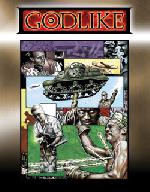
Nice hardbound book, with an accurate blurb on the back cover describing the game succinctly. My book, however, came with the front cover and back cover bowing inward, and the binding somewhat crackly. I showed this to friend of mine, who does layout and binding for a living, and he was doubtful that my rulebook would hold up to any constant use. Whether this flaw is throughout the initial publishing, or I just got a bad copy, only time will tell.
The interior was a pleasant surprise. The altered B&W photos and ink drawings by Detwiller perfectly conveyed the mood and theme of the game, and this comes from someone who generally thinks art in RPGs is a waste of valuable space. The text is smaller than usual, but I can assume that it was necessary to shoehorn all the information in. It's still legible, and it has a working TOC and index, something rare in the RPG industry. Yes, there are typos and "page xx" is nowhere to be found. In 354 pages, however, these do not occur often enough to hamper the reading experience.
So, except for the covers, this game did aesthetically what it was supposed to do. To art fanatics, it may seem dry, but it's legible, well layed-out, and still has enough of the necessary atmosphere to get the point across without overkill.
MEAT
This book shines where (IMO) it really counts: the content.
First, the mechanics. It's a typical dice pool game, with rolls of Stat Skill determining your success. This should be familiar to anyone who's ever used White Wolf or Legend of the Five Rings. The twists are that you roll ONCE to determine initiative, success, where you hit, and how well you succeeded. How? By looking for how many dice have the same number (a "match") in the roll. "Height" is how high the number is (1-10 scale, 1 being lowest, 10 being highest), which tells you the quality of your attempt, or how well you succeeded. "Width", or how many dice have the same number, determines how quickly you do your action, but can also tell you how deadly your attack was, just as Height tells you on what part of the body your attack landed. You can only ever roll a maximum of 10 dice in any roll. At least two dice must match for any roll to succeed.
Using this as a foundation, the game adds Hard Dice (dice that are automatically 10s) and the even more valuable Wiggle Dice (dice that can equal any number rolled.)These dice are treated as part of the roll, except as their special abilities dictate. These dice simulate the hyper-normal abilities of the men and women referred to as Talents.
The scary thing is, it's much simpler to understand and smoother in play than I make it sound.
Next, character creation, is a simple matter of assigning ratings to Stats (the basics, which in this game are Body, Brains, Command, Cool, Coordination, and Sense, all of which are fairly intuitive and pretty well explained) and Skills (again, fairly self-explanatory.)The interesting part is deciding on your character's Talent, the "superpower" part of the game. Powers, in GODLIKE, are set rather low; there's no full-fledged Mind Control or Time Travel, for instance, although such a power could be built fairly quickly using the Talent building rules. The powers that do exist, in order to be effective, are quirky and flawed in odd ways, much like the men and women who use them. (GODLIKE rules could be an excellent game engine for a Mystery Men or Wild Cards rpg.) So while flexible ( there is both a pre-set power list and a design-your-own-power system), the results are low-power, and if your power does not specifically say it can do something, the default setting says it can't. This part of character generation is the one where most questions will pop up, and is the part which will most intimidate new players and GMs, although I personally think it's simpler and more intuitive than Champions, and that game has been around a long time. As far as what powers it can/cannot handle, I think it's right up there with Champions in being able to model almost every power out there, but it is more description-oriented, which helps in coming up with distinctive (alright, and WEIRD)powers.
WARNING: the system is "rules-light" in structure, which means that the GM will, at some point, have to adjudicate things on the fly and be prepared to guess at results. However, for those who favor "rules-light" games, the system is surprisingly realistic and combat is both deadly and gritty. In a war-centered game, that's a neat feat to pull off, but there will be those who feel overwhelmed by the detail or put off by the flexibility. To my preferences, it has structure where necessary (realistic rules on the effects of stress and combat on soldiers)and flexibility where necessary (skill lists, the One Role method, etc.)Your mileage may vary, but I was impressed with what the system could handle. And if you want your games with more grit, more cinematic, or maybe bits of both, they have rules tweaks both in the book and on the website to allow you to do so.
Also, your power (Talent)in an interesting twist is fueled by Will. You have Base Will (Command Stat Cool Stat), and then you have your Will Pool, which fluctuates as you experience the heights of triumph and good news, and the bitterness of defeat, the madness of war, or that "Dear John" letter from home. Thus, your character's emotional state directly impacts his/her effectiveness gamewise. A nice humanizing twist, one which it seems only the team from Unknown Armies and Delta Green could pull off so expertly.
In another twist, if your Talent can see another Talent activating his power, both Talents will know each other for what they are. Otherwise, the Talent is an ordinary human being, period. Further, if one Talent uses his power on another Talent, the defender can spend Will to counter the effect, which the attacker can counter by spending Will, thus starting a bidding war which will either neutralize that use of the power on the defender (if the defender wins), or let the attacker's power succeed (if the attacker wins the bid.) Certain Talents, usually defensive or ones that only affect the user, cannot be bid against. Since at least one point of Will is required to activate/maintain Talents, bidding wars are risky for both parties. This is a good way, however, to keep Talents from getting out of control and to allow "spot-on-the-wall" Talents (those whose powers are quirky and narrowly-focused) to do battle with those whose Talents are more combat-oriented and still triumph with the aid of strategy and firepower.
This brings up a point: Planning, survival-orientation, and caution are necessary for keeping a long-term character in this game. Combat and wartime conditions are LETHAL. Use your brains first, your firepower second, and don't use your Talent unless you MUST. Keep your wounds BANDAGED and CLEAN as possible. Keep track of your SUPPLIES. If at all possible, CALL FOR BACKUP and DO NOT BE AFRAID TO RETREAT. In short, character survival in GODLIKE upends many of the tropes seen in other superhero games, because even though you're hyper-strong, that won't do much to protect you from a sniper's bullet to the head. (This is why Talents don't wear spandex outfits; that, and any real soldier from the 1940's would rather be court-martialed than face his buddies in the squad in that outfit.) Just because you can bounce bullets off of you, doesn't mean you can survive a bazooka to the face or a mortar shell up your a**. This may be off-putting for those expecting more "superheroics" from a superhero game, but others will appreciate having to think their way through the challenges.
Oh, almost forgot: If you have trouble wrapping your head around the regular mechanics, there's a d20 conversion in the back of the book that looks pretty solid. (I don't know; I haven't tried it.)
Next is the setting, and here is where the authors' love of the game comes shining through. It's not only an rpg, it's a college-level textbook on World War II! Packed full of info on the battles, the strategies, conditions of the United States homefront, all neatly arranged according to date, this is excellent for GM's who want to drop their players almost anywhere and anywhen during the war. It even mentions the Asian theater of WWII in detail, something most games (and movies, and historians)don't cover in much detail.
There are some holes though. First, the game doesn't provide much of a "day-in-the-life" perspective of a given soldier (equipment, rank, how information was communicated, conditions on the front lines vs. the rear echelon, etc.,) and what is given, the lion's share of it is mostly devoted to American soldiers. And (this floored me) there's NO game stats for airplanes! GAAAHHH! In a game where they establish that the first Talent is a Nazi who flies, and who uses his power to harass the airforce of Poland, you'd think they'd provide stats for planes so that your players can fly and try to shoot down that Nazi "Ubermensch" *&@#! once and for all! But to be fair, that would have probably jacked the cost of the book even higher, and the airplane sample stats are available for free on their website, and most of the rest will either be covered in a supplement or can be extrapolated through research. Just be warned that, for a first-time player or GM, research and/or supplements will be quite helpful, bordering on necessary in some cases.
The neatest part of the setting (for me) was noticing how NPC Talents affected the war, but did not do much to actually significantly change it. Yes, there were hyper-genuises, mad-scientist inventors (this is called "Goldberg Science" in the book, after Rube Goldberg), people who could kill with a look, teleport, juggle tanks etc., but the vast majority of what really went on went on due to the efforts of regular people. This to me feels realistic and further gives the setting a sense of familiarity lacking in most "superhuman" games. Again, options are available to "four-colorize" the setting, but I can't help but feel that doing so is missing the point: A real hero can only do so much, but even knowing that, does what s/he can. This makes the Talents of GODLIKE more accessible, in many ways, than superheroes in other games. Also, the powers of some of the Talents were a hoot: one Talent could telekinetically lift things with his shadow, another could turn his enemies to salt, one was immortal... and stuck forever looking like a sixteen-year-old, one scrawny-looking Talent could lift a 64 ton crane over his head for nine minutes, etc. Even the most "spot-on-the-wall" power, used properly, could turn the tide of the war. There's even hints of weirdness via Mad Talents, Talents who can seemingly do anything and can't be countered by regular Talents, but the cost is terminal insanity. (Think Marauders from Mage: the Ascension, and you're on the right track.)
In short, with a little time, research, and some sense of adventure, GODLIKE is a book with plenty of ideas to keep you going for a long-term campaign in many different arenas: espionage, front-line warfare, problems along the homefront, non-European theaters of war: whatever you want, you can pretty much do, and the book will aid you. You could even play un-Talented soldiers, and still go into combat with Talents and even succeed if you keep your tactics about you, something that most superhero games can't promise.
On the whole, it's tough to find fault with this game, and I tried, especially with $40 at stake! It's a good game with solid mechanics (as solid as game mechanics get without getting intrusive) and a well-researched, believable setting. It's a grabber, folks, so get it while the grabbing's good.

