

 Search
Review Editing
Review of Godlike
 Goto [ Index ] |
GODLIKE Review
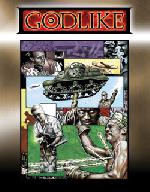
GODLIKE is a new RPG by Dennis Detwiller and Greg Stolze, dealing with the appearance of super powers during World War II. It’s a great big hardcover book, 354 pages for $39.95, and it comes from Hobgoblynn Press, although it was produced by Pagan Publishing.
Bias Alert
Here’s the deal. I got excited about this game at GenCon 2000, when Pagan Publishing was handing out flyers advertising it. I was really hoping to see it at GenCon 2001, but it wasn’t there. Dennis Detwiller was there, and he and I spent a little bit of time talking about the book. It was at that point that he promised me a free copy, as long as I promised to write an honest review of it for RPG.net. I agreed.
Now, I’m a freelance writer, and Dennis has already asked me to write a couple of things for the system, so it could be construed that I’m just a shill for Hobgoblynn when I write this review. I certainly hope to get more work from them in the future. I did, however, promise Dennis that the review would be honest, and I’ve done my best to make it so. If you feel that my post-publication association with the game makes me an unreliable reviewer, fair enough. It’s a valid viewpoint. You might want to read the review, anyway.
The Process
This review is broken into two parts: a discussion of what’s in the book (and what’s not), and a discussion of how it all worked in the playtest. I decided that, for a free book, Dennis and Greg deserved a solid playtest review. So, after I read through the book, I got together four friends, created characters, built a scenario, and ran it. The details are below.
The Read Through
The book is generally well written, although it could have used another editing pass before going to the printers. On the other hand, that would have made it even longer before I got my grubby little paws on it. Still, there are numerous p.xx references, and I found the use of hyphens instead of dashes sort of intrusive. Grammar and spelling are solid, with minor exceptions, and the layout is clean and easy to follow. All in all, it’s as good as any new RPG, and a darn sight better than most.
One really nice thing about the book is the binding. The book lies flat, with the pages flat. The glossy paper that they use for the pages is soft enough that it doesn’t try to close on you, and the book stays open to the page you want. Not a huge thing, but nice.
The art seems to be altered black and white photographs from the period. I say, “seems to be,” because I’m not sure how many are photographs, and how many are the amazingly impressive pen and ink work of Dennis Detwiller. Whichever they prove to be, and I suspect it’s a mix, they are very evocative of the setting, and entirely appropriate.
Now, onto the meat.
The System
GODLIKE uses a dice pool system with an interesting twist. You roll a number of d10’s equal to your stat plus your skill, and you look for matches. A match means a success; more matching dice and higher numbers for the match mean better successes in different ways.
You can never roll more than ten dice for any action, because eleven dice means an automatic success. This creates a fairly chunky scale of power, with only nine really applicable levels: two through ten. Some of this granularity is relieved by using the neat little dice tricks in the rules, but still there are only nine useful levels of ability. The probability curve also gets a bit weird, as is discussed in a nice sidebar on page 7. Essentially, a one-die bonus at low ends of the scale is far more powerful than a one-die bonus at the high end. Similarly, penalties hurt more at low ends than at high ends. Neither of these facts has a negative effect on the system that I’ve discovered so far, but they are the realities of the mechanics.
The powers in the book are modeled using a couple of interesting dice tricks. The first is something called a Hard Die, which is a die that is always a 10. If you have two Hard Dice in anything, you always succeed very well. The second is a Wiggle Die. Wiggle Dice can be any number you want them to be, and you can decide what they are after you roll the rest of the dice. This means that you will automatically succeed in any action where you have a single Wiggle Die, and can choose your degree of success with two or more Wiggle Dice. These work nicely in forming the basis of the powers in the game, with different point costs during character creation for different types of die.
With the match system, each roll has two axes of success, and the system takes advantage of that. The number of dice in a match (the width) means one thing, and the number on the dice that match (the height) means another. Generally, the width of the match determines the speed at which you accomplish the action, while the height determines how well you succeed. This means that four ones (a 4x1 match in game notation) succeeds before two tens (2x10), but not as well. Sometimes, degree of success (height) doesn’t matter, such as in a race, so the height is discounted. Other times, the speed (width) is irrelevant, such as listening for movement in the dark, so the width is discounted. This gives the system a lot of flexibility.
Combat is handled by a single roll determining initiative, hit location, and damage. The width determines the initiative order and damage, and the height determines hit location. Of course, no matches means a miss. This creates an interesting phenomenon: more damaging attacks happen first. Wider results happen first in the combat round, and damage is based on the width of the success. Thus, if I roll well enough to blow your leg off, that’s probably going to happen before you have a chance to graze my arm. I’m not sure how big an impact this will have on the actual combat, which is deadly in the extreme, but it seems an odd sort of artifact of the system. Obviously, two success axes were pressed into handling three variables in the name of a one-roll combat resolution. Whether it’s a problem or not remains to be seen.
Character Creation
Character creation is a point-based build that is conducted in two stages. In the first stage, you build a normal human character, and in the second you add the powers. This is very similar to the way things are done in many White Wolf games, and it is especially appropriate to a game where people develop super powers in the middle of their lives. It’s a very straightforward stat and skill system, with each skill being dependent on a specific stat. The skill list is far from exhaustive, encouraging players to develop their own skills.
One thing that I found to be problematic was the list of skills that characters can gain in the TOG campaign background provided by the game. The list contains skills that are not included in the main skill list, and the stats that they are associated with are not identified. Now, it may not be a big deal to come up with the appropriate stats, but it does call for the GM to make a judgement call about something that the game designers could easily have included. Is Knife Fighting a Body skill, like Brawl, or a Coordination skill, like Pistol? How about Climb? Explosives? Mortar? It would have been really nice to have this information included, and it would have taken very little to add these skills to the skill lists in the book to identify their governing stats.
Adding the powers, or Talents as the game calls them, is very smooth. They are broken into three categories: Hyperstats, Hyperskills, and Miracles. Hyperstats are stats beyond the human norm, Hyperskills are skills beyond the human norm, and Miracles are impossible things like flying or telekinesis. Again, it’s a point-based build that has some nice flexibility considering the relatively simple system. With a little bit of thought, you can easily build just about any kind of Talent that you want, limited only by the points you have to spend.
Aside from the point spending, there is a lot of emphasis placed on coming up with a personality, nationality, motivation, family, and so on for your character. In general, I like this kind of attention, but there is a small concern. Played at the default level of power and lethality, this game chews up characters, sort of like a war does. I can see players getting pretty blasé about creating the inner life of a character that’s going to be a casualty statistic in very short order. Still, it’s nice to see this emphasis in place for the higher-powered campaign options.
Background
Boy howdy, this is where the book really shines. There is a timeline in this book that spans 151 pages. That’s almost half the book. If you lump in the section on life in the 1940’s, the field manual that details weapons and equipment for all the forces involved, the detailed TOG Commando Squad campaign setting provided, and the fully-statted NPCs, you’ve got 196 pages or there abouts of meaty goodness for your game.
The timeline especially is a thing of beauty. Never mind that it covers (as far as I can tell) pretty much every major event of the war. Never mind that it’s got dossiers for the famous Talents interspersed with it, outlining their lives up to the present (if they survive that long). Never mind that events that differ from actual history are identified by a little bullet hole graphic by their entry. All these things are nice, even wonderful, but they pale alongside the little insights provided in the sidebars.
I don’t want to spoil any of the little surprises for people reading the book for the first time, or for players to discover in their games, but there are some real gems in there. The “Winoga Wonder,” on page 119. The Public Campaign to Detect Enemy Talents, on page 141. True Evil Never Dies…, on page 170. “All this killing, it’s wrong…,” on page 211. Everyone’s going to have their own favorites, and there is something in the timeline to tickle anyone.
I was very worried about this timeline, because I saw the detailed, day-to-day accounting of the events of the war as a limiting factor on play. It’s the same sort of complaint I have about playing in a game based on a popular movie or television series. If everyone knows who the big heroes are, how can your character be anything more than a supporting player? I was greatly relieved to see the timeline sprinkled with literally hundreds of references to Talents besides the big names, and ideas for different missions. Rather than limiting the scope of play, this timeline really opened it up. Kudos.
I do have some little quibbles with the rest of the background information, however.
First, the field manual stats out weapons and vehicles for the five major forces in the war. It does not, however, give you any real information about other types of equipment: no radios, survival gear, medical gear, binoculars, etc. Not a big deal if you already know a lot about this time period, or if you already own GURPS WWII, but it still would have been nice to see. Maybe a description of what you could reasonably expect to find in the pack of a standard infantryman for each of the countries. That would have been handy.
Second, there is no list of ranks for any army but the Americans. Again, not a big deal if you already know or if you own GURPS WWII, but it would have been nice and convenient.
Third, there’s no real discussion of what might be an appropriate challenge for a group of Talents. Granted, this would be difficult to do precisely, because of the incredible potential range of Talents and their suitability for combat, but I had no idea as I designed the scenario for my playtest whether I was building a cakewalk or a deathtrap. This could have been alleviated somewhat by an introductory scenario in the book, but there isn’t one. There is a nice scenario at the GODLIKE website, but it’s built for pregenerated characters, so it’s not ideal for judging the general level of challenge.
Obviously, all three of these things are the result of space constraints. The amazingly good timeline squeezed out some of the more useful, but less cool, things that could have been included. It was a decision that had to be made, but I can’t help pining for an extra fifty pages to cover what I felt was missing.
In general, after reading the book, I like the game a lot. It has a very detailed world to play in, and a great deal of flexibility. Of course, the real proof is in how the game plays.
The Playtest
Because some of my playtesters had read the free scenario on the GODLIKE website, I put together a new short scenario to run the players through. I gathered together four of my friends on two separate evenings, one to create characters, and the other to run the scenario.
Creating Characters
We put together four characters in less than two hours. That’s pretty good for a point-build system that has the wide-ranging variety of super powers. It helped that everyone had a good solid character concept when we got together, but it still ran pretty quickly, all things considered.
This started showing up some of the subtleties of the rules as we went along. Figuring out how to model the effects of a chameleon-like ability, trying to determine whether six Wiggle Dice in telekinesis were excessive, and deciding whether to by Hyperskill dice or Hyperstat dice all took some digging. Not all of the questions were easily answered by the book, however, and I had to make some judgement calls to make sure everything would work.
Fortunately, the system is clear and flexible enough that the judgement calls were easy to make after a little bit of thought. Finding similar things dealt with in the rules and then extrapolating from there solved most of the problems, and a simple decision was usually enough in the other cases. All in all, things went pretty smoothly.
I also gave the players a rundown on the system, and played through a couple simple rounds of combat to show them how it worked. We all learned that combat in the default setting of GODLIKE is deadly in the extreme: one hit with a rifle shot will almost always take a character out of play. This is realistic, of course, but looked to be very hard on the characters. After witnessing the effects of the combat, I decided to print out the pregenerated characters on the GODLIKE website in case substitutions are needed during play.
Then, it was on to the scenario two nights later.
The Scenario
I whipped up my own scenario for two reasons. First, some of my players had already read the free introductory adventure provided on the web. Second, I wanted to see how easy it was to assemble and balance a scenario given the information in the book. I’ve already talked about the challenges of trying to balance things with no real guidelines, so I won’t go over that again. Suffice it to say that I rolled a lot of dice trying to get an instinctive understanding of the various strengths and weaknesses of the various challenges.
I wanted an adventure that we could play through in about three hours, so I decided to make the characters part of Operation Rascal, teleporting into occupied France the night before D-Day, with orders to eliminate a pair of German Talents billeting at a farmhouse. To make things interesting, I put an extra Talent in the farmhouse that no one knew about, set up a sniper covering one approach to the farmhouse, two machine gun emplacements covering the other approaches, and a patrol on the way to farmhouse for the characters to dodge or eliminate.
I won’t outline the events step by step, but I do want to talk about some things that we noticed during play.
First, snipers are really, really deadly. Really. Sniping took out one Talent and the NPC partisan guide just when the characters were getting ready to spring into action. Bonuses for surprise attacks, and the bonuses for aiming really add up. In the ultra-deadly default setting, it is absolutely necessary to take all the precautions that the soldiers needed to take in real life: sticking to cover, using covering fire, carefully peeking around corners, etc. It all becomes vital. This is not a bad thing, but it came as a bit of a revelation to have it spring up in the middle of a super hero game, and it took some time for the players to adjust to that idea.
Second, the loose skill system requires a lot of improvisation in the middle of the game for the GM. What exactly does the Tactics skill do? How does the Explosives skill work? Of course, once a ruling is made, the problem goes away (until next time), but it can cause a break in the action while the decision is considered and made. As this was the first run-through, this cropped up a fair bit.
Third, combat can quickly get unwieldy for GMs. You have the common problem of dice-pool systems in that you wind up rolling fistsful of dice for each NPC involved in the action, but it’s compounded because you have to, in essence, roll them all at once. You need to have all the rolls for the round made before you can start determining what action happens first, so you don’t have the leisure of only rolling when it’s that NPC’s turn to act. The players said that it wasn’t terribly intrusive from their side of things, but I felt that I was scrambling constantly whenever I had more than two or three NPCs in on the action. Of course, this problem would lessen as I gained experience in running the combat, but it can be a huge hurdle at the beginning of things.
At the end of the evening, after about three and a half hours of play, most of it in combat, the characters had accomplished their objective, with three losses. In a brief post-mortem, it was determined that everyone had fun, although the lethality of the system gave them some doubts about the long-term playability of a campaign. I explained the optional rules for reducing the deadliness of the game, and the suggestions for Troop Play that are outlined in the rules, and they agreed that these would make a big difference.
Final Assessment
I really had high hopes for this game, and I wasn’t disappointed. It was every bit as exciting and interesting and fun as I had expected it to be. Thanks to Dennis and Greg for putting together a great game with a truly distinctive feeling, setting, and system.
It’s not perfect, though. Unless you’re a World War II buff, you’re going to want some supplementary material to help you run your game. If you’re a beginning GM, you may want to look elsewhere for your first game. GODLIKE is extremely demanding for the GM, especially during combat, and running a campaign in the default setting is going to put an extra burden on you as you have to juggle the requirements of the story and the system and the feelings of players who keep having their characters shot in the head.
If the extra research and the work of running combat doesn’t scare you off, though, pick this game up. Run it, and you’ll enjoy it. Even if you never do run it, it’s well worth the price tag as an example of world building and system design. And just reading it is fun.

