

 Search
Review Editing
Review of Godlike
 Goto [ Index ] |
Godlike: Superhero Roleplaying in a World on Fire, 1936-1946

Disclaimer:
While I'm still waiting to receive my pre-ordered copy from Wizard's
Attic, I was fortunate enough to score a copy of Godlike for my winning
entry in the publisher's Better Talent contest. Obviously, I am predisposed
towards liking this game. Despite that, or perhaps because of that, I have chosen
to submit this, my first review for RPG.net.
Please note that this is a capsule review. I have read the book from cover-to-cover, but aside from some character generation and solo mock combats, I have not yet had a chance to play-test the mechanics with a group of players. Quick-play rules and a ready-made scenario have been available on the Godlike website for some time, and I recommend that you look here (as well as here and here) for some quite entertaining play-test reports.
Introduction
Godlike is a new RPG that has generated a lot of hype on the ‘net, due in no small part to the previous efforts of its authors. Dennis Detwiller's past contributions towards Pagan Publishing products such as Delta Green and Delta Green:Countdown have garnered wide acclaim, while Greg Stolze's work on Unknown Armies and Usagi Yojimbo has also received high praise.
So what is Godlike, then? The quick and dirty answer is "World War II with superheroes," but that doesn't really do justice to either the setting or the system. Mr. Detwiller's setting is a grim and gritty alternate history that, despite the presence of people who can fly or deflect bullets or turn invisible, doesn't deviate too radically from our own history because of various checks and balances placed on the superpowers. Coupled with the intriguing setting is Mr. Stolze's innovative variation on the dice pool which some have termed the "one roll to rule them all" system. If that wasn't enough (it was for me), then there's also a set of Open Source (a.k.a. d20) conversion rules by Mike Mearls.
I'll get into more detail on both the setting and the system as I review specific chapters of the book, but first I want to give a description of the book itself.
Physical Description
Godlike is a hardcover book, with 360 glossy pages and what looks to me to be a durable, non-glued binding. It's a sturdy tome and stays opened flat from first page to last. The paper stock feels a bit thin, but strong, so when the book is closed, it's about the same thickness as other books with as many as 100 fewer pages. Print quality is very good – I experienced no smearing, which can be a concern with slick paper publications.
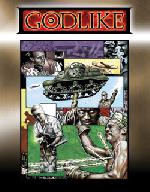
The book sports a cover featuring a collage of stylized tinted photographs, while the interior artwork is all black and white, and consists of an evocative mix of stock and cleverly retouched WWII era photos. These photos grace almost every other page, but they are small enough to be unobtrusive (about three inches wide and one-to-three inches tall). One thing I found disappointing was the lack of captions for the photos -- some of them have appeared on the Godlike website with captions, and while the pictures in the book usually have something to do with the text on the page where they're found, I missed the extra detail that the captioned photos provide.
The text of the book itself is laid out in two balanced columns per page. The typeface is a bit small, maybe 9-point, but still quite legible. Heading levels are clear, but I would have liked more of them to show up in the Table of Contents which is only a single page. The index is pretty thorough by RPG standards, albeit difficult to read, with entries arrayed in four columns on eight pages. The book isn't typo-free, but based on the word count, it's pretty damn clean. I only noticed three "page-xx" references and a few other minor grammatical and formatting boo-boos, so all in all, I am very impressed with the editing. (Note to Issaries, Inc.: Please hire these guys to produce Hero Wars, 2nd Ed.)
Taking all of these elements together – the page count, the layout, the artwork, and so on – the one word that comes to mind is "crammed." Not cramped, as in difficult to read or work with, but crammed with information. Even the obligatory game fiction is restricted to less than half a page per chapter. One gets the sense that putting this book together must have often been a matter of finding exactly the right place to squeeze in just one more cool thing. It also probably explains why the photo captions didn't make the cut – there simply wasn't room for any more text without making the pages overly busy.
Detailed Content Review
Okay, so the book is lovely and all, but what about the content? It looks like it's time for a breakdown, chapter-by-chapter.
Part 1: Introduction (5 pages)
The first half of this chapter sets the tone for the rest of the book and allows the authors to explain their goals in producing the game. Mr. Detwiller states that he wanted to create a setting which realistically extrapolated the impact of superhumans. As for the game itself, he is clear in his distaste for burdensome metaplots, incomplete rules requiring splatbooks, and the overuse of stylized writing. On the rules side, Mr. Stolze sought to implement a simple game mechanic which permits fast resolution of 20th Century combat effects while still allowing for the scalability required by superpowers.
The second half of this chapter includes the ubiquitous "What is Roleplaying" section, along with a brief list of World War II book and film references, and a handy glossary of game-specific terminology.
Part 2: Game Mechanics (23 pages)
The Godlike game system is the foundation upon which the setting rests. This chapter covers almost everything you need to run the game, with the exception of the specific superpower descriptions (which are detailed in Part 4: Talents).
First come the stats: Body, Coordination, Sense, Brains, Command, and Cool. Body is how big and strong and tough your character is, while Coordination determines how well he controls that body. Sense describes your character's awareness of his surroundings and Brains measures how smart he is. Command is personal charisma and leadership potential; Cool quantifies the character's capacity for grace under pressure. In addition, Command and Cool together help determine your character's Base Will. This calculated stat is very important later on because it relates to Will Points which are what drive the character's superpowers. All normal humans have stats ranging from 1 to 5, with 2 being average.
Next come the skills; each one is associated with a particular stat. For example, Brawl is a Body skill, Rifle is a Coordination skill, and so on. Normal humans also have an upper limit of 5 for any skill rating and no skill can be higher than the associated stat.
This leads us to the basic Godlike dice mechanic: rolling stat+skill in d10s. Pretty familiar territory, but here's the twist: Instead of trying to beat a target number to count successes as with many dice pool systems, in Godlike the objective is to get matches or sets, that is, one or more pairs, triples, and so on. The number of matching dice in a roll is called the width, while the number on the matching dice is called the height. By providing two values in one roll, the Godlike system streamlines a lot of dice handling. For example, width can be used to determine how quickly something is done, while height indicates how well. Or in the case of combat, width determines initiative and affects damage severity, while height indicates hit location and can be used to set difficulty by requiring a minimum height.
To keep the odds (and the dice handling) reasonable, there is a ten dice maximum to any roll. Generally, a success is any match (a pair), but getting a wider success (three or more of a kind) can sometimes be more important since it often determines when things happen. Performing multiple actions is pretty straightforward: use the smallest relevant dice pool, drop a die for each additional action, then roll and hope you get multiple matches (for each action to succeed, you need a separate set of matching dice).
Combat is fast and deadly. A round is typically not more than a few seconds. Each player declares their action(s) in order of Sense (from lowest to highest), then everyone rolls their appropriate dice pool simultaneously. Widest results get resolved first with height breaking ties. Taking damage makes you lose a die from your highest set, which may wreck your only pair and turn success into failure. Defensive actions like dodging can "gobble" lower dice from your opponents sets in order to break up pairs.
If you successfully hit your opponent, the width determines the damage (modified by the weapon) and the height tells the hit location. To make a called shot for a specific location, drop a die out of your dice pool because of the difficulty, set another die to the specific value you're aiming for, then roll the rest. If any of the rolled dice match the aimed die, then you made the shot. There are two types of damage: stunning and killing. Some attacks do one or the other and some do both. Take enough stunning damage and it starts to turn into killing damage. Both types of damage are marked off by hit location on the nice, clear character sheet.
In theory, it seems like a bloody cool system, but I haven't played the game enough to tell how well the system works in practice. There are a few aspects of the mechanics that some people may not like. It is rather grainy in that you will always roll between two and ten dice, and the chances for success (a single pair) rise quite steeply for small-to-medium dice pools, but plateau for larger dice pools. As a consequence, adding/subtracting a bonus/penalty die from the dice pool can have an enormous impact on a small dice pool, but have almost no effect on a large dice pool.
The rest of this section goes into greater detail on combat, focusing in turn on gun combat, hand-to-hand, the use of cover, armor (light and heavy), different types of weapon effects (area, burn, spray, penetration), and other miscellaneous ways of feeling pain (electrocution, falling, drowning, freezing, burning, crashing, and so on).
Finally, the chapter concludes with character advancement. Stats, skills, talents, and Base Will can all be increased by spending Experience Points and/or Will Points. Interestingly, while most advancement is done between missions, it is possible to advance a single item in the middle of a game scenario. As a player, I really like this feature; as a GM, I'm not sure.
Part 3: Character Creation (6 pages)
This chapter is deceptively short because it really only covers how to create normal characters. To make a Talent with powers, you'll need to look at the next chapter, too.
The authors recommend that character creation be done chronologically; that is, normal joes suddenly get powers. First come up with a background (nationality, age, family, education, friends, dependants, and motivation), then assign points to stats and skills. If you're just planning on using Godlike as a WWII game, you're all set and need read no further. However, to create a Talent (one of them fellas with powers), continue on to Part 4: Talents.
Now maybe it's just me, but when I make a new superhero, I tend to come up with the power concept first, then fill in the back story to explain/rationalize how he got that way. Also, given the brutal mortality rate that the default setting presents, I don't know how much work I want to put into fleshing out my character's pre-war life. On the other hand, it could be argued that it's exactly that kind of development that is required to humanize characters that are quickly dehumanized by the war and the dangerous situations in which they find themselves. This is the sort of thing that will require actual play, so for this capsule review, I leave this question unresolved.
However, the fact remains that, mechanically at least, the portion of character creation documented in this chapter is dog-simple and easy-quick.
Part 4: Talents (65 pages)
Now we come to the heart of any superhero game: the powers. If they're too restrictive, then players can end up feeling not all that super (Brave New World, anyone?). If they're too world-shattering, then they become the focus for the entire setting (see Aberrant). In order to maintain the premise that history in Godlike proceeds largely as expected (that is, Captain Lycra-Thong doesn't go back in time and use mind control to compel Hitler to keep painting), some limitations have to be placed on what Talent powers can and cannot do. However, I'm happy to say that they still leave a helluva lot of crunchy bits to play with.
In Godlike, powers are divided into three primary categories: Hyperstats, Hyperskills, and Miracles. Hyperstats and Hyperskills are almost self-explanatory. They allow characters to exceed normal human limits by adding dice to specific stats or skills. Miracles are the weird stuff, like flying, being bullet-proof, shooting lightning from your bum, whatever.
Talent powers introduce a new dynamic to the Godlike matched sets concept by adding two new kinds of dice: "hard" dice and "wiggle" dice. Hard dice are automatic 10s, so if you have two or more hard dice in something, you almost always succeed very well (but there's always the chance that someone else might roll wider and beat you to the punch). Wiggle dice are wild. You set them after you roll the rest of your dice, which makes it much easier to roll wide or multiple sets.
Hyperstats, Hyperskills, and Miracles can all be purchased with a combination of regular, hard, and wiggle dice, but keep in mind that the cooler die types are increasingly more expensive. Hyperstats and Hyperskills have set costs for the three die types, but Miracles can vary quite a bit depending on their qualities and any associated Extras or Flaws. There are four possible qualities that a Miracle may have: Attacks, Defends, Robust (no significant limitations), and Useful Outside of Combat. The more of these qualities a Miracle has, the more expensive each die type becomes. Die costs can be further raised by adding Extras (special ways a Miracle works beyond the basic description) or lowered by adding Flaws (limitations and weaknesses in how a Miracle operates).
While the rules make it pretty easy to design a Miracle from scratch (the so-called "Gourmet" approach), this chapter also provides over 40 "Cafeteria-style" Miracles ready to be used as is or modified with more Extras and Flaws. One of these is Godlike's equivalent of the gadgeteer: Goldberg Science. Characters with this power can construct outlandishly advanced technology that only works in the presence of the Talent because it's all really just a nonfunctional prop for focusing the character's subconscious power.
The cornerstone of Godlike powers is the idea of Will. Will Points fuel powers and are also used for character advancement. Will Points are gained when characters win victories or do psychologically restorative things, such as going on leave. Will Points are lost by losing fights, failing in objectives, or just plain being exhausted from too many nights spent under fire in a cold, wet foxhole. But the most important aspect of Will Points is their use in Talent versus Talent conflict. You see, Talents can sometimes interfere with each other's powers, and this usually culminates in a bidding war of Will Points to see who's going to have their way with reality. It can really suck to have some guy who can levitate a whole six inches whomp your mega-awesome heat vision into submission just because you're still crying over that Dear John letter you got last mail call. Will Points are very, very important.
What more can I say? This chapter is excellent. If the book had stopped here, I'd probably have been happy enough with the game to give it a decent score. But we're only 100 or so pages into the book. Yikes!
Part 5: Background (151 pages)
Yowza, this was a fun chapter, but then, I'm an unabashed setting junkie. After all the rules, it was just so easy to settle in and absorb the atmosphere of the Godlike world. Basically, this chapter consists of a detailed timeline of events spanning ten years of very turbulent world history. And I say "world" because there are entries for every continent except Antarctica (which was kind of surprising in a way, considering all of the Godlike potential for a Neuschwabenland campaign). Conveniently, the timeline entries are marked to indicate whether they are real history or alternate history.
Interspersed throughout the chapter are dossiers on more than 30 major Talents who had at least some impact upon the war. It's rather telling that most of them were killed before 1945. Each dossier takes up an entire page and they are arranged so that they appear close to the first timeline entry in which the Talent appears. This is nice enough when casually reading through the book, page-by-page, but it makes it harder to look up each specific dossier. Also, I would have liked to have seen stats and a photo accompanying each write-up. Stats for ten of them do appear in Appendix B: NPCs, but there is no direct cross-reference in either section that points at the other.
There are lots of little variances that make the Godlike setting different from real history, but that don't turn it into a farfetched fantasy history. The authors treat history like a big river: they might move a few rocks around, creating new currents and eddies, but the river still flows where it always did. For example, while the U.S.S. Arizona survives the Japanese attack on Pearl Harbor, none of her crew go on to, say, cure cancer. And while the Germans do put an artificial satellite into orbit in 1944, they don't manage to establish a laser-armed station in a geosynchronous position above London. In other words, any historical references you might use for campaign preparation are still 90% accurate for Godlike. Well done.
Part 6: Now and Then (12 pages)
While the previous chapter delivered a 10-year history of the world, the first half of this chapter focuses on the culture of the United States of America, circa 1940. It examines the prevalence of isolationism (a position which lost popular support more quickly in the Godlike universe), as well as the more commonplace attitudes of racism and sexism. The authors make the point of saying that it is up to the gamers to decide what level of historical accuracy should be used. The internment of Japanese-Americans, racial segregation in the military and in civil society, the role of women in wartime -- all of these issues can be incorporated or ignored.
The second half of the chapter offers an overview of U.S. Army training and organization, factoring in the growing presence of Talents as the war went on. To make it easier to get into the spirit of the period through language, the chapter closes with a brief list of 1940s American slang. Together with the previous chapter, I felt that the authors truly evoked a sense of living through that momentous time.
Part 7: The Field Manual (19 pages)
What would a war(game) be without the means to wage it? That's where this chapter comes in handy. The most common arms and equipment for Germany, Japan, the USA, Britain, and the USSR are listed in this chapter. Under each nation, are lists of statistics for personal weapons (ammo, pistols, carbines, rifles, and submachine guns), heavy weapons (machine guns, anti-tank weapons, grenades, mortars, artillery, mines, and flamethrowers), and vehicles (tanks, armored vehicles, and light vehicles). In other words, lots and lots of big implements of death to encourage the characters to keep their heads down (remember, most Talents can be taken out by a sneaky head shot just as easily as any normal soldier would be).
Statistics for Axis and Allied combat aircraft are missing, but have already been posted to the Godlike website (and will be incorporated into a future published supplement). The same is true for more unusual weapons like those used by more irregular forces such as the OSS.
I'm not enough of an expert on mid-20th Century armaments to notice if there are any significant gaps in the weapons lists, but given the selection presented and the relative simplicity of the statistics, it doesn't look like it would be terribly hard to stat out that swanky Italian rifle or French pistol your guy is keen to carry.
Part 8: The Campaign (14 pages)
Coming so late in the book, this chapter might be overlooked, but that would be a big mistake, because it is here that the three game themes are discussed. The default Godlike setting and standard rules assume what is termed a "High Realism" theme. All of the character generation steps and combat examples in the preceding chapters are based on this theme. Because of the realistically high likelihood of character mortality, the authors suggest the use of Troupe/Troop Play, in which players create and control multiple members of a military unit so that early character death won't result in a player having to sit out the rest of a mission.
For players who would rather enjoy more of an Indiana Jones-style feeling over Saving Private Ryan, there's the "Cinematic Adventure" theme. For this theme, in addition to getting more points for character creation, several optional rules (from Appendix A: Optional Rules) are used to increase the odds of character survival. For example, the "squishy dice" rule allows a player to trade width for height or vice versa after rolling the dice. Increasing the ratio for converting stunning damage to killing damage also makes sudden death a little less likely. Because of this, Troupe/Troop Play probably isn't necessary anymore.
Finally, if you really want to have at it with comic book superheroes, and to hell with all this carefully and subtly tweaked history, then go with the "Four-Color" theme. This gives the players even more points to build really, really powerful Talents, while a more liberal use of certain optional rules makes blatant player stupidity pretty much a requirement for character death. Of course, that carefully crafted Godlike setting probably won't make much sense anymore if there are characters running around who are this powerful, but at least now you have the option of booting Himmler's scrawny ass into orbit. (Note: Thinly disguised Godlike versions of several recognizable contemporary comic book superheroes have been posted to the Godlike website, just to show the versatility of the system.)
After themes, other aspects of setting up a Godlike campaign are discussed, such as the Theater of Operations, the different types of NPCs (categorized based on how much detail and spotlight time they get), possible missions and objectives, and so on. I thought this was a very useful section, even for experienced GMs, because the suspension of disbelief can be trickier to establish and maintain with modern setting games.
The chapter ends with a detailed look at the day-to-day life of a WWII U.S. Army soldier on the front lines, including standard military protocol and field tactics. The point made here (and reinforced in the next chapter) is that regardless of your character's powers, he's a soldier first.
Part 9: TOG Commando Squads (9 pages)
TOG stands for Talent Operations Group and is the designation for the joint services command that oversees the allocation of Talents (superpowered individuals) to the various branches of the U.S. armed forces. Continuing where the previous chapter left off, this chapter takes the premise that the player characters are all members of the same TOG Commando Squad. These small units were typically assigned to larger standard units (for example, an infantry division might have several TOG Commando Squads) and were used for a variety of missions, from scouting and infiltration to shock troops in major offensives.
After a brief history of the TOG program and an overview of what to expect as part of Commando training, a sample squad is provided with nine fully statted out soldiers (one lieutenant, one sergeant, and seven privates). This unit could be used as a quickstart entry to the game or just as good examples of how diverse the Talent powers can be.
Appendix A: Optional Rules (5 pages)
Because Godlike is scalable among the three themes discussed in Part 8: The Campaign, there are a few optional rules available to adjust the power level of play. In addition to the "squishy dice" and "die hard" rules mentioned previously, this appendix also offers up some additional ways to make life at the front unpleasant for the characters, such as faulty grenades and gun jams.
One interesting rule concerns what to do with dice pools that have more than ten dice. While the 10-dice limit still holds as far as dice rolling is concerned, those extra dice can be used to offset penalties and to extend various power limits (such as mass and range for teleportation or weight for Hyperstrength).
The trickiest option is to replace the standard Will Point bidding war used to resolve Talent versus Talent conflicts with a blind bidding system. I have a feeling that this could be pretty nasty and result in faster than normal Will Point consumption.
(Note: After several requests, optional rules covering hand-to-hand Martial Arts have been posted to the Godlike website and will probably be included in a future supplement.)
Appendix B: NPCs (4 pages)
This appendix provides full stats for the world's first ten Talents. Their dossiers are scattered throughout Part 5: Background among numerous other important NPC Talents. I would have liked to have seen stats for all of the listed Talents and cross-references between the dossiers and the stats would be helpful, as well. That being said, seeing how the included NPCs are built makes it that much easier to come up with original Talents.
Stats are also included for common and elite normal soldiers, since that's what your characters will be up against most of the time. My only complaint here (easily remedied) is that the common German soldier (Coordination 3 + Rifle 3) is too freakin' good with his rifle compared to the common Allied soldier (Coordination 2 + Rifle 2). If the Heer really had an 85% hit rate (and 10% of successful hits are to the head), then I think Talents or not, the war would have ended a bit differently.
Appendix C: Open Source Superhero Rules (30 pages)
Mike Mearls authored this appendix which provides an alternate rules system for use with the Godlike setting. I have mixed feeling about this. I'm not a rabid anti-d20 gamer – I'm currently enjoying a very nice D&D 3E game and I'm quite curious to see how d20 Cthulhu turns out. Furthermore, I understand from a market access perspective how having what amount to d20 conversion rules would be a good thing for the financial success of the game.
On the other hand, the standard Godlike mechanics were tailor-made for the setting and they are suitably evocative of the mood. Some how, it just seems wrong to replace all those hard and wiggle dice with a d20 roll (plus modifiers) against a Difficulty Class (DC). Initiative rolls? Movement rate? What place do these things have in the gritty world of Godlike?
It would be easier if Mr. Mearls had done a poor job in adapting the Open Source rules, but that isn't the case. In fact, they are excellent. Godlike stats map fairly easily to Open Source attributes, with the addition of Cool and a slight change of scale (the average attribute is 10, not 2). Skill ranks plus attribute bonuses are used to modify a d20 roll; if the total meets or exceeds the DC, the character succeeds.
Character creation involves spending points on attributes and skill ranks. Superpowers (Hyperstats, Hyperskills, and Miracles) are treated similarly to normal skills in that they, too, require purchasing ranks (which modify the d20 roll needed to activate the power). Feats are still here, but classes are gone, and levels are, well, different. The different themes of Godlike (realistic, cinematic, four-color) are covered by varying the amount of points and feats available for character creation.
Every 1000 experience points bumps up the character's level, but the experience points are spent between levels to raise skill ranks, saving throws, attributes, powers, or gain new feats. This means that characters improve gradually and continuously, rather than suddenly gaining a bunch of new abilities whenever a new level is attained. As in standard Godlike, Will is still the battery that makes the Talent's powers work. Hit points don't go up, so weapons remain just as potentially lethal for 20th-level characters as for 1st-level.
All in all, these are 30 pages well spent. Even if you aren't interested in the Godlike setting, they make for an excellent d20 supers game. So philosophical quibbles aside, the only remaining complaint I have about this appendix is that the typeface is even smaller than the one used throughout the rest of the book. There also seem to be a slightly higher percentage of formatting and grammatical gaffs, which lend a tacked-on feeling to an otherwise well-written rules set.
Conclusion
As mentioned in the description of Part 1: Introduction, Godlike was created to be a realistic historical superhero game with a streamlined and versatile (and deadly) game system. Did it succeed? I believe that it did and exceedingly well, too. Whether that was a worthwhile goal to begin with is really a matter of taste, but there's so much good stuff here that you really can't go wrong for only 40 bucks. If you don't care for the setting, you can borrow the system for a world more to your liking. If you don't dig the mechanics, you can use the Open Source rules as the basis for a d20 superhero campaign. Keep this in mind the next time there's a "Best Bang for the Buck" thread in the forum.
If you've read this far, I thank you. I hope that this detailed review has helped to inform you about an excellent new RPG. If you still have any questions, there is a wealth of information on the Godlike website and the authors are very active on the official mailing list. Now if you'll excuse me, I've got to go kick some Ubermensch Arsch!

