

 Search
Review of Chronicler's Shield
 Goto [ Index ] |
CONTENT
The Screen
First, the basics. The screen includes the following charts:
- Outcome Table
- Fear Table
- Base Modifiers Table
- Body Armor Table
- Role of Luck Table
- Targeting Specific Body Parts Chart
- Turn Steps
- Armor Value and Damage Capacity of Common Objects
- Close Combat Weapons Table
- Ranged Weapon Table
- Ranged Combat Modifiers
This is a good, strong selection, with the possible exception of the " Role of Luck Table" -- that's nothing more than a chart showing the range of results for Unisystem's odd 1d10-5 open-ending mechanic. None of them are specific to WitchCraft, however -- aside from the artwork, this is essentially a generic Unisystem screen. On the plus side, this means that you won't need to buy another GM screen from the Unisystem line unless you're after the included booklet. On the downside, some of those Metaphysics tables would have been awfully handy, but I'm not sure what could have been removed or reduced to make room for them.
The Booklet
Campus Crusade
This 35-page adventure involves a series of increasingly disturbing and apparently Satanic rituals taking place on the campus of a small college in Washington State, enflaming the already high tensions between the Christian and Wiccan student groups. The events are closely tied to the six pre-generated PCs -- not so closely that the adventure can't be played without them, but close enough that the author recommends using them as NPC allies for their resources that home-grown PCs may lack.
This adventure may disappoint combat fans in both the number and variety of battles. There are only two "scheduled" combats, and both involve a single mage with the same type of monster -- a dog possessed by a fire elemental -- assisting him. The second combat simply involves a much more powerful mage and more fiery dogs. What's more, it's expected that the mage in the second battle will mop the floor with the PCs until help arrives. (Actually, the latter may be due to the fact that the pre-gen PCs aren't exactly combat whirlwinds, but the master magician is tough enough to give most PCs a good fight -- especially if he has time to prepare a powerful Shielding.)
On the other hand, fans of interaction will be in Heaven. Both the PCs and NPCs have nicely detailed personalities and motivations that intertwine quite naturally, and most clues are to be found through pure roleplaying.
The adventure is well organized, with both player and GM maps of the college campus and a timeline of events as they will occur barring PC interference. The main flaw is that players who aren't both sharp and proactive might easily miss the link to the master magician behind all the trouble. The adventure may seem to be over after the first battle, in fact. As a "failsafe", an important NPC will show up to get them moving again, however.
The second and final battle takes place at an opening into a cave complex beneath the college that exists partially in Geburah, the Death Realm. After the PCs defeat the evil magician, they may decide to explore these caves. This could prove tricky for a couple of reasons. First, depending upon when the final confrontation takes place, the way into the caves may be open from only a few hours to a mere 15 minutes, after which the PCs will be trapped on the other side. And second, the caves are described only in fairly general terms. In fact, the true nature of the being at the center of the caves, the "Mother in the Heart of the Cascades", is left up to the GM, with three sample theories provided. This means a bit of extra work for the GM, of course, but some GMs may like this room for customization. At any rate, the aura of death and menace about the tunnel may be enough to dissuade PCs from entering in the first place.
A Winter's Tale
This is not so much of an adventure as it is a series of adventure hooks all tied to the location and aftermath of Campus Crusade. The chapter first provides some general information about the town of Cascade, home of the college where Campus Crusade takes place, then proceeds to describe how the pre-gen PCs have fared since that adventure. Some players may take offense at the way the text presumes upon the actions of the PCs in this section. This won't be a factor if the pre-gens aren't used, of course, but many of these hooks are awfully difficult to disentangle from them.
On the bright side, if the pre-gens are used, their players will be delighted at how deftly they're woven into the plots. The hooks deal with a hungry Wendigo showing up in town and the two Ferals who the PCs may falsely suspect of his crimes; the return of a deceased shallow, promiscuous character from the previous adventure as a shallow, promiscuous Phantasm; a Winter Solstice rock concert that includes a Vampyre hiding in plain site in a Goth band; a Combine team led by a dangerous Seer agent sent to investigate the events of Campus Crusade; and the persecution of an NPC friend of one of the PCs by an atheist professor who takes offense at the friend's Christian faith.
The Horror Campaign
In this section, CJ Carella offers tips on running WitchCraft as a "pure" horror game. Only the instructions for the creation of horror PCs using the Pre-Heroic campaign level are specific to WitchCraft; the rest of it consists of more generic advice applicable to any horror roleplaying game. It is, however, very good advice, even if the subject has been covered in many other game books. Topics include the tricky matter of isolating the PCs in a 21st-century setting, dealing with guns and other hardware, staple horror NPCs, and horror adversary concepts.
Optional Unisystem Rules
Here CJ Carella introduces some new rules applicable to any Unisystem game.
First up is random attribute generation -- a nice option for those who prefer such methods, although the system suggested will produce a wild range of results, from inferior to the Pre-Heroic campaign level to well beyond Heroic. Unless your players are unconcerned about play balance, use it with caution.
Next is the combining of character creation point allotments into lump sums rather than separate pools for Attributes, Skills, Qualities, and Metaphysics. CJ Carella clearly doesn't think a whole lot of the idea himself, pointing out that it makes much more sense to pump up Attributes than skills with this method. If it's to be used at all, therefore, he suggests at least keeping Attributes separate.
The section offers several new combat rule options as well. The most noteworthy to my mind is the option to allow defense roll Success Levels to negate attack roll Success Levels. This gets rid of Unisystem's equivalent of TORG's so-called "Glass Ninja" effect, by which characters with strong defenses are only hit by blows that also do devastating damage. On the downside, this option adds an extra step into combat. It also will extend combats -- especially between closely matched opponents -- but that's largely a matter of personal taste. Other combat options include having attack-defense ties reduce damage (rather than resulting in a miss), reducing gun lethality (for more cinematic games), and some rather detailed rules for more realistic gun use. (And when I say "detailed", I'm talking on the order of accounting for burns resulting from hot gasses vented from the sides of revolvers.)
Last are some options for making Magicians more powerful by making Invocations, Essence, and Essence Channeling cheaper. All of these are meant to mollify players who feel that despite its greater versatility, Magic is too weak due to its costs in comparison to other Metaphysics. However, these changes -- especially cheaper Essence Channeling -- may move things too far in the other direction, increasing the overall magic level of the setting to the extent that the "secret magic" premise becomes less plausible. It might be a good option for using Unisystem as a high fantasy system, though.
Character Sheets
Finally, the booklet includes character sheets for Mundane, Gifted, Lesser Gifted, and Lesser Supernatural character types, as well as a second sheet for the characters' weapons, equipment, contacts, history, and personal details such as height and weight. These sheets are noteworthy mainly due to the fact that they take advantage of the booklet's larger format, offering more space than the sheets in the smaller rulebooks.
STYLE
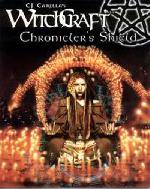
The exterior of the screen features the most stunning art I've seen on any GM screen for any game. (You can take a look for yourself here.) The interior art is nowhere near as flashy, but it is slick and stylish. The character portraits do a particularly good job of bringing the personalities of their subjects to life.
The interior of the screen looks a little busy in places, largely due to the lack of borders around the tables. The tables themselves are quite legible, however. The layout of the booklet is very crisp.
The writing seems as mostly error-free as it has been in all of Eden's products I've read so far. The style is friendly and conversational.
I'd also like to take a moment to applaud the manner in which Campus Crusade and A Winter's Tale deal with people of different faiths. It's not at all politically correct, but it is wonderfully realistic. For example, there are spiritually enlightened Wiccans, but there are also self-indulgent intolerant Christian-hating Wiccans. There are closed-minded Christians, but there are also genuinely nice Christians with valuable knowledge and assistance to offer the PCs. And there is even an atheist who is a dogmatic son of a bitch, something I've not seen in an RPG product before. It's refreshing to see religious people treated as individuals rather than as members of stereotyped groups. Nicely done.
CONCLUSION
This is without a doubt a quality product. But is it worth $18? Well, that depends. The fact that the screen is basically a generic Unisystem screen increases its worth if you have or plan to purchase other Unisystem games. The horror campaign tips and rules options are nice, but they're more perks than anything else. The bulk of the product is the adventure and the adventure seeds, and the latter are tied directly to the former. That being the case, if you don't get any use out of the adventure, the value of the product drops markedly. If you can use the adventure, though, you'll definitely get your money's worth, even if using it without the pre-generated characters may be a bit of a chore.
But at the very least, you'll still have a good GM screen with some damn fine artwork.

