

 Search
Review of Hollowfaust: City of Necromancers
 Goto [ Index ] |
Hollowfaust: City of Necromancers
Introduction
Imagine an independent city-state built from the ruins of an ancient civilization and governed by lawful, sophisticated necromancers. Undead patrols keep the streets safe at night; undead legions and a colossal skeletal dragon defend the city when invaders lay siege; a lawful good lich runs the secret police; and one’s body, according to a strict set of laws, is forfeited upon death to a particular necromancer for . . . research. Death, really, is a way of life for the regular citizens, so they live enthusiastically, to the fullest.
A sweltering desert that sends forth perennial enemies lies to the west. A dark, violent forest to the east harbours an exiled, evil cult of necromancers intent upon reclaiming the city. A kingdom bent on conquest and tyranny edges closer and closer from the south, desiring for itself the city’s powerful arcane secrets.
Exotic, enchanting, gloomy stories and adventures await everywhere in and around Hollowfaust, a city sure to give you the time of your life -- and, perhaps, your death.
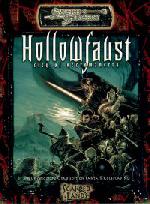
Hollowfaust: City of Necromancers is a Scarred Lands sourcebook from Sword & Sorcery Studios detailing, as the back cover text notes, “one of the strangest cities in all of Ghelspad.” This soft-cover, perfect bound sourcebook checks in at a hefty 132 pages (plus 4 pages of Sword & Sorcery ads) and costs $19.95 US. The cover painting depicts an evocative scene of three heroes (one, apparently, an undead; another, as we learn in the book, a Hollowfaust necromancer) beset by an army of skeletons, with a dormant volcano looming in the background.
The interior is primarily black-and-white, though chapter pages, several illustrations, and a continuous margin graphic employ grey scale extensively. All of the interior artwork -- of which you get a lot -- captures well the alien, dark atmosphere of Hollowfaust. The text itself is relatively dense and liberally populated with various text boxes that provide information on everything from creature and NPC stats to particular details of life in the City of Necromancers. A overview map of the city closes out the book.
Overall, Hollowfaust: City of Necromancers gives you a heap of intriguing, creative, imaginative, and highly usable ideas in its 132 pages, representing an excellent value, whether or not you use the Scarred Lands as your campaign setting.
What’s Inside
Hollowfaust: City of Necromancers comprises a Preface, Introduction, five chapters, an Appendix (of prestige classes and new creatures), and a map.
The Introduction sets up effectively the unique feel of Hollowfaust through two letters penned by visitors who recorded their impressions of the city, and then through some words from the sourcebook’s authors that give an overview of what to expect from Hollowfaust. Here, as in the rest of the sourcebook, the authors work carefully to familiarise you with the notion of a city established and maintained by necromancers who do not easily fit the stereotype of “a cadaverous, barely human creature in black robes adorned with skulls, working evil for unfathomable and hateful reasons” (9). I appreciate very much this aspect of the authors’ writing, for it demonstrates a keen awareness of the uniqueness of Hollowfaust as not just a city but a campaign base. By the end of the sourcebook, I not only accepted readily a society of necromancers “who speak to the dead in respectful tones” (9), but I could barely contain my excitement at the setting’s imaginative potential.
Following the Introduction are five chapters covering, respectively, Hollowfaust’s history; the city itself (layout, laws, important locations, and more); the necromancer’s society (divided into seven “Guilds”) and the NPCs who rule the city; several possible adventure seeds (beginning in or getting PCs to Hollowfaust); and, finally, all the new magic items, spells, prestige classes, and creatures needed for a Hollowfaust campaign.
Although the background of Hollowfaust’s inception and growth as described in Chapter 1: The History of Hollowfaust understandably relies heavily on the Scarred Lands setting, the basic premise for the city’s existence, I think, lends itself nicely to incorporation in different settings (home-brew or published). Hollowfaust lies right at the base of a now-dormant volcano. Many years ago, the city was called Sumara, and it was the jewel of the nation of Zathiske; yet the volcano’s eruption during a massive war suffocated the city in ash and razed it mercilessly with lava. Everyone in the city died, the populace turned into “ash-covered skeletons and children’s ghosts” (12). What drew the original necromancers (called the Seven Pilgrims) to the city, then, was its especially intense necromantic energies and its numerous undead denizens. From this point on, Hollowfaust’s history becomes one of accepting refugees to build a populace, beating back numerous sieges, codifying laws and social practices, and establishing a presence as an independent city-state and a trade centre. On the one hand, Hollowfaust thus captures perfectly the edgier, darker feel of the Scarred Lands setting. On the other hand, it could be made a very intriguing element of other settings with only a modicum of tweaking, as all you need, really, is an ancient city destroyed by a volcano and then reclaimed by a group of necromancers.
Hollowfaust: City of Necromancers, however, truly shines in Chapter 2: The City, which comprises the meat of this sourcebook. Chapter 2 takes us through an overview of Hollowfaust’s surrounding regions (the desert, the forest, and the hegemonic kingdom mentioned earlier, plus much more) and its particular resources; a discussion of the city’s citizens and their ways of life; an in depth explanation of Hollowfaust’s laws; and a description of specific, notable locations in the city (such as prominent taverns and inns, religious shrines, and more).
Through all of this information, the authors craft a convincing picture of a city and a people that live daily with undeath as the basic raison d’etre of their existence. Hollowfaust’s laws especially demonstrate the authors’ creativity in giving the city its unique flavour. The laws rely upon a distinct separation of soul and body: a person has “living possession of his physical body” (50) until death, at which time the necromancers show up to claim the body for research, paying the deceased’s family a fee based upon the corpse’s value (i.e., famous or powerful individuals are worth more than common citizens). This law affects everyone in Hollowfaust, whether native or visitor. Furthermore, it represents the precise means by which the city’s necromancer rulers maintain its undead legions and labourers.
Hollowfaust’s people, therefore, live knowing that their bodies will ultimately be forfeited to the state -- from natural death, crime, or even war. This knowledge, really, underlies the city’s alien atmosphere, as the authors must then answer a host of questions about how a society functions in such conditions. By fashioning Hollowfaust as “a city of law” (43), the authors offer a deft and wonderful solution. From visitors to citizens to the necromancers themselves, Hollowfaust relies upon “maintaining order” (43), and any threats to this order are handled swiftly, efficiently. When dealing daily with the (un)dead, one presumes, strict laws might be the only means of keeping everyone sane.
Chapter 3: The Necromancers details the seven Guilds that make up both the necromancers’ society and way of governing Hollowfaust, providing the statistics and personalities for each guild’s current NPC Guildmaster -- one of whom, as mentioned at the start of this review, is a lawful good lich in charge of the secret police that watches not just the city’s people but the necromancers as well.
Chapter 4: Hollowfaust Adventures provides several potential hooks for adventuring in and around Hollowfaust. These hooks are presented only in a general, suggestive manner (i.e., without stats or keyed encounters), but they fit the setting well, touching upon scenarios such as ghoul hunting in the city’s still abandoned section (called, appropriately, the Ghosts’ Quarter) or bringing characters to the city to reclaim the unlawfully stolen body of a friend that may have been sold to the necromancers (an excellent way, I think, of introducing Hollowfaust’s “bone trade”).
Lastly, Chapter 5: Spoils & Denizens and the Appendix give us all of the “crunchy bits” for the Hollowfaust setting. We get five prestige classes tied to the necromancers’ guilds and other elements of the setting (the Animator; the Mourner; the Shade Touched, those who are not necromancers but are affected by Hollowfaust’s necromantic energies -- perhaps better done as a new creature template; the Speaker of the Dead; and the Unfailing, the necromancers’ personal bodyguards), several new necromantic magic items and spells, plus a healthy complement of new creatures (such as the ash golem and the risen, constructs unique to Hollowfaust and employed in its defense). These two closing sections of the sourcebook deliver superbly the practical tools needed for reinforcing Hollowfaust’s strange and unique character.
What’s Not So Good
I know that so far I have painted a rather rosy picture of Hollowfaust: City of Necromancers. The richness of the ideas behind this sourcebook deserve, perhaps, even more praise -- they are that good, that evocative, that exciting. I consider the Scarred Lands the most creative fantasy gaming campaign setting to come along in quite a while, and Hollowfaust: City of Necromancers only reaffirms and enhances this impression.
Yet we know from experience that no gaming product is wholly perfect, and Hollowfaust: City of Necromancers owns its fair share of glitches and problems.
The primary problem, and one that becomes something of an unfortunate annoyance once you notice its presence, involves the editing and layout. Editorial oversights average out to at least one per page, including typos (the hit die for the Unfailing, by the way, should be d10, not “d1” as in the book), grammar missteps (some subtle, some painful), and often poorly developed stat blocks that also have an inconsistent format throughout. Either the authors and/or the editor appear not to understand the basic conventions of d20 stats; moreover, game mechanics errors are too frequent, so GMs should pay attention especially to NPC stats.
Several peculiarities in the layout also somewhat hamper this product. In particular, the numerous text boxes all too often bear no immediate relation to the surrounding material, which gets even a bit irritating at times when they are especially out of context. For example, in Chapter 2: The City, some text boxes provide the stats and personalities of those clerics who head the shrines of gods represented in Hollowfaust, but these text boxes are anywhere from three to five pages separated from the actual descriptions of the shrines. Other similar examples include the stats for Hollowfaust’s guards and patrols appearing with sections detailing the city’s labourers while its military aspects are discussed four pages later on, or a side box on a specific fighting style taught by one named Abarces appearing five pages before we actually meet Abarces. Another layout issue occurs on pages 108-09, where sections of text for different spells are set so out of order (i.e., one spell’s description appearing with another spell) that the reader needs to spend some time figuring out the puzzle. If this sourcebook’s ideas did not possess such strength, it would suffer much more under the weight of its unfortunate textual problems.
Beyond these textual matters, I have only one major criticism of the content. While the sourcebook does provide an overview map of the city, it fails to gives us maps of what may be the city’s most intriguing area -- what is called the Underfaust, where the necromancers live and conduct their research, located within and underneath the volcano. The authors justify not mapping out the Underfaust by claiming that it is “too expansive and too multidimensional to map effectively” (74). Although perhaps true, some examples of specific Underfaust locations would prove highly useful for GMs: locations such as a master’s quarters (said to include a kitchen, laboratory, bedroom, and sitting area); or a training area; or the entrance to the Underfaust itself, which comprises a gate, the Bone Market, and the chambers of governance. Despite all of the information packed into Hollowfaust: City of Necromancers, the lack of an Underfaust map feels somewhat glaring.
Conclusion
In the end, I fear that I am inadequately communicating my enthusiasm for Hollowfaust: City of Necromancers. We rarely get the opportunity to see truly fresh ideas that re-invigorate and take fantasy gaming campaign worlds into new territory, but this sourcebook embodies one of those opportunities.
Even if you feel no inclination at all to run a Scarred Lands campaign, Hollowfaust: City of Necromancers offers a fully developed, unusual, and infinitely rich city setting that would most certainly throw players a few curve balls and add a fascinating location to almost any game world. Because the authors carefully yet persistently establish Hollowfaust’s necromancers as not conforming to stereotypes, they inevitably end up building a logical, understandable society that reflects in all its aspects what makes Hollowfaust’s necromancers so surprisingly unique.
Death assumes a whole new meaning, does it not, when you can become a skeleton soldier or the materials for a necromancer’s scientific research -- all for the good of the city?
How much would your corpse be worth, then?
Garrett Williams

