

 Search
Review Editing
Review of Everway
 Goto [ Index ] |
In the middle of all this, WotC sold the line (and the rest of their RPGs) off, claiming focus on the CCG market. All this is history.
In the months following, Everway was picked up by Rubicon Games. Good thing, too. Because Everway is a fantastic game.
Like most games, it provides a setting and rules both. I'll review each seperately.
Most people would consider, I think, Everway a "mythic" game in the same way fairy tales are mythic -- they deal with large issues, focusing on potent objects, fantastic magics, intrigue, the gods and their gifts, wonderous beasts, and humanity's vitues, faults, and fates.
The setting of all this is not typical. This is true low-tech fantasy -- most people of the Spheres are agrarian in nature. Everyone speaks the same language -- the Tongue, a gift from the gods -- and while worship takes its own form, the rule is tolerance, though there are exceptions.
Each Sphere is composed of Realms -- nations, almost -- whose people have their own nature and identity.
In one such place lies the City of Everway, around which are scores of Gates -- passages to other worlds. And only Spherewalkers can pass through (not just any peasant). And you guessed it: our heroes are all Spherewalkers.
In all, the setting is rife with ideas, but it's not really well defined. The game set comes with a map and lots of information about the city of Everway, but not much else. There's an amazing amount of raw material for setting ideas, but it requires some work for the GM.
The game system is simple, compared to most others, and quite elegant.
Characters are described in the mechanics by their scores in the 4 elements (Earth/Air/Fire/Water), as well as optional scores in Powers and Magic. Each element governs its own set of relevant character attributes, and takes a very abstract view of character attribute division. For example, air is simultaneously intellect, oratory and a rating of the character's knowledge.
Flexibility and creativity are the rule. When specifying one's powers, you have the complete tableau of your imagination to work with -- there are no lists of powers to choose from (though Tweet provides us with a large pool of samples to get us thinking in the right direction).
Magic is similarly undefined. In fact, this is a weakness of the game, in my view. I prefer structure to flexibility when it comes to something like magic. With powers, the player defines a discrete ability. With magic, it's almost incumbent on the player to develop their own system and style of magic! From casting style to spell lists (if lists they have -- the game's flexibility suggests a more on-the-fly magic use like Ars Magica's spontaneous spells), it's all up in the air. But there's some structure, here. Magic must be associated with one of the elements -- this association can determine what family of style/content your magic falls into.
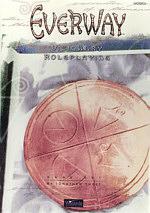
Everway's subtitle is "Visionary Roleplaying" and in considering the visual elements, the game makes headway where few games have tried going before -- and none so successfully.
The heart of the character creation system is in selecting a few "vision vards" which present interesting, colorful scenes. On the reverse side of each card are questions relating to the images, to provoke thought. Characters chose a few cards, consider their connection, and spin a character concept from the imagery and ideas presented.
Everway is an RPG, and thus a social game, and builds on this assumption. Everyone is assumed to create their characters simultaneously. Part of character creation is explaining your character to the other people in the group. Questions are encouraged throughout the character creation process, eventually culminating in in-character conversations.
There are no dice in Everway. Rather, there is the Fortune Deck. The deck is composed, like Tarot's Major Arcana, of cards representing objects/concepts in the world -- steps toward wisdom. Characters rifle through this Deck and chose a Vritue, Fault and Fate -- three cards that indicate the divine forces at work in their lives.
The use of the Fortune Deck during the game is fascinating. The interesting thing about the Deck is that it's an object in the game world, too. Scholars in the city of Everway speculate after its origin. But in gameplay, the GM pulls a card and examines its relevance to the situation. In principle, this sounds easy enough, but in practice, unless you're a skilled reader of Tarot cards (and how many of us are?), it's not easy indeed. Resolving combat actions is, in particular, challenging at any significant level of granularity.
Two other means for ajudication are given. The Law of Karma allows the GM to let the character reap what they've sown earlier in the game -- for good or ill. This comes from the idea that these people are Heroes (in almost Greek degree -- complete with watching gods) in the true sense of the term. And the Law of Drama is a brave formalization of what GMs do more than their players would like to think -- create the outcome of a situation based on their idea of what the game needs to keep things interesting and dramatic.
Tweet proposes a Quest structure to wrap adventure ideas around. Quests are composed stories with discrete beginings and endings (again, like fairy tales). GMs are expected to create their own settings (unless the adventure is in the city of Everway), non-player characters, and plots. The game comes with a ready-to-run Quest to get your feet wet, and get an idea of the story-like structure.
Overall, Everway is a game that's rarely found. I've seen some boxes tucked away on top shelves in hobby shops here and there, selling for under $15 -- a fraction of its list price.
For the quality of the set, the dozens of Vision Cards, the Fortune Deck, the full-color character sheets (including several pre-made and ready-to-run characters), the fold-out (two page) map of the city of Everway, a Player's Book, a Gamemaster's Guide, and a brief guide to the Fortune Deck -- it's a steal.
In the end, I highly recommended Everway to anyone who enjoys a more fluid style of gameplay, a mythic setting, and gaming in what amounts to a playground of the imagination.
Style: 5 (Excellent!)
Substance: 4 (Meaty)

