

 Search
Review Editing
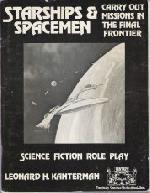
Review of Starships & Spacemen
 Goto [ Index ] |
The campaign universe takes place in the 23rd century. Earth and its allies have just joined forces with their former enemy to battle a race of religious zealots. Among Earth's allies are the Taurans, which are heavily inspired by Vulcans, the Andromedans (sort of anti-Vulcans) and the Rigel (inspired by Gordon Dickson's, Dorsai novels). The former/sometimes enemies are the war-like, and Kinglon-like, Zangids. The Videni are the big enemy. The fact that they physically resemble the Taurans, and have the same copper based biology (ie green blood) is only one way they mimic Romulans. The other similarities include; their atomic fireball ship-based weapon that requires all available power, their ships shields are cloaks, they are devoted to their state, and their wounded are often discarded as useless.
PCs are crew members of Galactic Confederation starships, all having saucer living sections and hyper drive pod engineering sections. All are members of the Space Service, which is commanded from Space Fleet Headquarters (any of this sound familiar?). Every character is designed around eight attributes. 3d6 determines 4 attributes; marksmanship, intelligence, technical skill, and combat skill. Charisma, strength, psionic potential, and loyalty are considered inborn attributes and are determined by racial modifier plus 1d6. Psionic powers have point values, seven powers are detailed, and a character can choose powers with points that add up to their attribute score. Players chose a branch of the space service for their character(s); military, scientific or technical. Each requires a prime requisite attribute of 9 or better. Within each branch are subclasses, which improve some abilities but are not required specializations, requiring secondary requisite attributes of 12 or better. The military branch subclasses are; command, security and fire control. Alien life and medical subclasses are under the scientific branch. Lastly, the technical branch can specialize in the subclasses; communications, navigation and engineering. As with most rpgs, race and attributes provide advantages and disadvantages in any of the chosen branches/subclasses.
As with most games of that era, it doesn't take itself too seriously. There are some humorous names presented in examples of play (ie Capt. Jerk) and elsewhere. For example, tauran names are hyphenated with a second syllable ending in "K", like Red'nek and Bottle'nek.
Combat is kept simple enough. Ranged attacks are handled with modified die roll vs. a target number skill. Melee/hand to hand is just modified die roll vs. modified die roll. The highest roll and the difference between them determines the number of hits and damage taken from an attack.
Experience points are earned by completing missions and exercising your skills within your branch and subclass. They can be used to buy improved equipment, gain rank promotions, improve abilities and gain command of larger starships.
Ships are divided into military classes by size; destroyer, cruiser, battle cruiser and dreadnaught. Ships operate by expending energy units. Each has a maximum they can expend per day, everyday. If energy units are over spent, the ship is considered damaged and will be unable to regenerate the over expenditure until it is repaired. So, if a ship with 100 EU/day expends 120 in a single day, until it makes port for repairs it will only have 80 EU/day thereafter.
Notes for galaxy creation, and alien life forms are provided but are simple and very much geared toward Star Trek original series norms. Space clouds, space amoebas, wormholes, time travel and space diseases are all right out of one episode or another. The rules do however deal with the subjects of radiation, gravity, temperature and atmosphere with much more detail than Kirk and Spock ever had to.
Three sample adventures are provided at the end of the book. They are single page mission briefings and reminded me of deep7.com 's free one-page Star Legion scenarios. There is just enough information and detail for a GM to start with, nothing more, but full of potential. If you happen to have/get a copy of Starships & Spacemen, I would recommend using deep7.com Star Legion scenarios in your campaigns as they are similarly "just enough" and full of possibilities.
A great piece of work, especially considering its early publication. If you get the chance to read it, you will agree. I can't imagine much real collectible value so, if you decide to pursue a purchase, do not pay more than you would for a newer product of the same size and volume. Mr. Kanterman revisits this campaign universe, with the help of Douglas Bonforte, in 1982 with FGU's Star Explorer board game (but that's another review).
This review appeared in Alarums & Excursions #314 (see database for review) and appears here with permission.

